
Sign up for the Today newsletter
Get everything you need to know to start your day, delivered right to your inbox every morning.
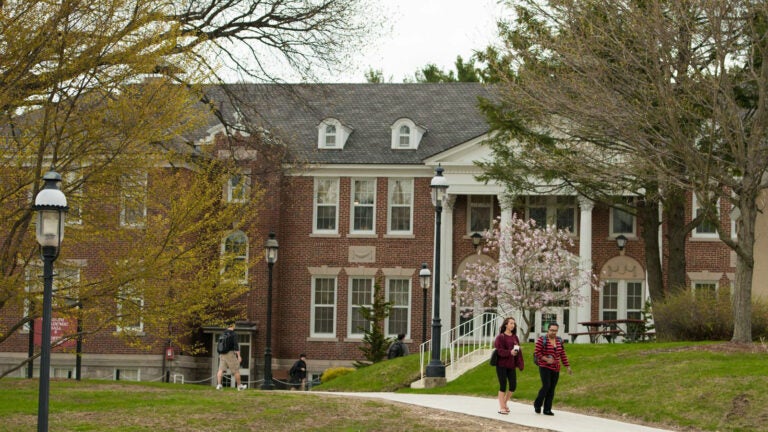
New billboards, displaying the message “Fulfill the promise of free college; fair pay for community college educators,” are popping up along Massachusetts highways from Cape Cod to the Berkshires.
The campaign, led by the Massachusetts Community College Council and funded by a grant from the Massachusetts Teachers Association, warns that low wages and chronic understaffing are jeopardizing the success of MassEducate, the state’s new tuition-free college program.

Over 30 billboards will go up near campuses and graduation sites across the state.
“Community college faculty and staff have been chronically underpaid for decades, as well as overworked,” said Claudine Barnes, president of the MCCC.
Barnes said job openings remain vacant for months and sometimes years because the state’s 15 community colleges cannot recruit qualified candidates.
As workloads increase due to rising student enrollment, Barnes says faculty and staff fear that the schools will not only be unable to attract workers but also start losing qualified ones.
“We’ve got a significant problem,” she said.
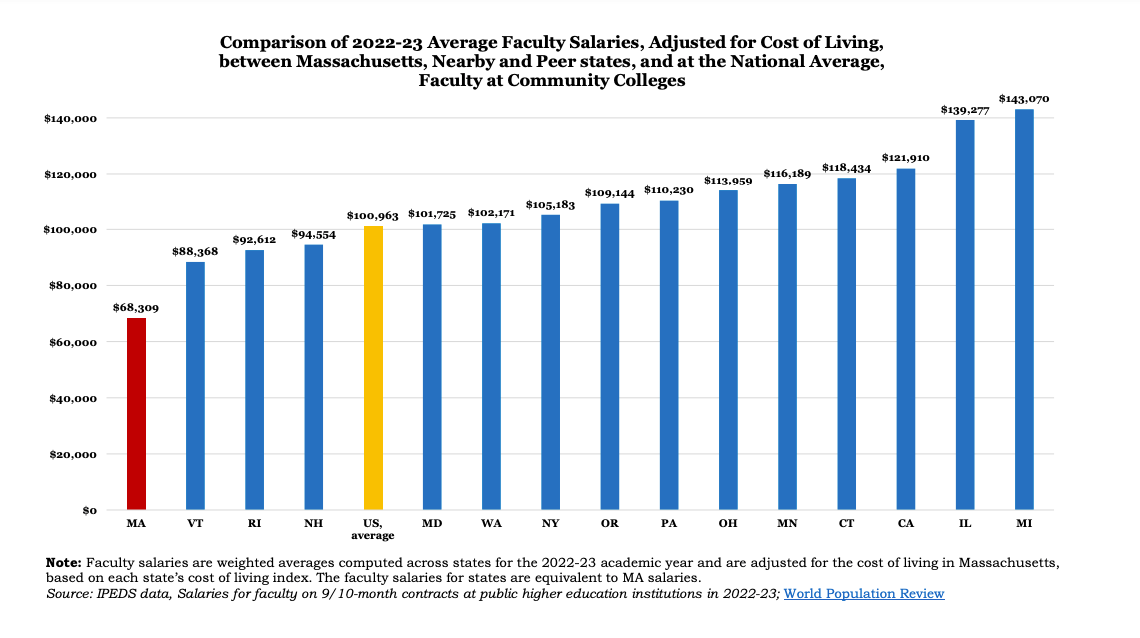
According to the MCCC, community college faculty are paid, on average, $34,000 less than the living wage in Massachusetts. And according to an MTA study, Massachusetts has the lowest average faculty salary for community colleges, adjusted for cost of living, compared to nearby and peer states and the national level.
In addition, an MTA survey shows that nearly half of the union’s members struggle with food insecurity, and most need a second job to pay their bills.
“It’s untenable,” said Barnes. “It’s also unfair. And we have been pleading with multiple governors to increase the parameters.”
Parameters are the percentage the governor allows state employees to receive for a pay increase.
Barnes said, “We have begged and pleaded” to increase the parameters. However, despite the governor’s efforts, it’s not enough, she said, with wages still 48% behind the national average.
Now, they are asking the Legislature for help.
But the process is slow, and “the situation is becoming acute,” Barnes said.
“The reality is, it’s just too much work for too little money,” she said.
Community college faculty teach more courses per semester than their peers at state universities and UMass campuses. And to help fill in the gaps of understaffing, community colleges rely heavily on low-paid adjunct faculty who do not have access to benefits and have low job security.
Barnes says that relying too heavily on part-time and adjunct faculty, who often travel between multiple campuses to teach, unfairly limits students’ access to academic advisers.
The state Department of Higher Education says they are working on solving this issue.
“Faculty bring life-changing opportunities to community college students, and we’re committed to a fair contract that recognizes their contributions while also meeting budget criteria,” a department spokesperson said in a statement to Boston.com.
The spokesperson said that the Higher Education Quality and Affordability Commission is actively engaging and reviewing recommendations to improve faculty recruitment and retention.
The state created the commission to assess what Massachusetts’ public campuses need to support faculty recruitment, retention, and affordable access amid historic financial aid increases. A final report is due in the spring.
The Department of Higher Education is also in contract negotiations with the MCCC. But, Barnes says the MCCC understands there is only so much they can ask for when the budget is constrained.
There is some hope, MCCC Vice President Joe Nardoni said.
The MCCC is working with the state Legislature and the governor to secure funding for a classification study to research the problem. Once the state completes the report, he hopes the state will allocate funding to this cause.
Nardoni said the billboard campaign is a way to inform students, parents, and community members about what is happening. He hopes the billboards will persuade residents to call on their legislators to fund community college faculty and staff appropriately. After all, Nardoni and Barnes say, they are only asking for a living wage.
“It’s been a silent crisis,” said Nardoni. “It’s been a silent crisis for way too long. For myself, I can’t stay silent anymore.”

Get everything you need to know to start your day, delivered right to your inbox every morning.



To comment, please create a screen name in your profile
To comment, please verify your email address
Conversation
This discussion has ended. Please join elsewhere on Boston.com