
Sign up for the Today newsletter
Get everything you need to know to start your day, delivered right to your inbox every morning.
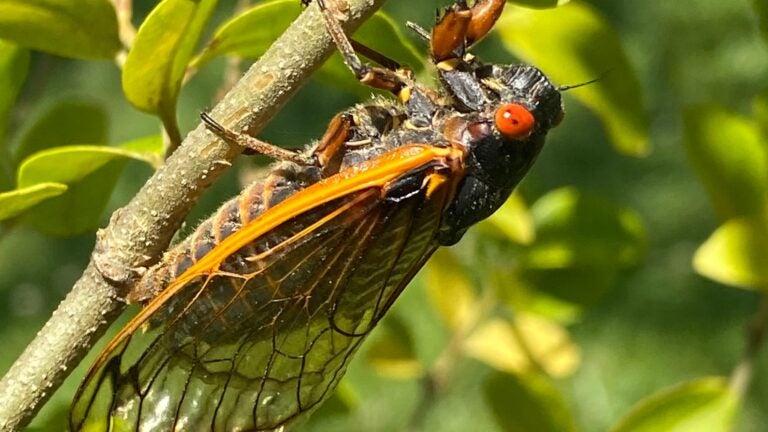
Cicada season is around the corner — and they’re coming out in parts of Massachusetts.
The 17-year Brood XIV will emerge between mid-May and June mostly in Tennessee, Kentucky, and Pennsylvania, but also on Long Island, New York, and in the Cape Cod area.
This periodical brood has not been seen in Massachusetts since 2008 and will not emerge again until 2042. Massachusetts sees the typical “dog days” cicadas, which emerge every year, but rarely sees the periodical cicadas that arrive in 17-year cycles.
Most periodical cicadas are alive for a few weeks above ground, in which they reproduce and rely on trees for planting eggs. These eggs eventually hatch nymphs, which drop from the trees and burrow into the ground to begin their 17-year development.
There are 12 different species of cicadas that emerge in the Brood XIV cycle. John Cooley, associate professor-in-residence of Ecology and Evolutionary Biology at the University of Connecticut, said only one of these types will be present in Massachusetts.
“When you’re dealing with any species at the edge of the range, they’re always on the verge of just blinking out of existence,” he said. “That’s the big concern that we have with this population on Cape Cod and the one on Long Island.”
Tawny Simisky, an entomologist with the University of Massachusetts Amherst Extension Landscape, Nursery, and Urban Forestry program, provides information to landscapers and arborists about invasive insects but also provides information about native species like cicadas.
The specific species, called the Pharaoh cicada, appears in the Cape Cod region and Plymouth County because of the sandy soil conditions in those areas, she said.
“On the Cape, those populations are pretty small compared to the rest of the area that Brood XIV covers, and we really just want to preserve them,” Simisky said.
The ideal conditions for a periodical cicada to appear are when soil temperatures at 7 to 8 inches of depth reach around 64 degrees Fahrenheit, according to the University of Connecticut.
Because the Northeast has been experiencing warmer temperatures for longer periods of time in the last several years, Cooley said he is surprised periodical cicadas have not spread out farther in New England.
“The conditions here are just getting better and better for periodical cicadas,” he said. “They haven’t historically been here because usually the cold temperatures, the short growing season, and the cold winters have kept them out. But all that is changing.”
Simisky said because of the small population size, it is important to preserve cicadas because they bring a “resource burst” into the ecosystem as sustenance for predators and fertilizer for forests.
“We want folks to not panic,” she said. “These insects are not pests, they’re not a plague. Enjoy them while they’re here.”
Cooley said people who see the cicadas should not spray them with pesticides as it can affect the animals that eat the insects. He also said the cicadas have been around for millions of years and they “belong here.”
“If you’re lucky enough to have periodical cicadas or see them, it’s something really to experience and appreciate,” he said. “There are not many places in the world where you can go and see anything at all like this.”
Get everything you need to know to start your day, delivered right to your inbox every morning.





To comment, please create a screen name in your profile
To comment, please verify your email address
Conversation
This discussion has ended. Please join elsewhere on Boston.com