
Sign up for the Today newsletter
Get everything you need to know to start your day, delivered right to your inbox every morning.
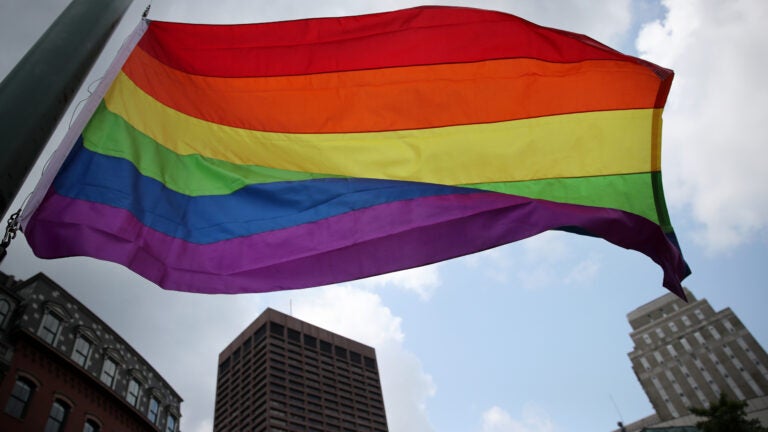
Massachusetts is home to a growing and increasingly dispersed LGBTQ+ population. But, according to a new report, deep disparities in health care, mental health, employment, and economic stability persist.
“While the data show the remarkable vibrancy, vitality, and growth of Massachusetts’ LGBTQ+ population, this report comes at a time when this vital part of the fabric of our Commonwealth is under ever greater attack,” said M. Lee Pelton, president and CEO of the Boston Foundation, in a statement.
He continued, “This report shines an important light on the many dimensions of the fight for equity that LGBTQ+ people and their allies must, and will, continue to make good on our promises for a truly equitable Commonwealth.”
The report from The Fenway Institute and the Equality Fund at the Boston Foundation, released on Tuesday, examines changes in LGBTQ+ demographics, health and wellness, employment, and economic well-being, building upon research done in a 2018 report.
The researchers compiled demographic and other data using population-based surveys, including the Massachusetts Youth Risk Behavior Survey, the Massachusetts Youth Health Survey, and the Massachusetts Risk Factor Surveillance System survey.
Online listening sessions and interviews provided anecdotal and qualitative data based on lived experiences across the state.
“We must acknowledge that true equality for LGBTQ+ people in the Commonwealth remains unfinished work — especially for those outside Greater Boston, and particularly for individuals who are Black, Indigenous, or people of color, older adults, and those facing economic insecurity,” said Jordina Shanks, CEO of Fenway Health, in a statement.
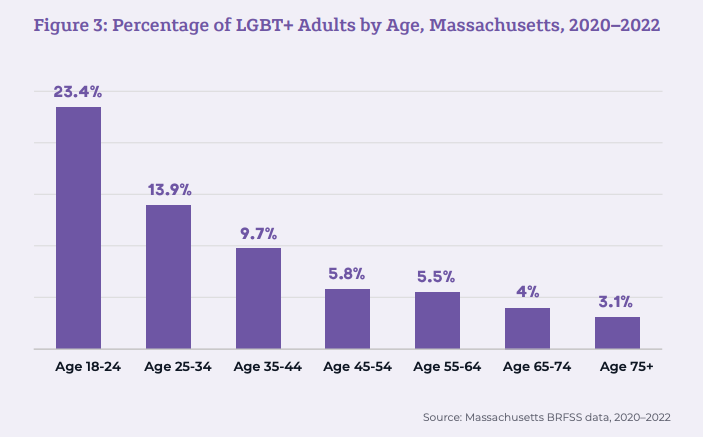
The report finds that 9.1% of people identify as LGBTQ+, a 26% increase from 2016. Age-related differences exist, with 23.2% of students in Massachusetts high schools and 23.4% of 18-24 year-olds identifying as LGBTQ+ versus 6% of those older than 45.
The report highlighted how same-sex couple households are more common in every Massachusetts county compared to other U.S. counties.
Hampshire and Franklin counties are among the top four counties in the U.S. for female-female couple households in 2020, while Suffolk County ranked fourth in male-male couple households, behind San Francisco, Washington D.C., and New York City.
The data on health care access and affordability shows room for improvement. The report found that LGBTQ+ adults in 2020 to 2022 were 1.6 times more likely to say their health was fair or poor than straight, cisgender adults.
The report shows a similar gap in access to healthcare, with LGBTQ+ adults being 1.8 times more likely to report they were unable to see a doctor at some time in the previous year due to cost.
Where costs were not a barrier, commenters highlighted concerns over finding quality, culturally competent care or caregivers who knew their specific needs. Transgender and gender diverse people face additional challenges in getting insurance to help cover the costs.
Data showed that LGBTQ+ adults are more than twice as likely to report being told they have a depressive disorder and are 3.8 times more likely to report considering suicide than straight, cisgender peers.
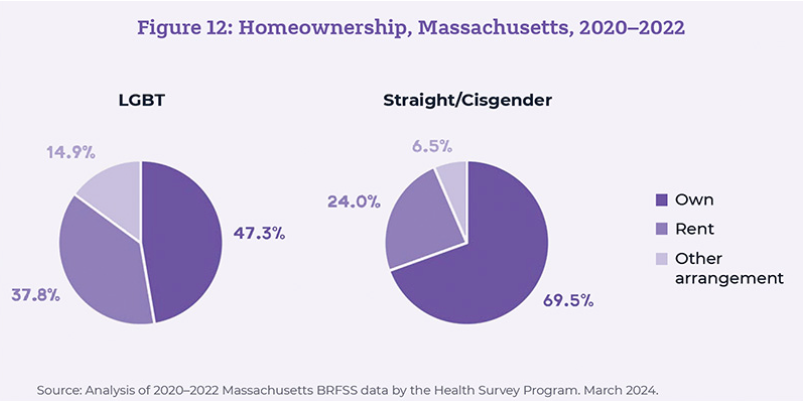
In addition, the research showed that sexual and gender minorities continue to lag behind their straight peers in housing and economic issues.
LGBTQ+ people are more likely to have household incomes under $25,000; less likely to have household incomes over $100,000; and, across all age demographics, less likely to own a home.
The report found that LGBTQ+ people faced additional hurdles in finding affordable and stable housing, with LGBTQ+ adults 48% more likely to report having difficulty paying their mortgage, rent, or utility bills than their straight counterparts.
Discrimination in the housing market exacerbated these challenges, with some saying that the housing market isn’t always safe for nonbinary and trans people.
Many older people also spoke of finding it difficult to find environments that are accepting of their community, especially in senior housing.
One participant said, “I’ve spoken with [LGBTQ+] people about their experience in public elder housing, where it’s kind of the Wild West, at least in Cambridge it is. You’re lucky if you’re in a space that is welcoming.”
Despite the state’s history of progressive politics, participants in the survey’s discussions say there is ongoing discrimination and an “alarming” frequency of hate crimes against this population.
Data from the U.S. Department of Justice showed that hate crimes motivated by sexual orientation and gender identity bias increased from 2020 to 2022 in Massachusetts, from 54 to 94 reported under the sexual orientation bias and from 11 to 23 under gender identity bias hate crimes.
“Reports like this are important not just because they capture where we are, but they identify the places where we need to invest resources — including greater philanthropy from LGBTQ+ allies, time, and creative advocacy — to develop solutions that improve the lives of LGBTQ+ people across Massachusetts,” said M. Scott Knox, executive director of the Equality Fund, in a statement.
Knox added, “If we do that, we will improve not only our community members’ lives, but those of millions across the Commonwealth.”

Get everything you need to know to start your day, delivered right to your inbox every morning.




To comment, please create a screen name in your profile
To comment, please verify your email address
Conversation
This discussion has ended. Please join elsewhere on Boston.com