
Sign up for the Today newsletter
Get everything you need to know to start your day, delivered right to your inbox every morning.
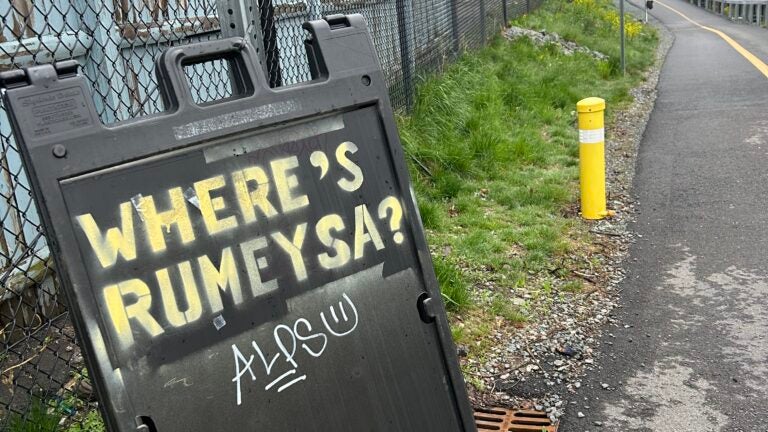
A federal judge in Vermont ordered Friday that the Trump administration release Rümeysa Öztürk, the Tufts University student who was arrested by ICE agents in Somerville in March.
She has been confined in an ICE detention center in Louisiana for about six weeks, and will now be free to return to Massachusetts and continue her studies under certain supervision requirements.
Judge William K. Sessions III made the decision after hearing testimony from Öztürk herself, who participated in a bail hearing remotely from Louisiana. Much of the hearing centered on Öztürk’s asthma, which she says has gotten significantly worse since her arrest. Öztürk suffered an asthma attack during the hearing, removing herself briefly before returning. As Sessions issued his ruling, she shared a hug with one of her lawyers who had flown down to Louisiana.
“For 45 days, Rümeysa has been detained in Louisiana — over 1,300 miles from her friends, her community, and her lawyers. During that time, she has suffered regular and escalating asthma attacks. And at the same time, the government has failed to produce any justification for her detention,” Jessie Rossman, legal director at the ACLU of Massachusetts said in a statement. “We are so relieved that Rümeysa will soon be back in Massachusetts, and won’t stop fighting until she is free for good.”
Öztürk’s legal team successfully argued that not only do her deteriorating health conditions necessitate her release, but that she does not pose a danger to the community or a flight risk. Öztürk is a former Fulbright scholar from Turkey who is pursuing her PhD in the university’s Child Study and Human Development department.
After her arrest, federal officials including Secretary of State Marco Rubio said that Öztürk’s student visa was revoked because she participated in violent campus protest activity against the war in Gaza. A spokesperson for the State Department said that the government “found Öztürk engaged in activities in support of Hamas.”
The government produced no evidence to support these claims other than an op-ed that Öztürk co-authored in the Tufts student newspaper. That piece makes no mention of Hamas. In it Öztürk identified as a “graduate student for Palestine” and pushed Tufts administrators to do more to advocate against Israeli aggression in Gaza.
Öztürk was not charged with a crime. She was not notified that her student visa was revoked before masked, plainclothes ICE agents swarmed her on a Somerville sidewalk as she went to break her Ramadan fast with friends in late March.
Her lawyers maintain that Öztürk’s arrest and detainment violated her constitutional rights to free speech and due process. Numerous people who know Öztürk have said publicly and in sworn affidavits that she is softspoken academic who was not known on campus as an outspoken protest leader.
In announcing his decision, Sessions offered some of his own observations on Öztürk.
“This is a woman who is just totally committed to her academic career,” he said. “There is absolutely no evidence that she has engaged in violence, or advocated violence. She has no criminal record. She has done nothing other than, essentially, attend her university and expand her contacts within the community in such a supportive way.”
Video of Öztürk’s arrest spread widely online and caused significant outrage both locally and nationwide. After she was whisked into an unmarked vehicle, federal agents quickly moved Öztürk first to New Hampshire and then Vermont before flying her to Louisiana. A Massachusetts judge ordered Öztürk not be moved out of Massachusetts that night but by then she was already in transit in Vermont.
Sessions had ordered Öztürk to be transferred to ICE custody in Vermont. The government requested a delay, then a federal appeals court upheld his decision earlier this week. It ordered Öztürk to be transferred to Vermont no later than May 14. But Sessions chose not to wait for that transfer and to proceed with the bail hearing Friday while Öztürk remained in Louisiana.
Removal proceedings against Öztürk are still pending in immigration court. Sessions did not rule on whether the government violated Öztürk’s constitutional rights. A habeas hearing where she can challenge the legality of her detention is scheduled for May 22.
“I am relieved and ecstatic that Rümeysa has been ordered released. Unfortunately, it is 45 days too late. She has been imprisoned all these days for simply writing an op-ed that called for human rights and dignity for the people in Palestine. When did speaking up against oppression become a crime? When did speaking up against genocide become something to be imprisoned for?” Mahsa Khanbabai, the immigration lawyer who sat with Öztürk in Louisiana during the hearing, said in a statement afterwards.
Öztürk testified that her lawyers and others would be able to help transport her to Vermont for that hearing and any other court dates. But Sessions declined to impose any travel restrictions on Öztürk, noting that her PhD program could necessitate her participation in lectures or other events outside of Massachusetts and Vermont.
Becky Penberthy, of the Burlington Community Justice Center, testified that she would impartially supervise Öztürk upon her release. This could include both planned and unplanned check-ins, as well as coordination with Öztürk’s supervisors at Tufts. Sessions invited the government to file requests for further conditions on Öztürk in line with standard ICE practices. These would be submitted for consideration at a later date and will not get in the way of her immediate release.
Tufts officials have offered Öztürk multiple housing options on campus, and she said that she is prepared to take them up on one of these offers.
“We’re pleased that the court has approved Rümeysa’s request to be released on bail, and we look forward to welcoming her back to campus to resume her doctoral studies. As we have noted previously, Rümeysa is a student in good standing, and nothing in her co-authored op-ed of March 26, 2024, in The Tufts Daily student newspaper violated either the university’s gatherings, protests, and demonstrations policy or its Declaration on Freedom of Expression. We hope that she is able to rejoin our community as soon as possible,” Mike Rodman, a Tufts spokesperson, said in a statement Friday.
Öztürk told the court about her history with asthma and the steps she took to keep healthy while living in Somerville. She described experiencing a severe asthma attack during her transportation to Louisiana and that conditions at the ICE detention center have only made her asthma attacks worse and more frequent. She spoke about cramped conditions and “constant triggers” that exacerbated attacks. Öztürk also said that medical staff there removed her hijab without her consent at one time.
Jessica McCannon, an asthma expert at Massachusetts General Hospital, was called to testify by Öztürk’s lawyers. McCannon said that she has not examined Öztürk personally but spoke with her multiple times about her asthma and reviewed her medical records. McCannon determined that Öztürk’s health was indeed deteriorating because of her confinement.
“My opinion is that she is at significantly increased risk of developing an asthma exacerbation if not released that would potentially require emergency evaluation,” McCannon said.
Sara Johnson, a Tufts professor, was also called to testify. She is Öztürk’s primary advisor and has known Öztürk since 2020. She told Sessions about Öztürk’s work studying how media can be used to positively impact the development of young people. Öztürk is irreplaceable in the lab where they work, Johnson said, and she is a mentor to many younger students.
Sessions said that Öztürk’s continued detention possibly chills the speech of millions of non-citizen students in the U.S., who could be afraid to express their free speech rights.
“Spending over six weeks in detention for writing an op-ed is a constitutional horror story. Her release is a victory for everyone committed to justice, free speech, and basic human rights,” Monica Allard, a staff attorney with the ACLU of Vermont, said in a statement after Sessions’ ruling.
Get everything you need to know to start your day, delivered right to your inbox every morning.




To comment, please create a screen name in your profile
To comment, please verify your email address
Conversation
This discussion has ended. Please join elsewhere on Boston.com