
Extra News Alerts
Get breaking updates as they happen.
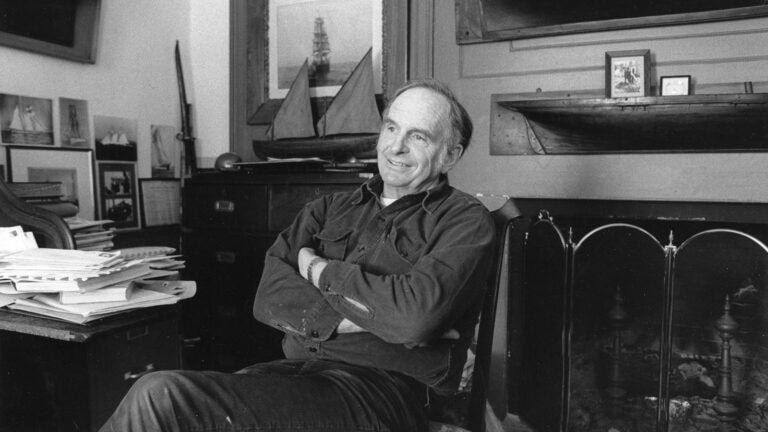
Robert Douglas, a sailor and aviator who founded the Black Dog Tavern, a Martha’s Vineyard restaurant that gained national recognition through shirts emblazoned with its canine mascot – a Labrador-boxer mix, tail upturned, that became a symbol of laid-back summer days – died April 23 at his home in the island town of West Tisbury, Massachusetts. He was 93.
The cause was prostate cancer, said his son Morgan Douglas.
Mr. Douglas grew up in the Chicago suburbs, hundreds of miles from the nearest ocean. But at 15, he began spending part of each year on the Vineyard, an affluent summer destination off the coast of Cape Cod, where his parents rented a home and where he became entranced by the sea. He learned to sail aboard a 15-foot boat and, by 1964, had worked his way up to a 108-foot topsail schooner, the Shenandoah, whose construction he oversaw and whose design he modeled after an 1850s revenue cutter.
Although Mr. Douglas spent much of his time on the water, skippering chartered tours on the Shenandoah, he was eager for a place near the harbor where he could sit among friends with a good cup of chowder. Most of the island’s restaurants were closed in the winter, when visitors stuck to the mainland.

With help from carpenter Allan Miller, who became a part-owner of the restaurant, Mr. Douglas took matters into his own hands, opening the Black Dog in January 1971. The restaurant remained open year-round, offering steak, chicken and plenty of seafood specials, including locally caught bluefish and flounder stuffed with crab.
Within a matter of months, it was attracting attention well outside New England.
“Stockbrokers and freaks, infants and old seadogs swell the line seven days a week every day of the year,” restaurant critic Raymond A. Sokolov wrote in the New York Times that August, praising the food as “an expert blend of the gourmet and the gutsy.”
By then, the restaurant was frequented by unassuming locals as well as celebrities including singer James Taylor and actress Ruth Gordon. It gained an even wider following with help from T-shirts, hats and other merchandise bearing a picture of Mr. Douglas’s pet dog, the aptly named Black Dog, for whom the restaurant was named. The dog was itself named after a pirate in Robert Louis Stevenson’s novel “Treasure Island.”
In its classic version, the Black Dog T-shirt featured only the dog logo on the front, drawn by artist and restaurant hostess Stephanie Phelan. On the back was the Black Dog’s name, along with the year of the shirt’s purchase – a detail that helped visitors memorialize their trip to the island and, intentionally or not, served to distinguish newcomers from old-timers.
Although the shirts were first sold in the early 1980s, the merchandise really took off a decade later, after President Bill Clinton and his wife, Hillary, began sporting the gear on summer trips to the island. (Under questioning about his relationship with White House intern Monica Lewinsky, the president testified that he had given Black Dog T-shirts to Lewinsky as a gift, along with a Black Dog tote bag and stuffed animal.)
“What the Lacoste alligator shirt was to the 1970s, and Ralph Lauren’s polo pony to the ’80s, the Black Dog threatens to become to the ’90s, in appropriately faded shades of moss green, stone-washed blue, soft cherry and classic white,” Washington Post journalist Ruth Marcus wrote in 1994.
“At times this island looks like a veritable kennel club, with every other person sporting some piece of Black Dog gear,” Marcus added, before noting that “Black Dog shirts have been sighted everywhere from a country lane in Provence to the slopes of the Grand Tetons. A recent clipping from a Florida newspaper shows a Cuban refugee being picked up on the high seas – wearing a Black Dog hat.”
The restaurant capitalized on the trend by opening a succession of retail shops it called General Stores, first on the Vineyard and then up and down the East Coast, with locations now stretching from Florida to Maine. It released a cookbook; sold merchandise through mail-order catalogues that reached more than 200,000 customers; and expanded its lineup to sell Black Dog granola tins, baby onesies, bucket hats and soccer balls.
“The tail started wagging the dog,” Mr. Douglas once noted in an interview with the Vineyard Gazette. “It started as a restaurant and it turned into a dry goods business.”
The second of four sons, Robert Stuart Douglas was born in Chicago on March 18, 1932, and grew up in Lake Forest, Illinois. His paternal forebears helped found the Quaker Oats Co.
His father, James H. Douglas Jr., was an Army veteran who worked as a lawyer, investment banker and military official, serving as secretary of the Air Force and deputy secretary of defense during the Eisenhower administration. He was 16 when his mother, the former Grace McGann, died.
Mr. Douglas studied political science at Northwestern University, receiving a bachelor’s degree in 1955. He trained as a fighter pilot in the Air Force, was promoted to captain and flew his last mission in 1958, when he ejected from a malfunctioning jet, according to the Black Dog’s website.
Later that year, Mr. Douglas moved to Martha’s Vineyard full time and turned from the skies to the water. The Gazette reported that he worked for several months as a seaman on the 1962 film “Mutiny on the Bounty,” aboard a replica of the HMS Bounty that was built in Nova Scotia and sailed through the Panama Canal to Tahiti, where the movie was shot on location.
After returning to New England, Mr. Douglas worked at the Gamage Shipyard in South Bristol, Maine, and financed the construction of his own schooner, the Shenandoah, which he named after a favorite sea shanty. He later expanded his fleet by acquiring a second schooner, the Alabama, a former pilot boat built in 1926.
Mr. Douglas married Charlene Lapointe, a sailor and equestrian, in 1970. In addition to his wife, survivors include four sons, Robert Jr., Jamie, Morgan and Brooke, who have each played a role in the family business; and six grandchildren.
During a lull in his charter business in the 1990s, Mr. Douglas began leading sailing trips aboard the Shenandoah for local schoolchildren. “They are just great big sponges, they can’t get enough,” he told the Gazette in 2013. “Everything is new and interesting. I provide the platform, a different lifestyle, one that is entirely different from anything they have ever experienced.”
By 2020, when Mr. Douglas donated the schooner to a nonprofit, an estimated 5,000 children were said to have sailed aboard the Shenandoah, some in trips that lasted a week or more. The ship was engine-free and occasionally encountered fog that could stymie a voyage for three days at a time.
When that happened, Mr. Douglas said, the children were unbothered, learning to tie knots or jumping off the side to go swimming. Adults had less patience for the inconvenience.
“Grownups tend to lose their resiliency,” he observed. “That is the major grown-up problem.”
Get breaking updates as they happen.


To comment, please create a screen name in your profile
To comment, please verify your email address
Conversation
This discussion has ended. Please join elsewhere on Boston.com