
Sign up for the Today newsletter
Get everything you need to know to start your day, delivered right to your inbox every morning.
Faith leaders, civil rights advocates, and politicians gathered at the Boston Common on Saturday afternoon to honor the 60th anniversary of Martin Luther King Jr.’s march from Roxbury to the historic park.
“Those courageous marchers knew what we still know today, that power concedes nothing without demand that justice is not simply given freely,” U.S. Rep. Ayanna Pressley told the crowd. “We are witnessing — this is the season to call a thing a thing, so I’m going to say — of witnessing a dangerous resurgence of white supremacy, of state sanctioned violence, of economic exploitation, of authoritarian rhetoric.”
On April 23, 1965, King led more than 20,000 people, including local leaders Alan Gartner and Ruth Batson, from the Carter Playground to the Boston Common to protest racial inequalities in Boston’s schools.
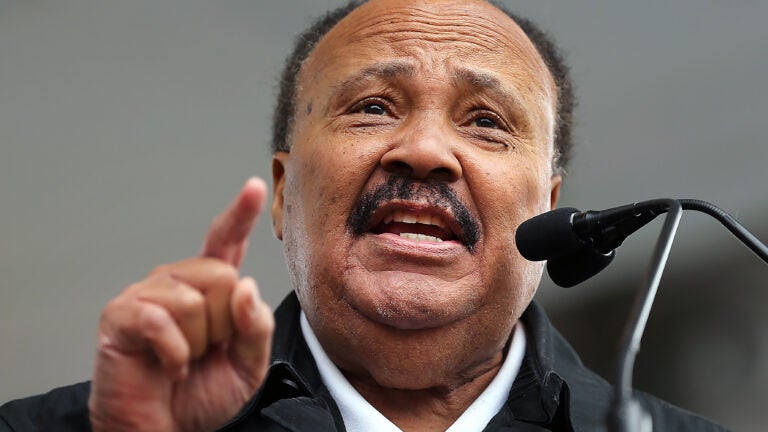
Martin Luther King III, the son of the Kings, spoke to the crowd, thanking Boston for bringing his parents together in the city and calling for people to “challenge this president.” The memorial “Embrace” honoring his parents was in sight, just beyond the crowd.
“We don’t have the luxury of stopping. We don’t have the luxury of giving in or giving out,” King III said. “We have to keep moving forward until that dream that Dad shared becomes real for all humankind.”
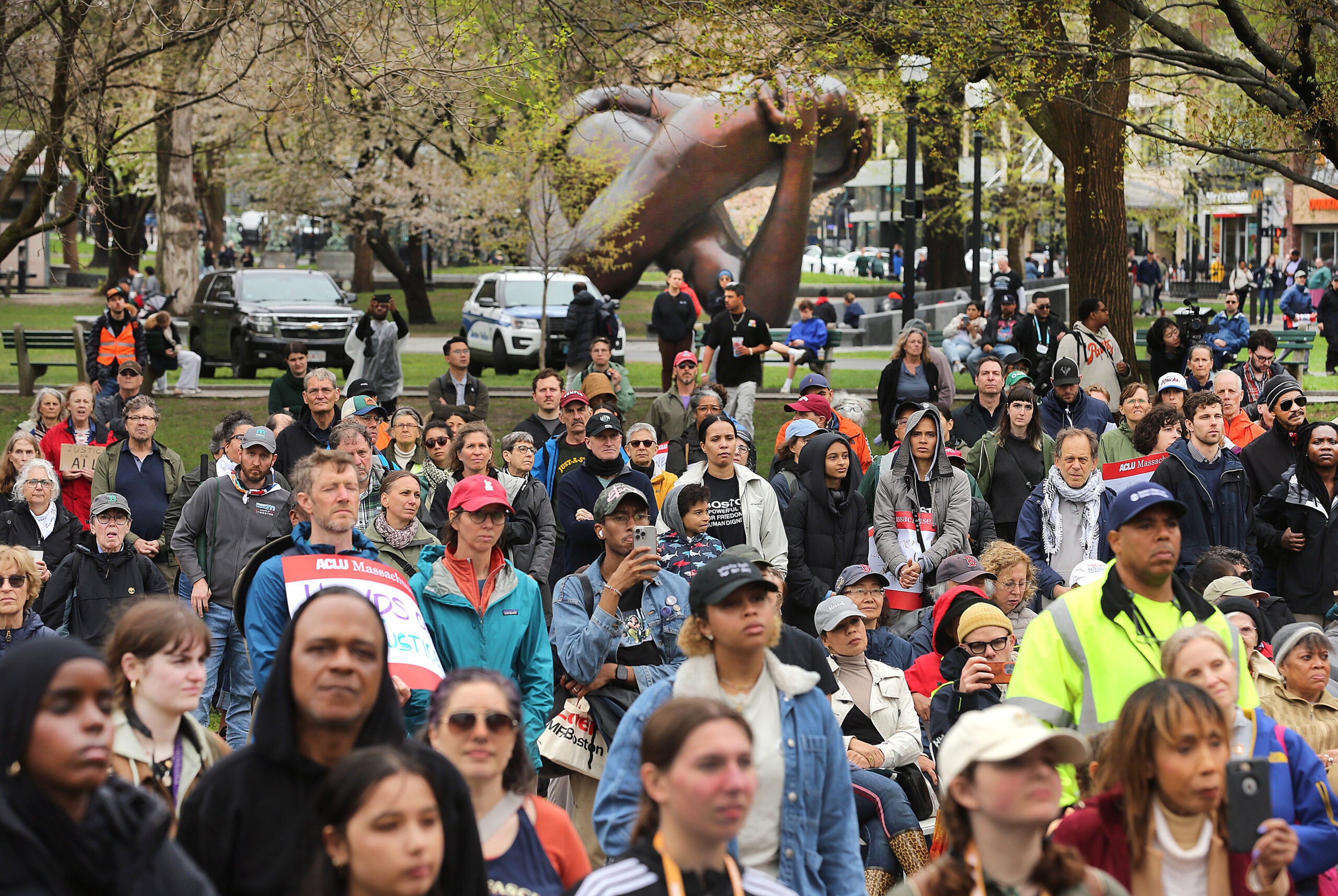
Pressley was joined by leaders including Lieutenant Governor Kim Driscoll, state Sen. Liz Miranda, and Boston Mayor Michelle Wu. The host of speakers, who began after the worst of Saturday’s rainstorm, called for attendees to remember King’s legacy, continue to fight injustices for all marginalized groups, and to protect democracy. Many invoked King’s own words to choose community over chaos.
“There are those who seek to stall our progress quietly and politely, but we must not repeat that history by pretending that today’s disparities are actually accidental. They’re the result of decisions,” said Miranda, the first Cape Verdean American elected to the Massachusetts State Senate. She referenced local leaders like Louise Day Hicks, a prominent opponent to integrating schools in Boston.
Embrace Boston, a nonprofit advocating to dismantle racism, organized Saturday’s event, which included a march from Copley Square starting at 10:30 a.m. The march stopped at the corner of Boylston and Charles Street, where Wu officially declared it as “1965 Freedom Rally Square.”
“For every Black resident, it means freedom to be Black and alive. Freedom to be Black and to thrive. Freedom to be joyful, freedom to be excellent. Freedom for all,” Wu said. “In Boston, we are continuing the fight: freedom for all residents here to walk down the street knowing you live in the safest major city in the country.”
Hundreds attended the speaking event on Boston Common, which also hosted tents nearby with representatives from the ACLU, the Massachusetts Immigrant and Refugee Advocacy Coalition, Black Girl Environmentalist, and 826 Boston.
Driscoll’s speech kicked off the event after an invocation from the Rev. Willie Brodrick. NBC10 Boston meteorologist Tevin Wooten hosted the event, and other speakers included Celtics legend Bill Russell’s daughter Karen Kenyatta Russell and Michael Curry, of the Massachusetts League of Community Health Centers.
Pressley told that crowd that “Jim Crow is still alive.”
“Jim Crow is still alive when they deny constitutional rights. Jim Crow is still alive when they will brutalize, imprison, intimidate you, to silence you,” Pressley said.
Nakia Hill, of Roxbury, and her friend Stefanie Belnavis, who lives in the South End, gathered at the Parkman Bandstand on the rainy Saturday. Hill, a writer, said she is supportive of Embrace Boston’s mission to honor King.
“I believe that change starts with us, regardless of what’s happening in our nation. We have the power to change as individuals and as a collective,” Hill said. “There’s no stopping us.”
Belnavis, who is originally from Jamaica and has spent more than a decade living in Boston, said remembering and fighting for King’s message especially applies to her “intersectional story.”
“Being a Black woman, an immigrant, Caribbean woman, educator, all of the different ways in which I am, who I am today, these issues are forever relevant,” Belnavis said.
King III spoke of the human right to housing, health care, top education, work, and justice, particularly in the United States. He said “wealth is in the hands in just a few.”
“I think my father and mother would challenge us to be a better America because we can become that,” King III said. “It starts with something called love.”


Get everything you need to know to start your day, delivered right to your inbox every morning.


To comment, please create a screen name in your profile
To comment, please verify your email address
Conversation
This discussion has ended. Please join elsewhere on Boston.com