
Sign up for the Today newsletter
Get everything you need to know to start your day, delivered right to your inbox every morning.
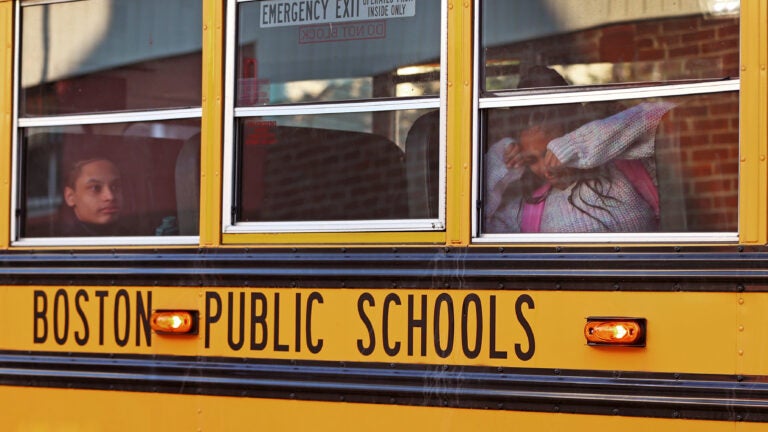
In an effort to improve a transportation system long derided for its unreliability, officials announced Wednesday that Boston Public Schools would automatically pause bus assignments for students that consistently do not ride the bus.
The announcement of this new “ridership procedure” came alongside the release of a new BPS report showing that “significant progress” was being made to fix the bus system. City officials highlighted the fact that 94% of BPS buses arrived at school prior to the morning bell in March, the highest monthly on-time performance recorded in the last five years.
The rollout also comes as Mayor Michelle Wu seeks reelection. Her administration received heavy criticism last fall when families across Boston reported significant bus delays and some complete no-shows. Wu’s most prominent opponent, Josh Kraft, has hammered her on the topic.
The policy changes announced this week will be implemented after the upcoming April vacation. If a student does not ride the bus for ten consecutive school days, and does not provide prior notification to BPS, district staff will “proactively reach out to their family and provide notice that they will be removed from the route.” Students or their families can contact BPS at any time to have their bus assignment reinstated.
Wu and Superintendent Mary Skipper said the new policy would improve efficiency and make bus service more reliable for the students who actually rely on the district for transportation. Officials estimate that around 1,000 students who have not consistently taken the bus this year will be opted out of transportation once the policy goes into effect.
“With the implementation of the new Ridership Procedure, our team will be able to build bus routes based on actual student ridership for the first time,” Executive Director of BPS Transportation Dan Rosengard said in a statement.
Wu and other officials largely blamed the spike in delays at the start of the school year on the rollout of a new app being used by bus drivers and families. The app, called Zūm, replaced a paper-based system with real-time GPS navigation. It allows the district to provide more accurate time estimates, gives drivers more information about individual students, and allows officials to collect much more data than they could in the past.
As drivers adapted to the technology at the start of the 2024-2025 school year, on time performance (OTP) cratered. The first day of the year saw a 34% OTP, the lowest first-day OTP in a decade, by far.
But, according to the city, OTP rapidly improved in the weeks that followed. From October through March of the current school year, morning OTP averaged 91.7%. Over the same period last school year, it averaged 90.6%.
“We are taking the leap forward of implementing technology that is going to have a learning curve and, as we saw, had a rocky start to this school year, but now is putting us in a place to be able to do even better than could have been imagined before,” Wu said at a media availability Wednesday.
But officials say that the only way to improve OTP further is to engage in “structural changes” that “right size the transportation system.” The Zūm app allows the district to systematically track student ridership for the first time, enabling the district to pinpoint which students no longer need bus service.
Skipper praised Wu’s leadership in her willingness to tackle the issue.
“This has been an issue in our city for decades and decades and decades,” Skipper said. “This is really the first time, under our mayor, that we are taking this on, kind of opening up the can and really looking at it and making everything as transparent as possible.”
Eileen O’Connor, a spokesperson for Kraft, said Thursday that the announcement is Wu’s way of papering over the school system’s entrenched flaws.
“A 3-year plan for 2022-2025, released with 40 school days left in the year and taking a victory lap on OTP nearly 8 months after the school year began, is cold comfort for the many students who never made it to school on time this year, not to mention the budget-busting $171 million spent annually to provide bus transportation for about 20,000 students,” she said in a statement.
“Once again, this feels like Mayor Wu is responding to Josh Kraft’s calling her out for a school system that regularly fails our kids on virtually every measure, including the ability to provide even the most basic services,” O’Connor wrote.
Get everything you need to know to start your day, delivered right to your inbox every morning.



To comment, please create a screen name in your profile
To comment, please verify your email address
Conversation
This discussion has ended. Please join elsewhere on Boston.com