
Sign up for the Today newsletter
Get everything you need to know to start your day, delivered right to your inbox every morning.
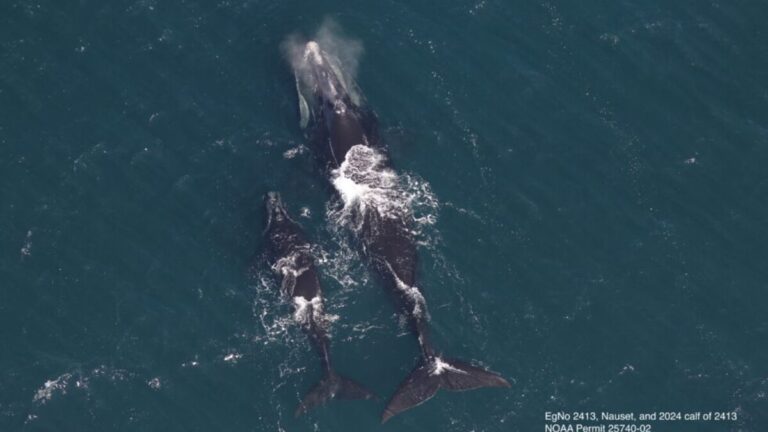
Researchers have reported the first sighting of a North Atlantic right whale calf in Massachusetts waters so far this year.
North Atlantic right whales are critically endangered, and there are estimated to be fewer than 400 alive today. They are very susceptible to vessel strikes and entanglements in fishing gear, and the animals have been dying at an alarming rate since about 2017.
Scientists monitor calving season closely to track population numbers. There are only about 70 reproductively active females remaining, according to the National Oceanic and Atmospheric Administration.
So experts were delighted when they spotted the calf recently. The sighting was reported by aerial observers from the Center for Coastal Studies, a Provincetown-based organization. The calf was seen with its mother about five miles west of Great Island in Wellfleet on March 11.
“We were on our final track line of a busy survey day, when we spotted a pair of whales about a mile south of us. As we approached to document them, we knew we had to move quickly due to rising winds, which were nearing the upper limit of our survey parameters,” researcher Ryan Schosberg recounted in a statement.
“Then to our surprise, a relatively small animal surfaced, and our initial confusion quickly turned to excitement when we realized this was our first right whale calf of the season!” he added.
Researchers keep a meticulous record of each individual right whale. The mother seen near Wellfleet was identified as Nauset, a 31-year-old who got her name because her callosity pattern resembles Nauset Lighthouse in Eastham.
This is Nauset’s fifth known calf, two of which are presumed to have died. Nauset and her calves have collectively experienced at least eight entanglements and four vessel strikes, according to the New England Aquarium.
Nauset was first sighted with this newborn calf on Dec. 1 off the coast of Georgia, according to the Center for Coastal Studies.
In the fall, right whales travel hundreds of miles from their feeding grounds off the coasts of New England and Canada to the shallow waters near North Carolina, South Carolina, Georgia, and northeastern Florida. Right whale calving season begins in mid-November and runs through mid-April.
As the spring progresses, the whales move back up north. Cape Cod Bay regularly plays host to large groups of feeding whales around this time of year. Researchers from the Center for Coastal Studies have already seen more than 80 individual right whales in the bay this year.
“The first sighting of mother/calf pairs in Cape Cod Bay each season is always an exciting moment that brings hope for the species,” said Daniel Palacios, director of the Right Whale Ecology Program at the Center for Coastal studies, in a statement.
“Their presence confirms successful calving in the southeastern U.S. during the winter months and marks a crucial stage in the calves’ early development,” Palacios continued. “Given the critically endangered status of North Atlantic right whales, every birth is vital for population recovery. The long-term survival of the species depends on these calves, highlighting the urgent need to protect Cape Cod Bay as a critical habitat where they feed and nurse.”
Female right whales become sexually mature at age 10, and give birth to calves after being pregnant for a year. Researchers say that these whales are having fewer calves and taking more time in between pregnancies. Three years is considered to be the healthy interval between births, but the whales are now having calves every six to 10 years. Scientists think that extra stress from entanglements, vessel strike injuries, and climate change-induced prey availability disruptions are to blame, according to the NOAA.
Despite some concerns about the effect of offshore wind developments on right whales, scientists are adamant that vessel strikes and entanglements should be the focus of conservation efforts.
Imposing greater speed restrictions in certain areas along the east coast could significantly help decrease vessel strikes, scientists say.
Experts from the New England Aquarium and elsewhere had been advocating for more speed restrictions to the federal government for years.
But they were opposed by those within the fishing and commercial shipping industries, who worried that expanding slow zones could be economically harmful. In the waning days of the Biden administration, federal officials withdrew a proposal to expand slow zones, further imperiling right whales.
Get everything you need to know to start your day, delivered right to your inbox every morning.





To comment, please create a screen name in your profile
To comment, please verify your email address
Conversation
This discussion has ended. Please join elsewhere on Boston.com