
Sign up for the Today newsletter
Get everything you need to know to start your day, delivered right to your inbox every morning.
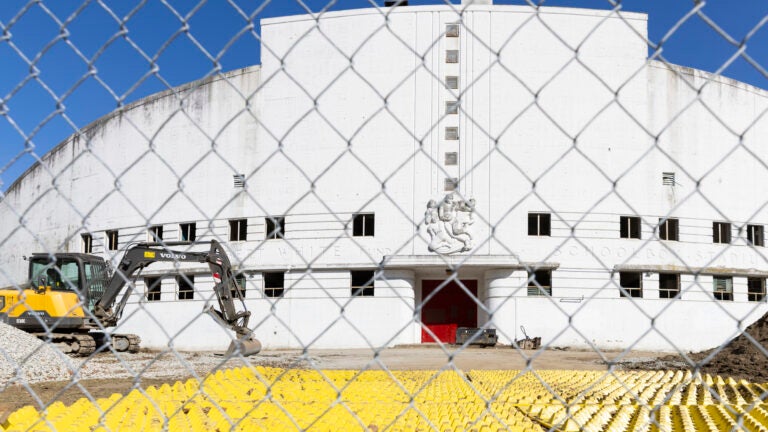
The ultimate fate of White Stadium in Franklin Park could be decided very soon.
For more than a year, Boston officials have been pursuing an ambitious redevelopment of the dilapidated stadium so that it can better serve the city’s student-athletes. But the plan rests on a public-private partnership with a new professional women’s soccer team, which would get to use the stadium for home games and practices.
Mayor Michelle Wu has thrown her full weight behind the plan, and demolition work began earlier this year. The stadium’s future has even taken on a prominent role in this year’s mayoral race.
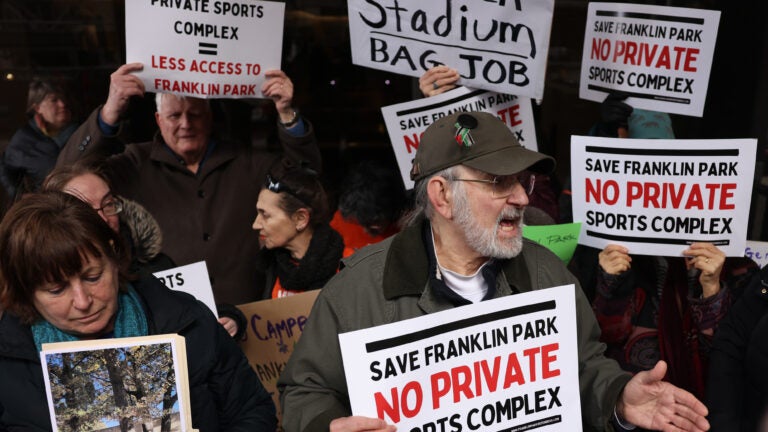
Some residents and local advocates have been prominently opposing the renovation. Last February they sued the city and Boston Unity Soccer Partners (BUSP), the private group of investors backing the soccer team, arguing the project violates state law.
That case heads to Suffolk Superior Court this week. A trial is set to begin Tuesday. Here’s what to know ahead of time.
The one thing nearly all parties can agree on is that White Stadium is in desperate need of a makeover. Originally built in 1949, it is now in a state of disrepair. Aspects of it do not meet current safety codes or accessibility requirements, according to the city, and there is not adequate space or amenities to accommodate student-athletes. The 10,000-seat stadium was last renovated in the ’80s, and a grandstand was seriously damaged by a fire in the ’90s.

The city’s solution was to partner with the professional women’s soccer team, formerly known as BOS Nation FC. The team’s leaders are currently working on a rebrand, saying that a new name is needed as that name failed to resonate with fans and stakeholders. The team will be part of the National Women’s Soccer League. New teams in Boston and Denver will bring that league to 16 teams next year. They are planning to begin play in March 2026.
As part of the plan workers would add a new natural grass field, new public restrooms, a new eight-lane track, ADA-compliant facilities for students, a strength and conditioning suite, a sports medicine office, and more.
The city says a public-private partnership was needed “due to the size of investment needed to renovate the stadium.” Boston will pay for about half of the project, while the team will cover the rest. Boston officials initially estimated that the city would pay about $50 million, but now say it could cost $91 million. Those rising costs have caused headaches for Wu.
A recent report in the Boston Herald raised transparency concerns about the project’s request for proposal (RFP) process. That report centered on internal communications between BUSP and the Wu administration that apparently preceded the RFP. Josh Kraft, who is running against Wu this year, seized on that report. He called the RFP process “secretive and rigged.”
The city and BUSP are adamant that the RFP process was conducted in full compliance with the law and with full transparency. Claims that the RFP process was conducted illegally are not a part of the lawsuit, and “assertions to the contrary are only politically motivated misstatements of fact,” according to BUSP.
Boston and BUSP signed a 10-year lease recently. Boston will continue to own the stadium, and BUSP will be a tenant, responsible for paying $400,000 in rent a month beginning “in the first full season where the entire facility is available.” The rent will increase by 3% annually after the team’s second season, and Boston expects to collect around $4.3 million in rent over the 10 years.
The city will collect a portion of in-stadium advertising, naming rights, and concessions revenue. An annual fund has been established to distribute $5 million over 10 years to support local businesses, youth sports, and other community initiatives. One-dollar per ticket sold will be used to support other improvements to Franklin Park. The plan will create about 500 construction jobs and 300 permanent jobs, according to BUSP.
Opponents have raised concerns about displacing student-athletes so that the soccer team can play and practice in White Stadium. The team will take away public access to the stadium on the majority of Fridays and Saturdays from March-November, during the warmest and busiest months of the year, they say.
The city and BUSP contend that overall community access to the stadium will more than double, from 45 hours a week to 105 hours. Instead of being open 7 a.m. to 4 p.m., it would be open 6 a.m. to 9 p.m. daily. The time allocated for Boston Public Schools events would increase from 250 hours a year to at least 700 hours a year. The city has “absolute priority” to reserve up to 12 days a year for “major events.”

The plaintiffs in this case are 20 citizens and the Emerald Necklace Conservancy, a private nonprofit that works to conserve more than 1,000 acres of green space throughout the entire chain of parks known as the Emerald Necklace. A group calling itself the Franklin Park Defenders has been heavily involved in opposing the project.
The lawsuit makes two key claims. First, it alleges that the development proposal violates Article 97 of the Massachusetts Constitution. This law requires the state Legislature to approve of a change to the use of public park and recreation land. No vote has taken place. The plaintiffs say that, for the last 20 years, White Stadium and the surrounding land have been specifically listed as “protected” in the city’s “Open Space Plan.”
Under Article 97, the project would be subject to an environmental review from the state. This would include considerations of alternative plans. The plaintiffs argue that an environmental review must be conducted “due to the project’s traffic impacts, the rezoning of the stadium parcel, the land’s change in use, the scale of activities and construction, and the project’s impact on environmental justice neighborhoods.”
BUSP says that it has received full approvals from all city regulatory agencies with direct jurisdiction. The group argues that Article 97 does not apply to this situation because the land is not being transferred and its use is not being changed. They also say that Article 97 only applies to “forever parkland,” and White Stadium is actually located on distinct BPS property. The city points to legislative votes taken in 1947 and 1950 that approved the use of the land for a stadium under BPS control. These votes amounted to a relinquishment of the land as “forever parkland,” the defendants say.
The plaintiffs make a second claim: that the lease and stadium use agreement between the city and BUSP breach the terms of the George Robert White Fund, a permanent public charitable trust. This project qualifies as a “joint undertaking,” which the trust specifically prohibits, they argue.
The defendants say that nothing in the trust prevents private investment in the White Stadium parcel, which is “legally separate from the rest of the ownership of Franklin Park.” They say that private investment is not the same thing as “privatization” of public lands.
White, a philanthropist, dictated the use of the trust in his will. It discusses leasing the land out and specifically encourages the creation of a “forum of substantial proportions for public gatherings.” The will does not place any restrictions on what entities can lease the property, BUSP says.
Those opposed to the project had been hoping Attorney General Andrea Campbell would step in on their behalf. But Campbell’s office said last month that it has “absolutely no role” in the debate.
Campbell’s office cited a decision from a Suffolk Superior Court judge, who last year denied a temporary restraining order and preliminary injunction filed by the project’s opponents. She said that the plaintiffs are “not likely to be successful based on the merits” of their claims and that the project appears consistent with White’s will.
Plaintiffs said that they disagreed and were looking forward to the trial this week. They have put forward an alternative plan that would not involve a private partnership and would only cost around $29 million.
Sorry. This form is no longer available.
Get everything you need to know to start your day, delivered right to your inbox every morning.



To comment, please create a screen name in your profile
To comment, please verify your email address
Conversation
This discussion has ended. Please join elsewhere on Boston.com