
Sign up for The Dish
Stay up to date on the latest food and drink news from Boston.com.
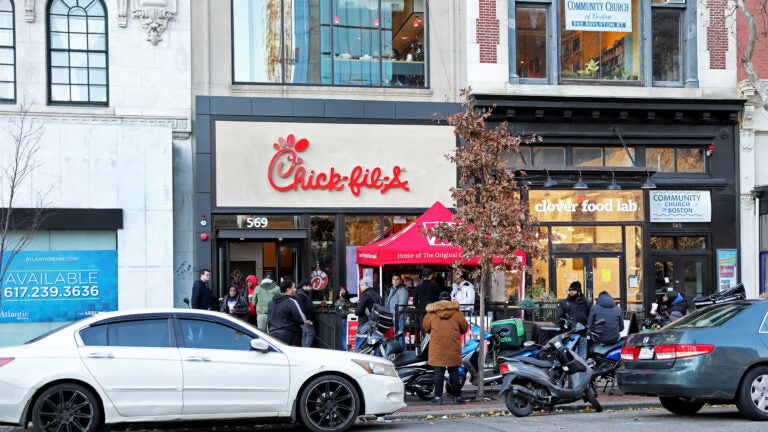
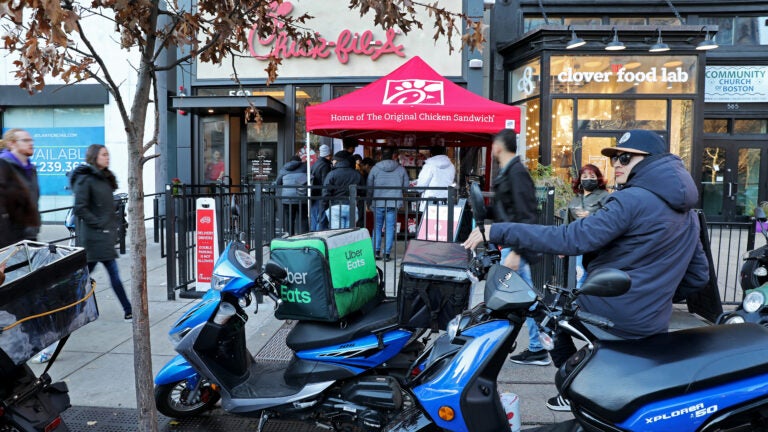
It’s a common sight in Boston: food delivery drivers on mopeds and scooters weaving in and out of traffic and dodging pedestrians as they hurry to drop off their orders on time. While Boston officials took previous steps to rein in the behavior of individual drivers, the city is now taking aim at the large companies that employ them.
Mayor Michelle Wu announced Monday that she is filing an ordinance with the City Council that would require companies like DoorDash, GrubHub, and Uber to obtain permits from the city’s transportation department in order to continue operations in Boston.
To obtain that permit, the companies would have to both provide umbrella liability insurance coverage for all their delivery drivers and commit to sharing certain delivery data with the city.
Wu, speaking from a podium set up on Boylston Street on Monday morning, said that the city received more than 100 reports last year from concerned residents. Delivery drivers on mopeds and scooters were seen running red lights, riding on sidewalks, driving the wrong way down one-way streets, breaking the speed limit in residential areas, and causing collisions with other vehicles, she said.
“These practices aren’t just against the law, they put our residents’ lives at risk. It’s not safe for anyone: the delivery drivers, pedestrians, cyclists, other vehicles on the roads, and anyone else trying to get around our city,” she said.
Last summer, city officials sent a letter to Uber, GrubHub, and DoorDash executives accusing them of “a concerning lack of oversight and care in regard to public safety.” Boston Police Commissioner Michael Cox directed officers to increase enforcement on traffic violations, and the city warned the companies that violations could lead to fines, drivers losing their licenses, and vehicles being seized.
The city also launched an educational campaign aimed at the drivers, informing them about their responsibilities to register two-wheeled vehicles and to follow the rules of the road. Officials have seen better adherence from drivers since then, but now the companies themselves need to step up and “do their part,” Chief of Streets Jascha Franklin-Hodge said.
“Safety on our streets is not only the responsibility of individual drivers, but also the platforms who recruit and dispatch thousands of people to make deliveries, usually with little or no safety training and operating under a system of financial incentives that encourages speed above all else,” Franklin-Hodge said.
Food delivery companies would have to provide insurance coverage that offers recourse to anyone injured in a crash with a delivery driver, regardless of the type of vehicle they were operating or the insurance status of that driver, he said.
Franklin-Hodge also stressed the importance of the data sharing requirement. Right now, without data from these companies, the city has to operate from a reactive position. Hotspots of dangerous activity are frequently identified only after frustrated residents contact the city themselves.
The companies would have to share information on the types of vehicles being used in Boston, when restaurants receive their highest number of orders, how quickly trips are completed, how long delivery vehicles idle on streets, and how fast they travel, officials said. This data would be used by the city to improve roadway design and to better enforce traffic laws.
Sharing this data should not be difficult for these companies, Wu said.
“The companies already have the information within their systems of who was driving the wrong way, the unsafe behaviors that are taking place. This will help ensure that we are getting that into oversight of our public sector,” she said.
The food delivery companies would not be asked to share data that identifies individual customers or delivery drivers. Only large companies like DoorDash and Uber would be subject to the ordinance. Local restaurants who offer their own delivery options and general delivery companies like FedEx would not be impacted, Franklin-Hodge said.
There is already resistance from at least one major company. A DoorDash spokesperson said that the company was committed to promoting safety in cities like Boston, and that it has already worked to reduce congestion and support “oversight and enforcement on dangerous riding.”
“However, this ordinance would clearly miss the mark in its efforts to create safer streets, doing little to improve safety for Dashers or the public and creating new costs that would add price hikes for Boston families along the way,” the DoorDash spokesperson said in a statement. “We plan to continue working closely with Boston policymakers to help them understand the consequences of this ordinance and find more practical solutions that would actually help ensure more vibrant and safer streets for everyone.”
DoorDash says it already provides third-party auto liability coverage and occupational accident insurance when safety incidents occur.
“We’re committed to collaborating with cities to improve safety and are reviewing the ordinance in Boston to understand its potential impact. Our delivery partners agree to follow local traffic laws and maintain the necessary insurance coverage when joining our fleet, and drivers have access to in-app safety training and regular reminders. We look forward to working with the city to find solutions that prioritize safety while avoiding unnecessary costs or regulations for both consumers and couriers,” GrubHub spokesperson Patrick Burke said in a statement.
Spokespeople for Uber did not immediately return requests for comment Monday.
If the ordinance is passed, companies that operate without a permit would be subject to fines and potential legal action for noncompliance, Franklin-Hodge said.
Wu’s ordinance would have to win the backing of City Council and then be approved by lawmakers in the State House. It is set to be discussed during the City Council meeting this Wednesday. The ordinance’s prospects in that body are unclear, but Wu has many allies on City Council and multiple councilors have expressed concern about food delivery drivers in the past.
Councilor Sharon Durkan and state Rep. Jay Livingstone appeared alongside administration officials during Monday’s press conference. Livingstone, who represents much of Beacon Hill and Back Bay, said he was almost hit by a delivery driver over the weekend while walking with his children on Dartmouth Street.
“It’s incredibly dangerous what’s happening,” Livingstone said.
Durkan said she chaired a hearing on the topic months ago, and publicly called for these companies to share more data with the city. Since then, they have offered little transparency and have neglected to respond to her concerns, she said.
“For far too long, third-party delivery platforms have operated as if rules don’t apply to them,” Durkan said.
Stay up to date on the latest food and drink news from Boston.com.



To comment, please create a screen name in your profile
To comment, please verify your email address
Conversation
This discussion has ended. Please join elsewhere on Boston.com