
Sign up for the Today newsletter
Get everything you need to know to start your day, delivered right to your inbox every morning.
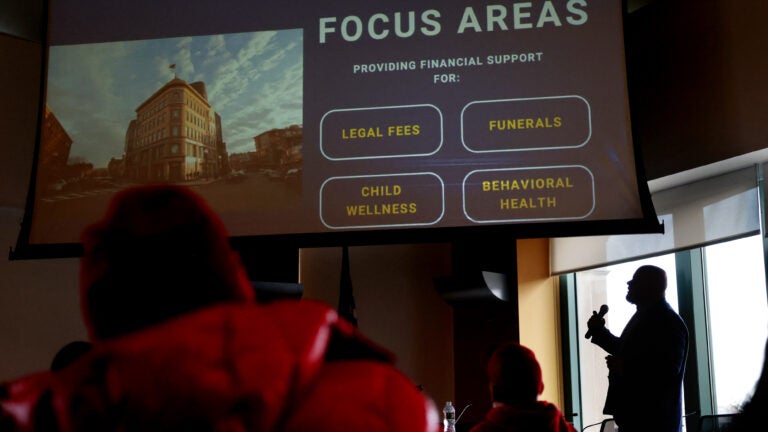
A new support fund will provide up to $5,000 in financial assistance to Boston families who have lost an immediate family member to an opioid overdose, city officials announced Wednesday.
The Family Overdose Support Fund aims to “address both immediate needs and long-term challenges related to health, healing, and community connection,” according to the program’s website.
The city and the Boston Public Health Commission have committed $250,000 to the program, drawing from funds from multistate settlements with opioid manufacturers and distributors, according to authorities.
“Overdose deaths have impacted every corner of our community and those who lost loved ones carry grief and trauma with them forever,” Mayor Michelle Wu said in a statement. “Our community engagement process made it clear that residents see the establishment of this fund as a crucial way we can help our grieving friends and neighbors pick up the pieces in the face of tragedy, and I’m proud to see it launch today.”
The Boston BullPen Project — a non-profit that partners with social service organizations — is administering the fund.
Only one immediate family member is allowed to apply to receive money from the fund, which can cover one invoice up to $5,000 paid directly to service providers for services such as childcare costs, clinical therapy or behavioral health support, or legal assistance to apply for public benefits.
Applicants must live in Boston, be seeking support for a family member who died from opioids within the past two years, and be related to the deceased person by blood or marriage.
Over 50 families will receive financial assistance through the program, according to the BPHC.
“Before my beloved son, Ja’Maar 5ive Johnson, lost his life to this relentless struggle, I witnessed the depth of his fight and the toll it took on all of us,” Janice Johnson, founder and executive director of Mothers Against Drugs Inc., said in the announcement. “I know all too well the sorrow of having to say goodbye to someone you love because of this devastating issue. That’s why I believe so passionately in the importance of this fund. It offers hope and support to families who are grappling with similar tragedies.”
From July 2021 through December 2022, four settlements were announced, providing nearly $1 billion to Massachusetts over 18 years, according to the BPHC.
Boston will incrementally receive at least $22 million from the state’s opioid settlements through 2038, the commission said.
Just last week, Massachusetts Attorney General Andrea Joy Campbell announced that up to $108 million from the $7.4 billion settlement in principle with members of the Sackler family and their company, Purdue Pharma, will be distributed to Massachusetts.
“While this settlement cannot bring back the lives lost, it will bring in much-needed funds to begin to remediate the damage and ensure that the Sacklers can be held accountable for the lasting devastation they have caused,” Campbell said in a statement.
The fund’s announcement comes as new data shows a “significant decrease” in opioid-related overdose deaths from May to August 2024 in Boston compared to the same time period the year before, according to the BPHC. Opioid-related overdose deaths were down 39% overall.
In 2023, there were 2,104 confirmed opioid-related deaths in the state, according to the Massachusetts Department of Public Health.
The commission found that unintentional drug overdose is still the leading cause of early death in Boston, disproportionately impacting Black and Latinx residents, who account for 40% of Boston’s total population and 52% of all overdose deaths from May to August 2024.
The commission attributes the decline in part to increasing access to naloxone, an overdose-reversing drug, which is becoming more accessible in public spaces across the city. In 2024, BPHC distributed nearly 22,000 doses of naloxone in Boston.
“Having naloxone means you are prepared for when emergencies happen, which is especially important if you know your loved ones use substances,” Leah Randolph, executive director and co-owner of Commonwealth Mental Health & Wellness Center, said in a statement. “Naloxone saves lives, and ensuring more people have access to it is a critical step in combating the overdose crisis.”

Get everything you need to know to start your day, delivered right to your inbox every morning.




To comment, please create a screen name in your profile
To comment, please verify your email address
Conversation
This discussion has ended. Please join elsewhere on Boston.com