
Sign up for the Today newsletter
Get everything you need to know to start your day, delivered right to your inbox every morning.
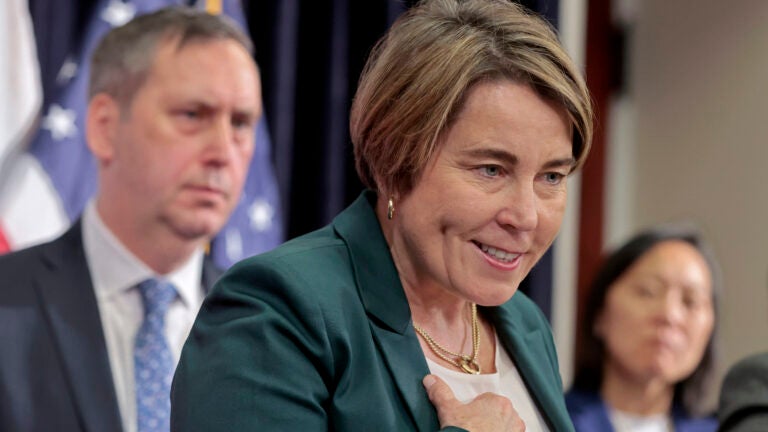
Gov. Maura Healey unveiled her $62 billion budget proposal for the next fiscal year Wednesday. With the help of revenue from the so-called millionaires tax, it would allocate hundreds of millions of dollars toward priorities like increasing housing affordability, funding the MBTA, and investing in education.
The administration is looking to increase spending by 2.6% over the current fiscal year. This does not include the proposed $1.95 billion in spending powered by the millionaires tax, or the Fair Share Amendment.
The governor is also planning to close two state hospitals, a move that quickly prompted union backlash.
Despite good news surrounding General Manager Phil Eng and the elimination of slow zones, the MBTA is in a perilous financial situation facing a roughly $700 million budget deficit.
Earlier this month, Healey announced plans to “stabilize” the MBTA’s finances and improve regional transit infrastructure by spending $8 billion over the next 10 years. To do this, the budget proposal dedicates $765 million in Fair Share revenue to enable $5 billion in borrowing over the next decade to support transportation.
The budget would send $500 million in Fair Share revenue to the MBTA for operation costs, more than double the amount allocated last year. A total of $687 million in direct support for the MBTA is included in the proposal. It allocates $400 million to implement safety and workforce improvements recommended by the federal government. The budget proposal maintains the Income-Eligible Reduced Fare program with $67 million.
Regional transit authorities would receive $204 million in total support, including $110 in Fair Share revenue that would go towards measures like expanding service hours and grants for fare-free service.
MassDOT would get $617 million to support its operations, including $55 million in Fair Share revenue. Officials are budgeting $80 million alone for snow and ice removal.
The Healey administration is focusing on higher education. $125 million in Fair Share revenue will “unlock” $2.5 billion in capital funding for infrastructure improvements on college campuses. $94 million would be used to sustain the state’s free community college program, while $80 million would fund need-based financial assistance and maintain the financial aid expansion from the previous budget.
For the state’s youngest learners, $1.1 billion would be used to fund child care financial assistance programs, which support about 65,000 children and 4,000 providers. Healey is proposing $475 million for Commonwealth Cares for Children (C3) grants, which fund the day-to-day operational and workforce costs of early education providers. More than $67 million would go towards the Commonwealth Preschool Partnership Initiative to increase pre-K enrollment.
Healey wants to spend $7.3 billion on Chapter 70 aid to school districts, representing an increase of about 6% compared to fiscal year 2025. $682 million would be used to fully fund the Special Education Circuit Breaker. $170 million would be earmarked to continue providing free school meals, $32.5 million would support college and career readiness initiatives, and $25 million would keep Healey’s “Literacy Launch” initiative afloat.
Across the budget, Healey is proposing $1.2 billion in investments designed to make housing more affordable, officials said. $253.3 million would be set aside for the Massachusetts Rental Voucher Program, with the goal of supporting more than 10,400 voucher holders by the end of the next fiscal year. The budget would allocate $115.5 million for subsidies to Local Housing Authorities.
The state has been struggling to deal with an overburdened emergency shelter system, with Healey now pushing to change the right-to-shelter law by adding residency requirements. The state is expected to spend about $1 billion on the shelter system this year.
Healey proposed $325 million for the system in the budget, the same as previous years. Officials said they expect to have to seek more money for the system at a later date.
The administration is also trying to impose cuts on the Residential Assistance for Families in Transition (RAFT) program. Currently, RAFT provides up to $7,000 per 12-month periods to families facing eviction, foreclosure, loss of utilities, and other “housing emergencies.” The proposal calls for stretching this $7,000 over a 24-month period instead. This would save up to $40 million, per The Boston Globe.
The administration wants to close Pocasset Mental Health Center on Cape Cod and Pappas Rehabilitation Hospital for Children in Canton, which would save the state about $31 million, according to the Globe. Pappas has aging, inadequate infrastructure and only 36 patients, half of whom are over 18 and able to move into an adult facility. The Pappas patients would be moved to a new specialty unit at Western Massachusetts Hospital in Westfield. State officials told the paper that they will work with employees to “ensure they are able to transition to new roles.”
“It’s my intent that services will not be disrupted,” Healey said.
Union representatives blasted the administration for these moves. SEIU 509 President Dave Foley said in a statement that 170 mental health workers stand to lose their jobs.
“The proposed cuts are an injustice to those who rely on these crucial programs, further reducing access to an already under-resourced system of care and services. Cutting services will only exacerbate existing issues, leaving children, families, and individuals to languish on growing wait lists while further threatening an already strained system,” the union said.
Massachusetts AFL-CIO President Chrissy Lynch warned that 17,000 public union members could see increasing insurance costs, and that vulnerable people will be left without access to necessary care.
The Massachusetts Nurses Association said that Western Massachusetts Hospital is already 90% full and does not offer the specialized services offered by Pappas.
“There is no way these children can receive the level of care and education at Western Mass Hospital or any other setting,” Pappas nurse Karen Leahy said in a statement from the MNA.
Get everything you need to know to start your day, delivered right to your inbox every morning.





To comment, please create a screen name in your profile
To comment, please verify your email address
Conversation
This discussion has ended. Please join elsewhere on Boston.com