
Sign up for the Today newsletter
Get everything you need to know to start your day, delivered right to your inbox every morning.
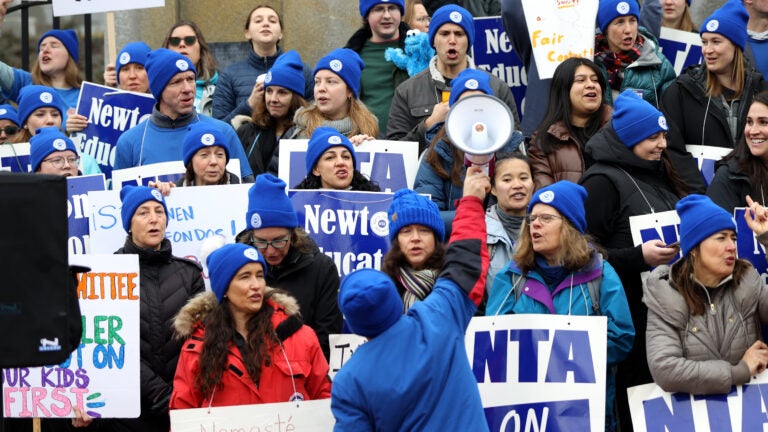
The Massachusetts Teachers Association laid out its priorities for the new legislative session this week, filing a raft of bills that would make changes including legalizing teacher strikes and guaranteeing new minimum salaries for educators.
The union, which has around 117,000 members and affiliates in almost every district in the state, is riding momentum from last year’s successful push to eliminate the practice of using MCAS test scores as high school graduation requirements.
While the MTA has many priorities, the topic of teacher strikes is perhaps the most high-profile. Public employees, including teachers, are barred from striking under state law. But that has not stopped local teacher unions from engaging in work stoppages across Massachusetts in recent years. In November, educators in Beverly, Gloucester, and Marblehead successfully won new contract agreements by forcing school closures that lasted longer than a week. Other teacher strikes have occurred in communities like Brookline, Haverhill, and Newton.
The MTA and some lawmakers have been trying to shepherd legislation that would legalize teacher strikes through the State House for years to no avail. Last session, new legislation was filed that would authorize public employees to strike except for safety personnel like firefighters and police officers. The bill would require six months of good faith negotiations for public employees before a strike. It was refiled this month.
Lawyers hired by school districts during contract negotiations are incentivized to delay as long as possible during bargaining, MTA President Max Page said. The legislation being promoted now would “set the clock ticking” so that resolutions can be reached and strikes can be avoided, he said.
“Having the legal right to strike will get everyone to the table, especially those few districts and their high-priced lawyer who want to outlast our local unions, it’ll force them to the table,” Page told Boston.com.
Another bill looks to establish a $55,000 minimum salary for Education Support Professionals (ESPs) and increases the minimum salary for teachers to $70,000. Many recent strikes were caused, in part, by stalled negotiations over these salaries, Page said, and establishing these wages would prevent future work stoppages.
“It would take a major cause of protracted bargaining and strikes off the tables,” he said.
The MTA is also setting its sights on higher education. Page praised recent efforts that made community college free for Mass. students, but said more needs to be done to expand access to those who want to attend four-year public colleges. A bill backed by the MTA would declare free public higher education as a right for all residents and create a grant to cover the costs of things like room and board and supplies for students.
One bill would make adjunct faculty who teach half-time or more at public colleges eligible for a state pension and health insurance. Page described adjuncts as the “gig workers” of the education system as they often lack job security, insurance options, and wage parity. Due to long-term funding cuts, higher education institutions are now more reliant on adjuncts, and they need to be supported, Page added.
“It’s a really terrible way to build a public higher education system,” he said.
A number of bills look to address what Page calls the “school funding crisis” by reimbursing more districts for transportation, increasing the reimbursement rate for the Special Education Circuit Breaker program, and giving more support to rural districts. The union is also looking to fix a “glitch” in the formula that determines school funding, as it does not allow this funding to keep pace with inflation over time.
“It’s a simple thing. Let’s do what we did before. When inflation rises let’s make it up so that the districts don’t lose out,” Page said.
Another piece of legislation would raise the base on which the annual state pension cost of living adjustment is calculated. The values of pensions for retired teachers rapidly decrease over time, Page said.
“What we say, and it’s kind of a sick joke, is that we have a good pension system for teachers as long as you don’t live too long,” he said.
When asked about President Trump’s stated plans to axe the Department of Education and how the MTA will operate under the new administration, Page said that the MTA recognizes that Trump purposefully stirs “chaos” and that the union must act on tangible actions, not his every utterance.
That being said, the recently-unveiled legislative priorities are meant to be a model for lawmakers and educators around the country during Trump’s term.
“We’re not going to sit quietly and be in a defensive crouch for four years,” Page said.
Get everything you need to know to start your day, delivered right to your inbox every morning.




To comment, please create a screen name in your profile
To comment, please verify your email address
Conversation
This discussion has ended. Please join elsewhere on Boston.com