
Sign up for the Today newsletter
Get everything you need to know to start your day, delivered right to your inbox every morning.
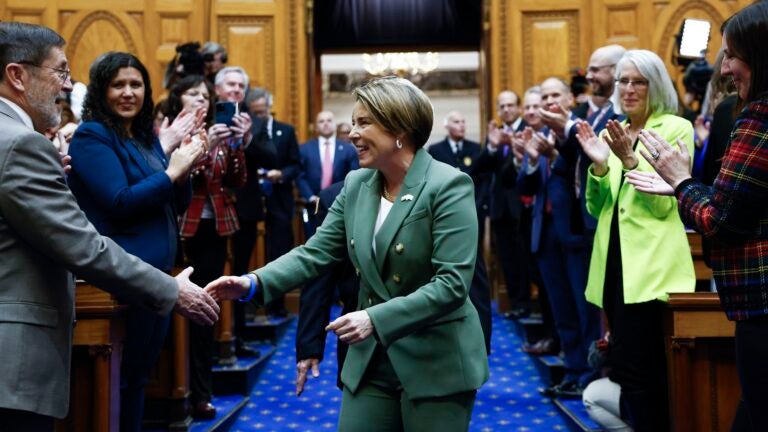
Gov. Maura Healey marked the approximate halfway point of her term Thursday night with a wide-ranging State of the Commonwealth address. Framed in the context of the upcoming 250th anniversary of the start of the Revolutionary War, Healey touted various accomplishments from her first two years in office and laid out ambitious plans to improve transportation, increase affordability, and more.
Healey’s speech can be read in full here.
Here are three key takeaways.
It is no secret that Massachusetts is one of the most expensive places to live in the entire country. Working-age adults are leaving the state in droves, and many young people cite sky-high rent prices as an important factor in their decision to stay or move elsewhere. Healey acknowledged that “too many people were leaving” and cast her administration as one that refused to kick the can down the road and ignore affordability concerns.
She spoke about the $1 billion tax relief package she signed into law in 2023, saying it amounted to the first tax cut in 20 years. It contained what officials called the most generous Child and Family Tax Credit in the country, which will be fully realized this year. Healey highlighted a budget measure that now allows every resident to attend a community college tuition-free.
Healey said her administration “saved” the childcare system in Massachusetts after the pandemic, becoming the only state to “fully replace federal support that went away” with a $1.5 billion investment.
Healey mentions housing affordability in many of her media appearances, and Thursday was no exception. This comes after new data showed that Massachusetts had the third-largest increase in homelessness of any state in 2024. The homeless population increased by 53% here in 2024, according to the U.S. Department of Housing and Urban Development. Healey referenced the Affordable Homes Act, which she signed into law earlier this year. It authorizes $5.16 billion in spending over the next five years to boost housing.
“For decades, we didn’t build enough homes in this state. We’re paying the price for that, now. There’s not enough housing and it’s too expensive. But we’re changing that,” Healey said.
A big component of this discussion is the MBTA Communities Act, which requires cities and towns served by the MBTA to zone for more multi-family housing. So far, 116 of 177 communities are in compliance. Despite resistance from some communities, the administration is all-in on enforcing the law.
Healey took a moment to speak directly to renters, who were found to be far more “cost-burdended” than homeowners in Greater Boston. Healey is calling for the abolishment of tenant-paid broker fees, which frequently result in renters paying the equivalent of a month’s rent for a service they “didn’t even ask for” when moving into a new apartment.
While extolling the state’s status as “America’s healthcare leader,” Healey spoke about plans to “shift healthcare resources to the front lines” to increase the number of primary care physicians in Massachusetts. A PCP shortage has been linked to longer wait times, racial disparities, and overall poorer outcomes for patients.
Healey praised the work of MBTA General Manager Phil Eng, who Healey appointed to oversee the beleaguered transit system in 2023. Through Eng’s leadership, and with the help of 1,500 new employees, the MBTA successfully met its goal of eliminating all slow zones by the end of 2024.
The T is now running at “full speed” for the first time in 20 years, Healey said. It has had its biggest workforce since 1999 and ridership numbers are showing signs of improvement.
“In Phil we trust!” Healey said.
Healey said transportation is improving across Massachusetts. Healey spoke about the $30 million in grants her administration announced in October for 13 of 15 Regional Transit Authorities to allow them to provide fare-free service.
She also said that, for the first time in 70 years, commuter rail service will connect Taunton, Fall River, and New Bedford to Boston through the South Coast rail project.
Healey said that her administration has made a concerted effort to win transportation funding from the federal government. Massachusetts moved from 34th place to 7th place nationwide in “transportation dollars alone,” she said. Some of this money is being used to improve Union Station in Springfield and the tracks between Springfield and Worcester, projects Healey called “the next steps forward on West-East Rail.”
The state also got nearly $1 billion to replace the Sagamore Bridge.
Recently, Healey has been receiving criticism for her handling of the state’s overburdened emergency shelter system. Amid high housing prices and a surge of immigrants coming to Massachusetts, the system has been at capacity for more than a year.
Healey vowed to prioritize transparency when taking office, but it took multiple records requests from The Boston Globe and others for the state to release records of more than 1,000 serious incidents at state-run shelters. This included more than a dozen alleged sex offenses.
The arrest of an undocumented immigrant who was allegedly found with 10 pounds of fentanyl and an assault rifle at a Revere hotel that was operating as a state-run emergency shelter prompted Healey to order a full inspection of the shelter system. Healey then acknowledged that full criminal background checks were not conducted on all emergency shelter residents despite her orders last year.
The administration is working to phase out the use of hotels and motels as shelters, something Healey reiterated Thursday.
Earlier this week, Healey proposed major changes to the state’s right-to-shelter law. New residency requirements would effectively bar newly-arrived migrants from shelter.
“I want to be absolutely clear: We are dramatically reducing costs; and we have, and will, prioritize Massachusetts families,” the governor said.
Throughout the shelter crisis, Healey has repeatedly pinned the blame on the federal government. On Thursday she again said that the federal government needs to “fix this at the source by passing a border security bill.” While violent criminals need to be deported, Healey said that “immigrant families who have lived here, have children here, have jobs and pay taxes here, need and deserve a path forward.”
Get everything you need to know to start your day, delivered right to your inbox every morning.




To comment, please create a screen name in your profile
To comment, please verify your email address
Conversation
This discussion has ended. Please join elsewhere on Boston.com