
Sign up for the Today newsletter
Get everything you need to know to start your day, delivered right to your inbox every morning.
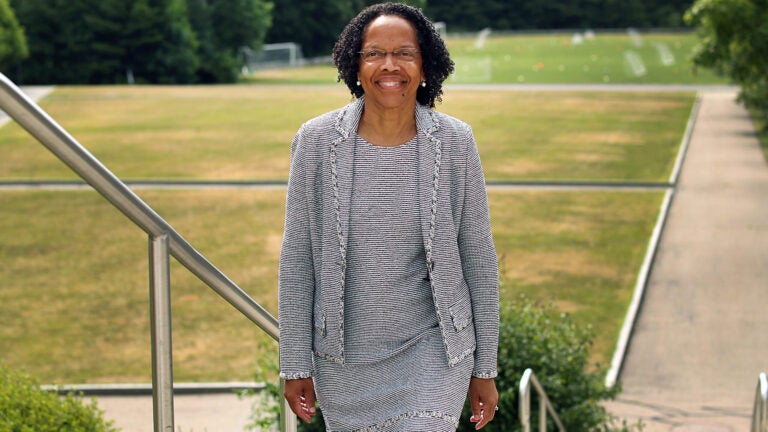
Amid financial challenges that have forced the school to change its merit scholarships, Olin College of Engineering announced its president Dr. Gilda Barabino will resign at the end of the academic year.
The college, in Needham, is a small, highly regarded engineering school founded in 1997.
Barabino is only the second president in its history, and the first Black and first female leader to run it. She was the first African American student in Rice University’s graduate chemical engineering program and the fifth Black woman to receive a PhD in chemical engineering in the country when she did so in 1986.
Under her leadership, through an initiative called “Engineering for Everyone,” Olin College has increased the number of women and people of color among both faculty and students. Of the 115 students who started at Olin this fall in the Class of 2028, 35% were women and 4% were genderqueer. Forty-two percent are students of color and 15% are underrepresented students of color. A quarter are Pell eligible, and 11% are first-generation college students.
Since she assumed the role of president in 2020, Olin College has also risen in the US News and World Report rankings from the No. 3 to the No. 2 undergraduate engineering college, after Rose-Hulman Institute of Technology in Indiana.
But Olin is facing financial trouble that has forced it to change one of its most unique qualities: instead of automatically covering half of every student’s tuition, it will now only contribute $10,000 annually.
When Olin welcomed its first freshman class in 2002, every student’s tuition was free, thanks to an endowment largely funded by industrialist Franklin W. Olin in support of the college’s mission to innovate the way engineering is taught. After the 2008 financial crisis, Olin changed its contribution from 100% to 50% of tuition for all students, and in an email to alumni this July, Barabino announced that moving forward, it would only be able to contribute $10,000 to each student’s education.
“Even with this change in our tuition model, Olin will remain among the most affordable and accessible engineering programs among our peers,” said the email, obtained by Boston.com and signed by Barabino and Chair of the Board of Trustees Jeannie Diefenderfer.
All students will continue to automatically receive the merit scholarship, meant to be a “tangible recognition of … academic achievements,” but starting with the Class of 2030, it will be for $10,000 per year. Currently, the 50% merit scholarship is valued at $29,986 per year, according to the email to alumni.
Draws from the college’s $421 million endowment have been “significantly higher than industry averages,” said Barabino and Diefenderfer.
“Our endowment draw — currently budgeted at 5.8% per year — is not sustainable,” they wrote in the email. “A high draw rate, compounded by inflationary pressures and the need to have conservatism in our investment strategy because of our endowment dependency, creates a scenario where our endowment’s purchasing power is struggling to keep pace.”
The college reported its net operating losses at around $4 million. After operational changes including debt renegotiations and student revenue rate and enrollment increases, a committee of trustees, college leadership, and faculty worked for five months with industry experts to arrive at the decision to change the merit scholarship.
“This committee informed the new merit scholarship structure that would allow us to support all Olin students while maintaining our commitment to meet full need,” the email said.
Though this change will go into effect in fall 2026, when the Class of 2030 starts at Olin College, a spokesperson for the college confirmed students who are already enrolled at that time — the Classes of 2029, 2028, and 2027 — will continue to have 50% of their tuition coverage met through the merit scholarship.
Between 2014 and 2022, two dozen colleges and universities in Massachusetts have closed, begun to wind down operations, or merged with other institutions, according to the Massachusetts Department of Higher Education. Eastern Nazarene College in Quincy announced in June it would close after 125 years due to ongoing financial hardship, and Bard’s College at Simon’s Rock in Great Barrington said in November it would close amid declining enrollment.
An accreditor from ABET, which accredits Olin’s engineering programs, also found issues with Olin’s “Program Goals” and “Learning Objectives” during a routine visit last September, but the spokesperson said they expect these problems to be resolved.
“From our perspective we really do not have any accreditation concerns,” the spokesperson said, adding that both Olin and the ABET evaluators “believe we will be able to resolve the three issues that were identified before their May 31 deadline.”
As long as it does, Olin will be granted a full six-year accreditation.
Barabino announced her resignation in an email to Olin faculty, staff, and students in November. She said she would join the faculty and “focus my efforts to effect social change through engineering and higher education more broadly.”
The search for a new president, led by the Board of Trustees’ Vice Chair Bruce Herring, is underway.
Get everything you need to know to start your day, delivered right to your inbox every morning.





To comment, please create a screen name in your profile
To comment, please verify your email address
Conversation
This discussion has ended. Please join elsewhere on Boston.com