

Sign up for the Today newsletter
Get everything you need to know to start your day, delivered right to your inbox every morning.
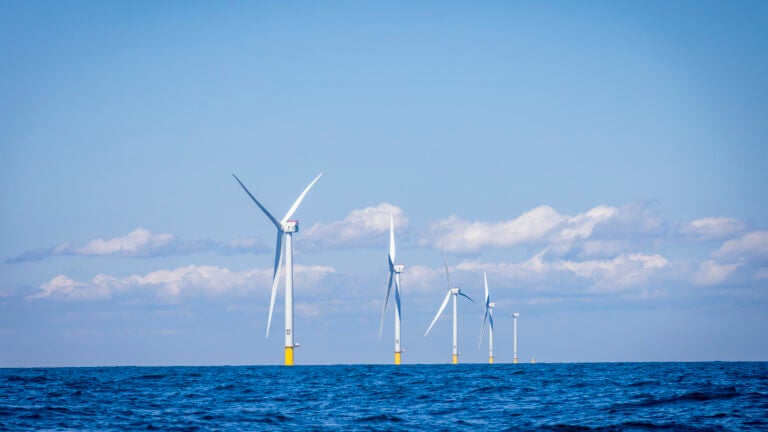
Deep into President-elect Donald Trump’s press conference last week, he mentioned Massachusetts and, specifically, the potential for offshore wind to negatively impact whales.
“The windmills are driving the whales crazy, obviously,” Trump said.
It is not the first time Trump has used his purported concern for whale safety as a way to attack offshore wind development. There are no known links between large whale deaths and ongoing offshore wind activities, according to NOAA.
Whales, specifically humpbacks and North Atlantic right whales, are dying at an alarming rate along the East Coast. And while there are some legitimate worries about how offshore wind could impact marine mammals, experts agree that vessel strikes and fishing gear entanglements pose a far greater threat, according to Jessica Redfern, the associate vice president of ocean conservation science at the New England Aquarium.
“As someone who studied large whales for my multi-decade career and who also, as a person, just really cares deeply about them … the focus for protecting whales really has to be on reducing entanglements and vessel strikes,” she told Boston.com.
While it is unclear what Trump specifically meant by insisting that windmills make whales “crazy,” he appears to be referring to concerns over how whales react to the sound generated by offshore wind development. Underwater sound can be generated before, during, and after the construction of offshore wind turbines.
Before construction, developers survey the ocean floor and produce noise that could disturb some marine mammals, according to NOAA. But there is no scientific evidence linking whale deaths to the noise from these surveys. The sounds generated during this process are often imperceptible to baleen whales like humpbacks and right whales, Redfern said.
The greatest risk of acoustic impact on whales comes during the construction phase, especially when a method known as pile driving is used to embed wind turbine foundations in the ocean floor. This can emit loud sounds that travel for long distances. Marine mammals nearby could experience temporary or permanent hearing damage, Redfern said. Even farther away, these noises could increase stress in animals and disrupt their regular patterns of feeding, socializing, and nursing. The animals could also be driven to leave the area temporarily or permanently.
Redfern and other colleagues from the New England Aquarium have been researching the waters off of Massachusetts and Rhode Island for more than 10 years as the Vineyard Wind project progressed.
Vineyard Wind began delivering energy from five of its planned 63 wind turbines last year. A blade broke off from one of those turbines last summer, prompting the wind farm to shut down for months.
After construction of a wind turbine is complete, there is some sound produced by operating turbines. But it is unlikely that this would reach levels that could harm whales, Redfern said.
What’s more important is how the movement of ships changes after a turbine is up and running. Vessels will invariably need to go out to the turbines to service them, and fishing boats could be drawn to new waters. This could increase the risk of vessel strikes.
Vessels large and small can kill whales. Endangered North Atlantic right whales are vulnerable because their habitat and migration routes often come close to major ports and shipping lanes, according to NOAA. Redfern has testified before Congress multiple times to advocate for proposed speed restrictions along the East Coast that she said would reduce the risk of vessel strikes.
Vessel strikes and entanglements are much greater threats to whale populations than undersea noises from wind turbines. Less than a month ago, two right whales were spotted entangled in fishing gear southeast of Nantucket. One, a juvenile, was likely to die as a result.
Gib Brogan, a campaign director with the international ocean advocacy group Oceana, decried the discourse surrounding offshore wind that Trump and his allies perpetuate.
“If these groups and individuals that are so intent on protecting the whales were truly committed to whale conservation, they would be lined up to help reduce the risks of entanglement and vessel strikes. But it seems that their interest in whale conservation begins and ends with fighting offshore wind,” he told Boston.com.
Both Brogan and Redfern said that offshore wind should not be abandoned.
“We need to minimize the effects of climate change as fast as we can. And offshore wind is one of our tools as long as it is responsibly developed,” Redfern said.
Get everything you need to know to start your day, delivered right to your inbox every morning.





To comment, please create a screen name in your profile
To comment, please verify your email address
Conversation
This discussion has ended. Please join elsewhere on Boston.com