
Sign up for the Today newsletter
Get everything you need to know to start your day, delivered right to your inbox every morning.
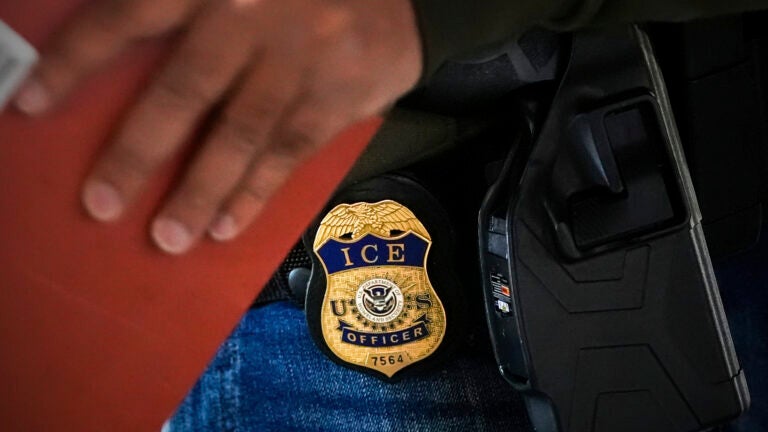
A large discrepancy exists between the number of immigration detainer requests the Boston Police Department said it received from U.S. Immigration and Customs Enforcement (ICE) in 2024 versus the number of detainers the federal government said it lodged with the BPD.
Boston Police Commissioner Michael Cox said recently that his department received, and did not act on, 15 civil immigration detainer requests from ICE in 2024. But an ICE spokesperson told Boston.com Thursday that the agency actually issued detainer requests for 198 people last year.
The reason for the two vastly different figures is unclear. Spokespeople for the BPD and Mayor Michelle Wu’s office did not return requests for comment Thursday.
“ERO issued each of the 198 detainers after the Boston Police Department arrested individuals on criminal charges who ICE had probable cause to believe were removable non-citizens,” ICE spokesperson Yolanda Choates said in a statement.
The news comes as President-elect Donald Trump prepares to move back into the White House and oversee what he promises will be the largest mass deportation effort in American history.
Mass deportation plans will likely lean heavily on the cooperation of local law enforcement officials. But some cities, like Boston, have laws on the books that limit how much local police can help ICE agents.
The Boston Trust Act delineates between two ICE divisions — Enforcement and Removal Operations (ERO) and Homeland Security Investigations (HSI) — and how BPD can interact with each. Local police can collaborate with ICE-HSI “on issues of significant public safety” like human trafficking, drug trafficking, child exploitation, and cybercrimes. But BPD cannot involve itself in civil immigration enforcement.
ICE regularly lodges detainer requests with local law enforcement agencies when it has identified a “removable noncitizen” in the custody of local police. Detainer requests ask local police to hold the noncitizen for up to an additional 48 hours and notify ICE as early as possible before the noncitizen is set to be released. The idea is to keep the person detained long enough for ICE to take custody of them.
Compliance with ICE detainers is not mandatory, and local law enforcement has to choose whether or not to cooperate. Most ICE detainers are not supported by probable cause, according to ACLU Massachusetts. In 2017, a federal court of appeals actually ruled that the Fourth Amendment requires detainers be supported by probable cause. Law enforcement agencies that hold people on unconstitutional detainers can be found liable.
The Boston Trust Act was originally enacted in 2014 and amended in 2019. Last month, City Council unanimously reaffirmed its support for the ordinance in anticipation of Trump’s incoming administration.
Cox must report annual statistics on the number of detainer requests made by ICE to the BPD. The 2024 data was contained in a letter Cox sent to the city clerk on Dec. 31. It was filed with the City Council this week and referred to the Committee on Public Safety and Criminal Justice during Wednesday’s meeting.
Cox gave minimal information on the 15 detainer requests he said were lodged with the BPD in 2024. The letter only included the dates of the requests and the districts where they were sent. The BPD receives the requests via fax, and the department “does not maintain a separate database of requests received to ensure continued compliance with the Boston Trust Act,” Cox wrote.
The reason given for each of the requests was that the Department of Homeland Security had “determined probable cause exists that the subject is a removable alien,” according to the letter. All of the 15 requests were not acted upon, per the Boston Trust Act. The letter does not include information on how many times, if any, the BPD did cooperate with ICE to detain suspected undocumented immigrants wanted for serious crime.
The 198 detainers that ICE said it issued were regarding people who had been arrested by BPD for engaging in “egregious criminal activity,” Choates said. This included armed robbery, assault with a dangerous weapon, assault and battery on a police officer, possession of a firearm, possession of a large capacity weapon, assault to murder, distribution of fentanyl, trafficking of heroin, indecent assault and battery on a person 14 or older, possession with intent to distribute fentanyl, possession with intent to distribute cocaine, and trafficking over 200 grams of cocaine, she said.
ICE had probable cause to believe that they were removable noncitizens. None of those 198 detainers were honored by BPD, according to Choates.
Proponents of the Boston Trust Act, like Mayor Michelle Wu, say that the ordinance increases public safety and community trust by ensuring immigrants can engage with local law enforcement without fear of deportation.
Choates said laws like the Boston Trust Act actually decrease public safety.
“Laws forcing municipal and state employees to ignore ICE requests for assistance do not protect the law-abiding community members,” she said. “The decision not to cooperate with ICE jeopardizes public safety and national security by thwarting ICE custody in a safe and secure environment. Instead, non-cooperation laws allow suspected and convicted felons, with no legal basis to remain in the United States, to integrate into our communities where ERO officers must then track them and attempt a public apprehension.”
In the wake of Trump’s electoral victory, Wu explicitly said that the BPD will not be required or expected to participate in mass deportations of residents who have not been part of serious criminal activity. That set off a back-and-forth with Trump’s incoming “border czar” Tom Homan, who insulted Wu’s intelligence and warned her to either help ICE or get “the hell out of the way.”
Cox, who has been in lockstep with Wu since she appointed him in 2022, wrote in the letter that the BPD is committed to upholding the Boston Trust Act.
“The Boston Police Department remains committed to complying with the Boston Trust Act and to building and strengthening relationships and trust with all our communities,” Cox wrote. “Boston’s immigrant communities should feel safe in reporting crime and quality of life issues to the Department and in proactively engaging with all members of the Boston Police Department.”
Get everything you need to know to start your day, delivered right to your inbox every morning.





To comment, please create a screen name in your profile
To comment, please verify your email address
Conversation
This discussion has ended. Please join elsewhere on Boston.com