
Sign up for the Today newsletter
Get everything you need to know to start your day, delivered right to your inbox every morning.
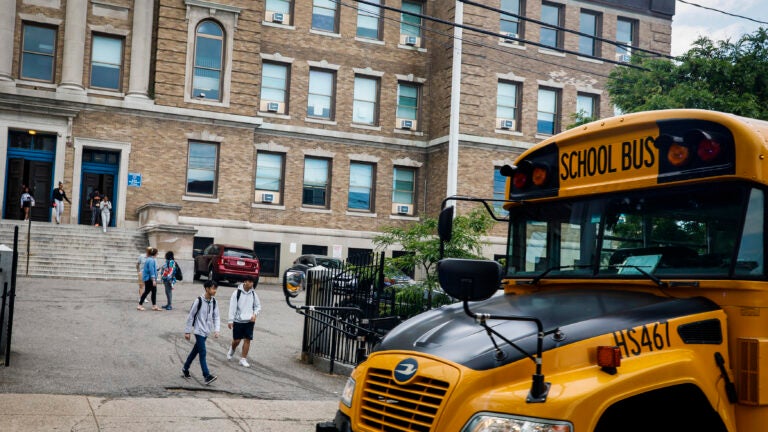
Boston Mayor Michelle Wu and Superintendent Mary Skipper announced Tuesday that they plan to pursue a series of school closures and reconfigurations across the Boston Public Schools system that would largely go into effect at the end of the 2025-26 school year.
Officials want to close Dever Elementary School, Excel High School, and the Mary Lyon Pilot High School. They want to merge the Winthrop and Clap elementary schools, and substantially redesign the Community Academy. Finally, they want to reconfigure the Mary Lyon K-8 School, the Boston Teachers Union Pilot School, the Young Achievers Science and Math Pilot School, and the Dearborn STEM Academy.
Students and their families were notified about the proposed changes Monday night. Wu and Skipper detailed the specifics during a media availability Tuesday morning. The changes are part of the larger implementation of the district’s Long-Term Facilities Plan.
That plan, finalized in late 2023, envisions a future where there are fewer BPS schools in total. Instead, officials would focus on supporting large schools with more diverse offerings.
The closures still need School Committee approval. The administration will officially present these proposals to the School Committee on Jan. 22.
The proposals are the result of an intensive community feedback process and are the best way to make sure BPS students have access to high-quality learning environments, Wu said.
“I know, as a BPS mom and mayor, the magic that is happening in every single one of our classrooms across the district everyday,” she said. “But I also have seen far too often that that is happening thanks to our educators and our students and families despite the condition of the buildings that they are in.”
These changes are a reflection of a mindset Skipper has sought to amplify since taking over as the head of BPS: that of a unified school district.
“We are one district,” she said. “While it is true schools all have different cultures and climates and foci, at day’s end we’re one district. What happens in one school impacts other schools. This is an opportunity … to be there for any of the students, families, or staff who are impacted by the changes that are being recommended.”
Excel High School, a smaller school housed within the former South Boston High School building, had only 387 students last year, according to state data. This “dwindling” enrollment, as Skipper called it, trended down over the past decade or so from a peak of 660 students in 2011-12.
It takes up about a third of the South Boston High building, which the city wants to renovate and eventually use to house an “anchor” high school.
Dever Elementary has been under state receivership since 2013. Located next to Ruth Batson Academy, the Dever has a “very fractured walk zone,” Skipper said. Officials believe they can get Dever students into higher-quality seats at schools closer to home.
The city is working to secure funding from the Massachusetts School Building Authority to develop a “state of the art” complex for Ruth Batson Academy. The building that houses the Dever school will be needed to facilitate the eventual overhaul of Ruth Batson, Skipper said.
There are two Mary Lyon schools in Allston-Brighton, one K-8 school and another high school. District officials want to close the upper school, which serves grades 9-12, and create additional capacity for the lower Mary Lyon school to take on more students. This could involve moving the lower Mary Lyon school into the larger building that currently houses the Mary Lyon upper school.
The final proposed closure would be Community Academy in Jamaica Plain. Officials want to close it as a degree-granting school. It would be redesigned to support students that need a “temporary code-of-conduct placement” and for those who are transitioning into BPS schools from the Department of Youth Services, long hospitalizations, or for others who need extra “wraparound” services.
The city’s last standalone middle school, the Lilla G. Frederick Pilot Middle School, is closing at the end of this school year. Officials are recommending that the Winthrop and Clap elementary schools merge and move into the Frederick building.
One throughline throughout the proposed changes is an emphasis on dividing BPS students into two distinct groups: from pre-K through 6th grade and another from 7th through 12th grade. While this divide will not be applicable in every situation throughout the district, the baseline expectation should be that students only have to withstand one disruptive transition: between 6th and 7th grade.
As such, Skipper announced that several schools are switching from a pre-K through 8th grade model to a pre-K through 6th grade model. Young Achievers Science and Math Pilot School, the BTU Pilot School, and the Mary Lyon lower school would all be undergoing that transition. The Dearborn STEM Academy would be reconfigured into a school that serves grades 7 through 12. The School Committee voted to adopt this grade reconfiguration strategy in 2019, and as such these changes do not require School Committee approval.
There are currently 119 schools in the BPS system, many of which are aging and in need of significant upgrades, according to the district. Only about one third of BPS schools have comprehensive heating, cooling, and ventilation systems. Only about 14% of BPS facilities were found to fully support a “holistic high-quality student experience.”
The Facilities Plan and its vision of school mergers comes after the “small schools movement” of the ’90s. The district converted four large high schools, including South Boston High, into 13 smaller new schools in 2003. This resulted in a patchwork system where notable disparities in the opportunities available to students abound, the Globe previously reported.
Each school being recommended for closure had subpar “building experience” scores from district officials. They all also could not offer a full continuum of services for students with
disabilities and multilingual learners. Finally, all the buildings themselves are being under-utilized by the current levels of students and staff.
In its response, the Boston Teachers Union called on BPS officials to ensure any school closures are paired with a “more aggressive and detailed commitment to the construction and renovation” of new and improved buildings. Specifically, the union said the district should commit to completing the construction of three buildings annually and share a plan to do so with the public in the coming weeks.
“The conversation cannot be simply about whether to retain or close poorly crumbling and dilapidated buildings – the conversation must be about how soon the district can complete the construction and renovations necessary to provide high-quality learning environments for every single BPS student, without exception,” the BTU said.
Some elected officials are expressing concern about the availability of information on the proposed changes. In a statement, City Councilor Erin Murphy said she was “deeply frustrated by the lack of communication” from BPS officials.
“I reached out today to Superintendent Skipper and other BPS officials after hearing rumors about potential closures of several schools, yet my questions were ignored. It’s unacceptable that I, along with families, had to wait for official confirmation while decisions were being made behind closed doors,” Murphy said Monday.
City Councilor Brian Worrell said in a statement that his “heart goes out” to all the families being affected by the closures, and that there is “no right way to close a school.” But Worrell supports adhering to a long-term plan that takes into consideration the needs and resources of the district.
“With declining enrollment, BPS needs to right-size to ensure every student is in a high-quality learning environment, and I am committed to working to ensure that those decisions are equitable, and students and families are supported in the transition,” he said.
City Councilor Ed Flynn called the closing of Excel High a “huge loss,” and also blasted BPS leaders and the Wu administration for a lack of communication.
“This is a tragic loss for the many families with graduates from both South Boston High School and Excel High School, as well as the community at large,” Flynn said in a statement. “It is imperative for Boston Public Schools and the city to provide clear information to the school community on their plan moving forward, while also exercising transparency with the people of South Boston regarding the future of the building.”
Get everything you need to know to start your day, delivered right to your inbox every morning.





To comment, please create a screen name in your profile
To comment, please verify your email address
Conversation
This discussion has ended. Please join elsewhere on Boston.com