
Sign up for the Today newsletter
Get everything you need to know to start your day, delivered right to your inbox every morning.
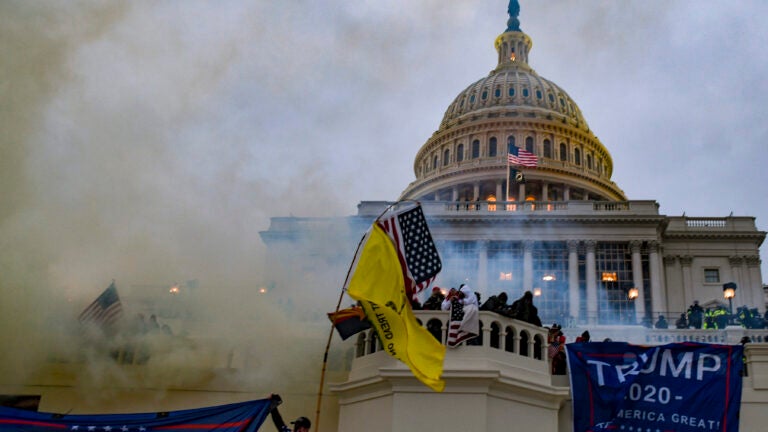
Earlier this month, the state Civil Service Commission vacated the termination of a Boston police officer who was fired for posting tweets in support of Donald Trump while in Washington, D.C. for the Jan. 6, 2021 “Stop the Steal” rally.
The commission concluded that officer Joseph Abasciano did not engage in misconduct on Jan. 6, and that there was no just cause for his termination. Two internal BPD investigations in 2021 determined that Abasciano did not violate the department’s rules. But in 2022, new BPD leadership reopened Abasciano’s file and came to a drastically different conclusion: that he should be fired for “conduct unbecoming.”
In its recent decision, the commission favored the two earlier investigations. The third review is “far less thorough, more subjective, exudes a tinge of being result-driven and fails to sufficiently explain how the two starkly different conclusions can be reconciled,” Commissioner Paul Stein wrote.
The commission, therefore, allowed Abasciano to appeal his termination. The specifics of what this means for him will be determined at a later date. “The scope of the relief, if any, financial or otherwise” must be adjudicated “in another forum with authority to interpret and enforce the applicable provisions” of the laws involved, Stein wrote.
Abasciano, an Iraq War veteran who joined the BPD in 2007, was spoken of highly by colleagues and had no prior disciplinary issues. He accumulated several notable injuries during his time as a Boston police officer, and in July 2020 he began using his sick leave. He was approved of continuous leave through Jan. 23, 2021, according to the report. He attended the Jan. 6 rally while on leave, with another off-duty officer. They attended Trump’s speech, but did not participate in the riot at the Capitol.
In writing the decision, Stein specifically stated that the Commission does not “overlook the fact that most citizens, including members of this Commission, rightly reject the Appellant’s misinformed opinions contained in his tweets about the 2020 election and its aftermath.”
“This decision should not be construed to condone or turn a blind eye to the unconscionable criminal acts committed by those who stormed the Capitol on January 6, 2021,” Stein wrote later in the report.
In one tweet, Abasciano replied to a post from Georgia Secretary of State Chief Operating Officer Gabriel Sterling, writing “I can’t wait to see you dragged away in handcuffs.” In another tweet from Jan. 6, Abasciano wrote “today there will be only two parties in America. Traitors and Patriots!” per the report.
The tweets were posted from an account Abasciano kept anonymous. He later told investigators that he was targeted by harassment and vandalism at his home in the past due to his support for Trump during the 2020 election. Abasciano had shut down his Facebook account, but kept using his Twitter account because he believed its anonymity was secure, according to the report.
After Trump finished speaking that day, Abasciano and the other officer slowly began walking to the Capitol. It reportedly took more than an hour to reach a grassy area near the Capitol, and by that time a mob had already broken into the building. They observed the attack on the Capitol from afar, and never crossed any barricades or lines, the reported noted. After seeing some of the violence, they drove back to Boston.
Abasciano’s link to the anonymous twitter account was revealed by another BPD officer who was not on good terms with Abasciano, he told investigators. The two 2021 investigations were then initiated, one from the BPD’s Anti-Corruption Division (ACD) and another from the department’s Internal Affairs Division (IAD). The former determined Abasciano did not personally participate in the Capitol attack or commit any criminal acts, while the latter concluded that Abasciano’s tweets were not intended to incite or condone violence and that they did not impact his ability to do his job.
Mayor Michelle Wu appointed Police Commissioner Michael Cox in the summer of 2022. About a month after being sworn in, Cox assigned a new head of IAD and directed them to review several files that needed a decision by Cox. Abasciano’s file was the largest, according to the report.
By December, Cox received a “non-concurrance” letter from the IAD that accused Abasciano of misconduct. BPD officials determined that Abasciano’s tweets negatively impacted the department and actually did warrant disciplinary action. So Cox sent a letter to Abasciano in March 2023 informing him that his termination was effective immediately.
At a commission hearing after Abasciano’s firing, Boston police Captain Sean Martin answered questions about Abasciano, who he had supervised for about five years. Martin said he knew Abasciano to hold “very conservative” political views, but that this never led to bias in his policing.
“Basically, these tweets . . . are extremely, extremely passionate about politics. He is very emotional, but looking at these, I don’t see how, given my history, my experience, and the time I supervised and worked with Joe, I don’t see how this – I have never seen this impact his ability to do his job or how he treated anybody,” Martin said when asked about Abasciano’s Jan. 6 tweets, per the report.
Ultimately, the commission concluded that Abasciano’s tweets were constitutionally-protected instances of private free speech and that they could not be sanctioned as “conduct unbecoming.” The commission found multiple issues with the 2022 findings, and said that the preponderance of evidence supports the 2021 findings.
“In sum, the decision in this appeal comes down to choosing between conflicting reports, with starkly different conclusions, completed by the same Department at different times,” Stein wrote. “Ultimately, the BPD’s 2021 ACD and IAD reports were more thorough, more objective and more reflective of the actual facts associated with the Appellant’s actions on January 6, 2021.”
Get everything you need to know to start your day, delivered right to your inbox every morning.


To comment, please create a screen name in your profile
To comment, please verify your email address
Conversation
This discussion has ended. Please join elsewhere on Boston.com