
Need weekend plans?
The best things to do around the city, delivered to your inbox.
Katie Flagg moved to Vermont when she was 18 to attend Middlebury College and fell in love at first sight — with the state. But after she graduated and moved to a farmhouse in the middle of rural Addison County, she had a sudden pang of doubt: Would she live there alone forever?
It was 2008. Dating sites were still a bit taboo, and she wasn’t sure how else to meet people in a place where there were not many people around.
So she turned to a publication that many Vermonters have long turned to when they were looking for love: Seven Days, an alternative weekly that is one of the last bastions of newspaper personal ads.
For decades, the ads have been reliably quirky, surprisingly effective and, well, very Vermont. Nowadays, Seven Days has a thriving online personals section to go with the print version. In a recent entry, one man in his 70s boasted of his several hundred maple sugar taps.
Flagg’s online profile in the Seven Days personals section featured a photo of her in sunglasses and a “faux hawk.” It caught the attention of Colin Davis, whose username on the site was “patternlanguage.”
That piqued Flagg’s interest. “A Pattern Language: Towns, Buildings, Construction,” a 1977 book on design that has a cult following, was one of her favorites. She also spied a Middlebury College landmark in the background of one of his photos.
“This isn’t the big scary internet,” Flagg, 38, remembered thinking. “This is an online version of the small town I live in.”

On their first date, she discovered they had many overlapping friends and had studied under the some of the same professors at Middlebury. About three years later, they were married.
Seven Days’ personals section was born shortly after Seven Days. In 1995, Paula Routly and Pamela Polston, two Vermont reporters — Polston was also a lead singer in a Burlington punk band — borrowed $68,000 to start an arts-focused alternative weekly. Across the country, weeklies like The Village Voice and The New Haven Advocate were thriving, and bohemian-ish journalists didn’t need much money to start their own publications.
From the 1970s through the mid-’90s, personal ads were a staple of these new papers — not least because they helped bring in revenue. In the print-only era of Seven Days Personals, Vermont singles could place the first 25 words of an ad for free, but had to pay per word after that. Those who wanted to get in touch with potential matches had to call a Seven Days hotline at a rate of $1.99 per minute or send the paper $5 sealed in an envelope with a letter for the staff to forward to the recipient.
But many independent weeklies started to fold in the early 2000s, shuttering their personal ads sections along with them. As dating apps boomed, many surviving alt-weeklies ended personal ads, too.
Recently, Routly posed a question to a listserv of alt-weekly publishers: Is anyone still doing personals? “You find you can still make money doing that?” was the only response she received.
In an interview, Routly said the personal ads fit in with the paper’s larger mission.
“One of the reasons we’ve survived is that we have a real community in a geographical place, not people sitting in their basement,” Routly said, adding: “We consider it a public service.”
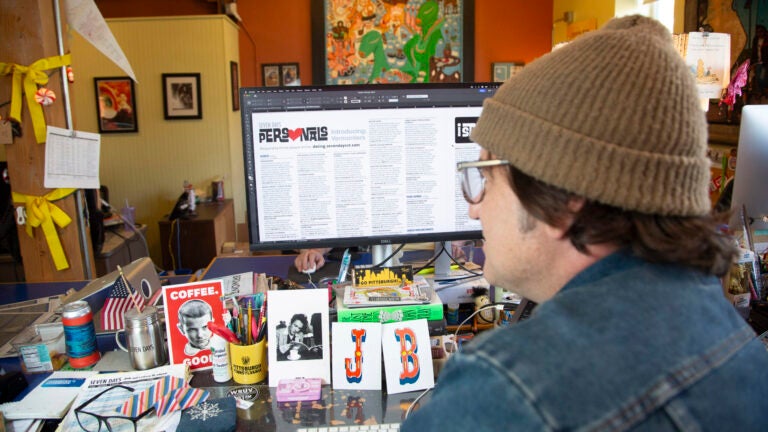
For the last 28 years, the Seven Days offices have occupied part of a warehouse in the South End of Burlington, where its neighbors include an acupuncturist and the wholesaler Vermont Wine Merchants. From a standing desk, Jeff Baron, an audio producer who started at the paper’s circulation desk in 2013, vets each personal ad application one at a time.
“It’s all just me,” said Baron, who lives with his cat, Frenchy, in nearby Winooski.

The first thing he looks for? Whether or not an applicant actually lives in Vermont.
“If it says Philadelphia, well, we’re sorry,” he said. (People in towns along the borders Vermont shares with New York and New Hampshire qualify as honorary citizens, as long as they’re in the paper’s circulation radius.)
These personals offer a new-old way of approaching dating — farmers market rather than meat market. In a landscape of dating app fatigue and romance scams, with real-life meet-ups (think running clubs or literary speed dating) on the rise, the anachronistic-seeming personals section can look like the way of the dating future: a community hub for people to gossip with neighbors, rather than an algorithmically optimized matchmaking service.
A few other niche publications, like alumni magazines, still maintain outlets for love seekers in the classifieds. The New York Review of Books has been publishing personals since 1968, beginning with an ad that ran: “WIFE WANTED. Intelligent, beautiful, 18 to 25, broad-minded, sensitive, affectionate. For accomplished artist and exciting life.” In a recent ad, an “abandoned poetess” was seeking a mate.
But few personal sections are as popular as the one that appears in Seven Days. The publication’s readers enjoy reading the ads, even if they aren’t looking for love themselves. At a local senior citizens home, where Routly’s partner once worked, the residents “looked forward to Wednesday in anticipation of reading our personal ads,” she said.
That’s partly because of the ads’ distinctive tone: eager, eclectic and earnest, with more than a dash of quirk and the occasional soupçon of kink. It established itself almost immediately. One post from January 1996 reads: “OYEZ, OYEZ. I like olives, opera, Oprah, omphalous, ovulation, osculation, Orioles and Ouija. Looking for an oasis among oafs.”


Though users run the gamut demographically, from age 18 to 80-plus, the personals tends to skew a little older — perhaps because Vermont, with a median age of 43.2 in 2023, is the third-oldest state in the country. One day, Routly recalled, an older woman stopped in at the Seven Days office to say that “she had met the love of her life through our personals and was about to drive off, in an RV, into the sunset with him.”
The Seven Days online personals section includes an “I Spy Message Board,” where readers post descriptions of people they have spotted in the wild, in the hope of meeting them in person after having seen them from afar.
“My theory is that Vermont is big enough that you might have an encounter with someone and not know who they are, but it’s small enough so other people will recognize who this person is,” Routly said. “True anonymity is impossible.”
Kiley Bourdeau, 33, said she grew up reading the I Spy section every week.
“Everybody wants to be seen in those I Spies,” said Bourdeau, who lives in Chittenden County, the state’s most populous area. “I was working with somebody, and they had been I Spied, and it was like, ‘Oh, my God! Somebody noticed me while I was in line at the grocery store.’”
Bourdeau met her partner, Colin McIntosh, in person at a local bar, but Seven Days Personals has played an important role in their story as a couple. One Wednesday, Bourdeau opened her issue of Seven Days and flipped to the I-Spy section to find the heading “Cute Pug Lady.”
Bourdeau, who loves pugs, read on and realized it was her. The entry ended: “Me: Mr. You: Mrs.” The couple had the notice framed, and placed copies on every table at their wedding in June.

Almost everyone who makes a connection through Seven Days has made a commitment to Vermont before committing to their date.
“We’re both transplants,” said Davis, Flagg’s husband, who is originally from South Dakota. “It’s a very Vermont-y way to meet.”
These days, the couple lives in Shoreham, a town on the shore of Lake Champlain, where Flagg is the president of Press Forward, a communications firm for outdoors and active brands in the state, and Davis, 43, runs Shacksbury Cider, a cider maker that he co-founded in 2013.
“There’s a permanence to the Seven Days personals,” Flagg said. “It’s for people who are making a life here in Vermont.”
This article originally appeared in The New York Times.
The best things to do around the city, delivered to your inbox.



To comment, please create a screen name in your profile
To comment, please verify your email address
Conversation
This discussion has ended. Please join elsewhere on Boston.com