
Sign up for the Today newsletter
Get everything you need to know to start your day, delivered right to your inbox every morning.
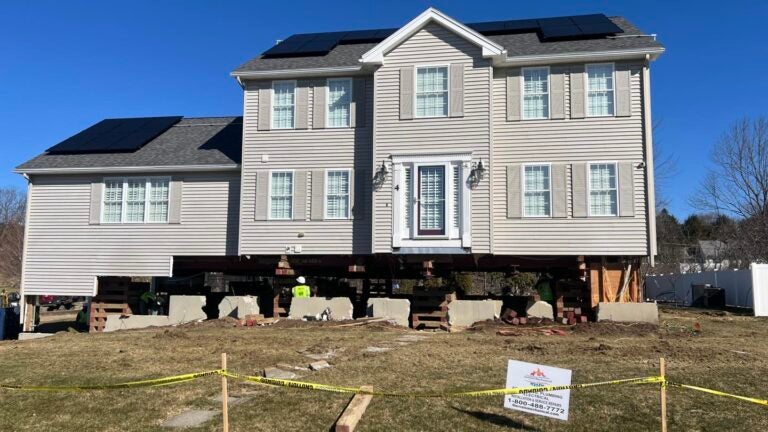
Whenever Cynthia Poirier of Holland hears a popping noise, she questions what part of her home is going next. The 31-year-old house that Poirier built herself as a single mom of two is failing her.
Unbeknownst to her, the concrete poured when the house was built contained a naturally occurring mineral called pyrrhotite. Over time, this mineral has cracked the foundation to the point where large chunks can be taken by hand and walked away.
As it continues to fail, the house structure is beginning to deteriorate, too, with bowed walls, doors that don’t close correctly, and fears that the supports upstairs are worsening.
“I’m sure they’re going to start snapping and breaking and hopefully nothing comes through the ceiling on my head,” Poirier said.
According to a 2019 State House report, thousands of homes across the state may have failing concrete foundations due to pyrrhotite, an iron sulfide present in concrete.
The report said pyrrhotite causes concrete to deteriorate when exposed to oxygen and water, leading to irreversible foundation damage. This damage can take over a decade to 30 years to appear and may result in horizontal cracks that form a web-like pattern. Rust-colored residue or white powder may also develop, and walls often flake.
The only solution is complete foundation replacement with pyrrhotite-free concrete. Depending on the size of the home, cost estimates as of 2019 ranged from $150,000 to $250,000 in the report.
Many crumbling foundations in the state were linked to JJ Mottes Concrete Company in Stafford Springs, Connecticut. Between 1983 and 2015, Mottes used aggregate from Becker’s Quarry in Willington, which tested positive for the mineral. It no longer supplies material for home foundations.
But, homes across the state have been discovered to have the mineral in areas too far away to have realistically received concrete from the Connecticut company. Most concrete is transported locally.
The Massachusetts Residents Against Crumbling Foundations advocacy group, founded and run by homeowners affected by this issue, is tracking the spread.
Beyond the neighboring towns to Connecticut, such as Hampton, Monson, and Holland, other towns farther away include Holden, located north of Worcester, and Winchendon and Dracut, near the New Hampshire border. The homes are located near quarries along fault lines known to have the mineral.
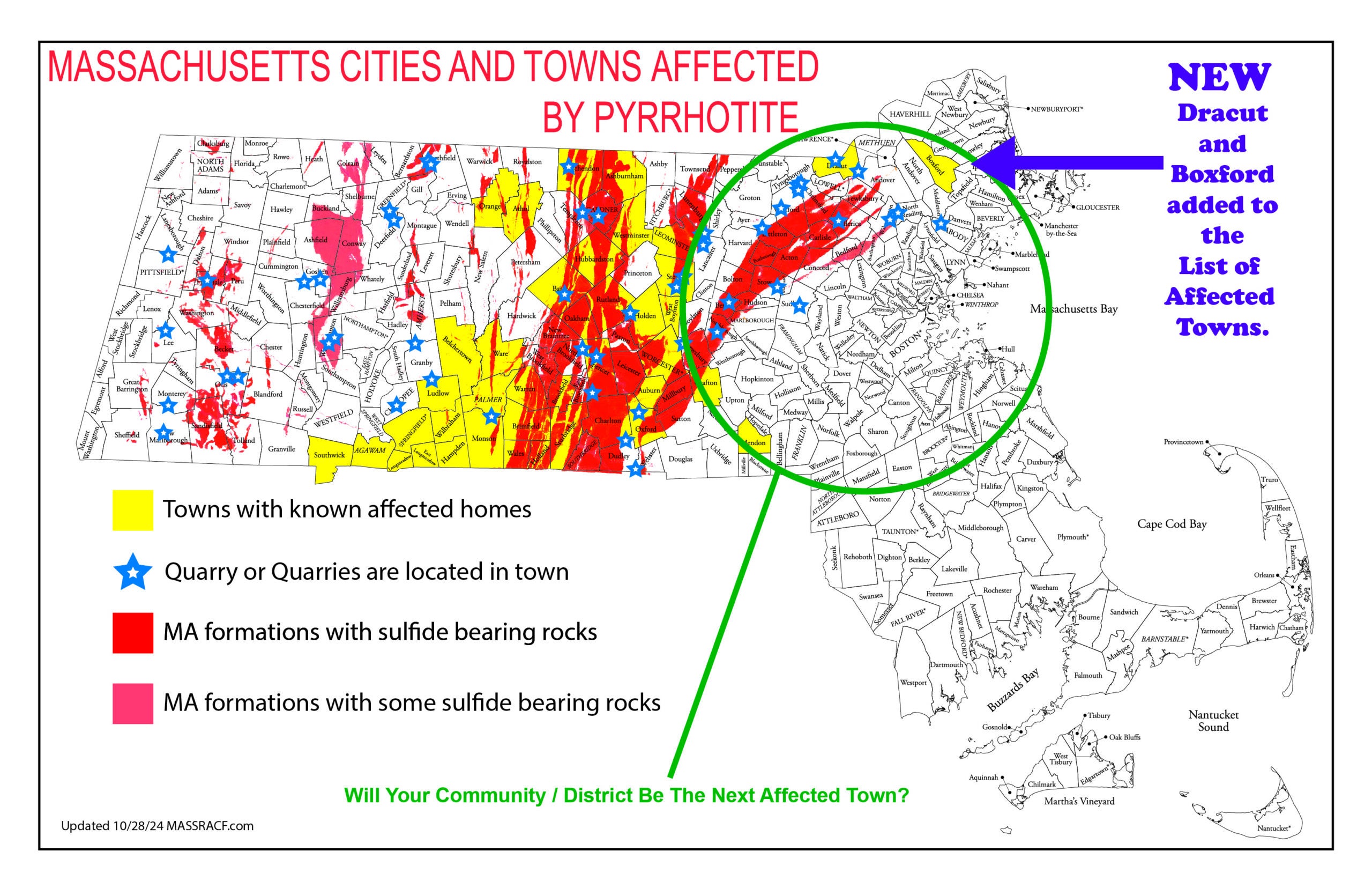
There are questions on “how far this will reach,” said Michelle Loglisci, one of the founders of Massachusetts Residents Against Crumbling Foundations. “We haven’t grasped that yet in Massachusetts.”
But for many homeowners, like Poirier, once their home tests positive for pyrrhoitite, they are left in a lurch.
When Poirier first found out 18 years ago, she sought help from her homeowner’s insurance—denied; looked to see if she could sue the concrete company—not liable due to lack of required testing; and applied for a loan—rejected, as her home was deemed worthless. Desperate, she turned to her state representatives, but they, too, could offer no solution.
“I feel like there’s no way out,” Poirier said. “I feel like I’m wearing an ankle bracelet.”
That is why Poirier and about a hundred other homeowners visited the State House on Oct. 30, demanding action after previous attempts failed.
Legislation to help solve this problem has stalled twice in the state’s Senate Ways and Means Committee.
This year, lawmakers from affected communities took a new approach, adding an amendment to the Affordable Homes Act to create a special commission focused on developing and funding a replacement program. However, in overnight negotiations in July, the amendment was removed.
“So now here we are, our last Hail Mary, asking our governor to use her power of executive order to create the commission,” said Loglisci, who has been fighting the state government to do something for seven years.
If Gov. Maura Healey doesn’t pass an executive order, the group will have to start from scratch by filing another standalone bill in the next legislative session.
“My life has been on hold, and others like me, thousands of us now, some of us for seven, eight, nine years — waiting for our state to do something,” Loglisci said. “And this is so easy to get done, and it makes so much sense. How could we have been left out of the Affordable Homes Act?”
Those who visited the State House said they were disappointed when they were turned away from Healey’s office.
The Healey-Driscoll Administration, in a statement, said it recognizes the importance of supporting homeowners whose concrete foundations are crumbling.
“We will continue to work together with partners in the Legislature to evaluate potential solutions that would provide relief to homeowners,” a spokesperson for the administration said.
Karen Riani, who spent $280,000 to replace her foundation in Holden, said she recently saw that Healey worked to help save the “Pink House” in Newbury. She questioned, “What about our houses?”
For two years, state Sen. Peter Durant, who represents the Worcester and Hampshire districts, has worked to help resolve the issue.
“It was so apparent that this is a massive issue here in Central Massachusetts, and it’s spreading,” he said. “You start going down that rabbit hole and find out how big this issue is and how devastating it is.”
When he found out the amendment in the Affordable Homes Act had not been passed, “upset is really an understatement,” Durant said, especially since it “doesn’t cost a penny to set up this fund and put a commission together.”
State Sen. Michael Moore, who represents the Second Worcester District, agrees.
“I was very disappointed it didn’t make it as part of the piece of legislation,” he said. “I really can’t understand how anyone can argue against this — have opposition to this.”
Everyone acknowledges there is a housing crisis now, Moore said. People who have invested their life savings into homes are now, through no fault of their own, in a position where they could be losing them.
“Often the Legislature or government waits for a tragedy to happen before they respond,” he said. “Hopefully, that won’t be the case.”
However, one key piece of legislation did pass last year requiring all aggregate producers to test for the presence of pyrrhotite by obtaining a license through the Highway Division of Transportation (MassDOT).
In a statement to Boston.com, MassDOT said it is still taking steps to implement the law’s requirements. Once completed, the agency will publish the proposed regulations and accept public comments.
Policymakers are also worried as more houses detect the presence of pyrhotite, property values will plummet, resulting in a fiscal impact on property tax revenues. Towns across the state are only beginning to grapple with how to abate homes found with the mineral that makes them worthless.
In one case in Rutland, homeowners Michale and Karen Cove say their town assessors unfairly valued their home, which was found to have pyrrhotite in the foundation. The couple is now bringing their case to the Appellate Tax Board, which will hear it in early December.
According to the State House report, Connecticut’s tax revenue decreased by an estimated $81 million due to the reduction in home assessment values.
In addition, legislators worry the real estate industry will be impacted as homeowners reassess and decide to either work toward repair and replacement or sell as-is. The State Report said homes in the Connecticut towns affected by the issue saw an average property value decline of about $89,000.
To help solve this problem in Connecticut, the state Legislature imposed a $12 yearly surcharge on certain homeowners insurance policies issued, renewed, amended, or endorsed between January 2019 and December 2029, which will be deposited into the Healthy Homes Fund. This general fund helps affected homeowners replace their foundations up to $190,000.
In addition, according to a United States Government Accountability Office report, communities in Canada and Ireland have imposed similar fixes on homes affected by this mineral.
Many in this situation cannot afford to pay out of pocket to spend $250,000 or more to raise their house, replace the foundation, and put it back together.
Homeowners say more people have not come forward because they are afraid. After all, once a foundation tests positive for pyrrhotite, it is, as one Dracut resident Scott Rosa said, “a death note.”
“Ignorance is bliss, I guess, for some people, and it was for myself,” said Karen Forgues, of Winchendon, who cannot afford to replace her foundation. “I can attest to that as well. But now is the time that we need to make change.”

Get everything you need to know to start your day, delivered right to your inbox every morning.



To comment, please create a screen name in your profile
To comment, please verify your email address
Conversation
This discussion has ended. Please join elsewhere on Boston.com