
Sign up for the Today newsletter
Get everything you need to know to start your day, delivered right to your inbox every morning.
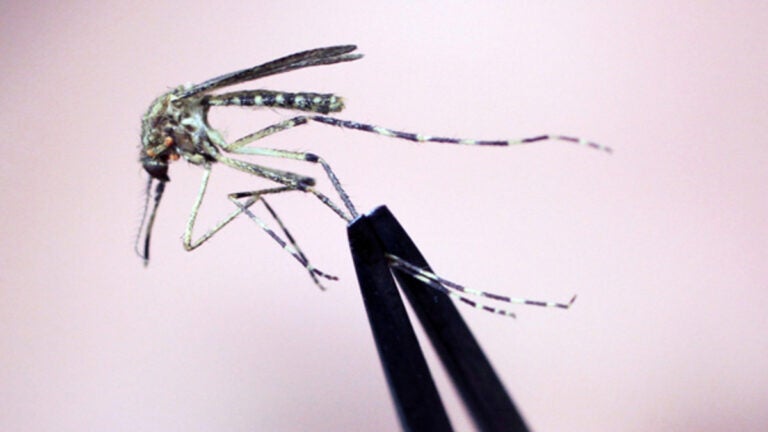
Late this summer, public health officials in Massachusetts began to warn residents about the risks of two mosquito-borne illnesses: Eastern equine encephalitis and West Nile virus. Now, officials are confirming that an Acton man died in early September from EEE.
The family of Basil Chigas, 76, told NBC10 Boston that he died within a week of catching EEE. Acton Town Manager John Mangiaratti told Boston.com that the town learned on Sept. 5 that a resident had died “several days earlier” from EEE.
“The death of our resident from EEE is a tragedy, and our sincerest condolences go out to the family, friends and loved ones. The Town of Acton supports aggressive, proactive public communication regarding public health emergencies and infectious disease. We are always evaluating and re-evaluating our public outreach methods to ensure they are modern, timely and appropriate as technology and the needs of our citizens changes over time,” Mangiaratti said in a statement.
Acton officials had no prior knowledge of the confirmed EEE case or Chigas’s death before Sept. 5, he added. The town issued public notifications that day and the following day through various methods. The alerts said that a human case had been found in Acton and that the community was at a high risk for mosquito-borne infections, but did not reveal Chigas’s identity or the fact that he had died.
That decision reportedly did not sit well with Chigas’s son, Nick.
“Why wasn’t it being more publicized from the towns and from the state? Because if it had been, my father could be alive right now,” he told NBC10.
EEE is rare but very serious. This year, state officials have recorded 96 EEE-positive mosquito samples, three horse cases, and four human cases. Chigas was the third person to catch it this year in the state. Many Massachusetts communities were designated high-risk areas last month. Most EEE infections occur by the end of September, and the state said this week that risk levels had been lowered across the state.
Releasing specific case-by-case medical information, including mortality information, is seen as something that increases the likelihood that others will determine the identity of the sick person. With illnesses like EEE, which can necessitate long and complicated treatment plans, Massachusetts public health officials follow cases over time and report aggregate outcomes.
“The Massachusetts Department of Public Health has a primary responsibility to protect the health of individuals in Massachusetts, while also balancing the importance of protecting patient privacy and confidentiality. The decision about disclosing details of an individual exposed to EEE should be left to the families. DPH works hard to prevent cases of EEE and recognize the significant emotional toll that it can take on families,” a Department of Public Health spokesperson said in a statement to Boston.com.
In New Hampshire, however, officials told the public in late August that a person had died after testing positive for EEE. He was publicly identified as Steven Perry, 41, by his family.
The department works with health care providers directly to obtain information about how and when a person may have been exposed. Officials track deaths by annually reviewing death certificates that include EEE or other diseases.
Many of the positive EEE samples were detected in Plymouth And Worcester counties this year. But Middlesex County, where Acton is located, was deemed a high-risk area as well. Many Middlesex communities were still listed as moderate-risk places this week.
This season’s first EEE-positive mosquitos were found in early July in Carver. The first EEE-positive mosquitos from near where Chigas lived were reported on Aug. 16. They were found in nearby Sudbury. DPH also reported on Aug. 22 that positive samples had been found there. Evidence justifying more extensive warnings was not detected until Sept. 5, with the first human case in the area.
The revelation of Chigas’s illness, and his death, prompted Acton’s Board of Health to hold an emergency meeting on Sept. 6 and issue an advisory about how people can avoid EEE.
Acton’s Health Department and the Board of Health both did not return requests for comment Thursday.
“Cities and towns throughout the region are faced every year with the extant threat posed by mosquito-borne illnesses, including EEE and West Nile Virus, and we issue guidance annually on the dangers of these diseases as well as advice for avoiding mosquitoes and bites,” Mangiaratti said in a statement.
Every year, Massachusetts DPH evaluates its surveillance plan and its criteria for determining mosquito-borne illness risk levels. A review of this season’s processes has already begun.
Nationally, 13 EEE cases have been detected in humans so far this year, according to the CDC. Massachusetts and New Hampshire both reported four cases. Vermont, Rhode Island, New York, New Jersey, and Wisconsin reported one case each.
There are no vaccines to prevent or medicines to treat EEE. Officials recommend wearing long clothing, using insect repellant, and avoiding outdoor activities from dusk to dawn. Eliminating standing water from around one’s house is also recommended.
About 30% of people who develop severe EEE die, and many survivors develop ongoing neurologic problems, according to the CDC. Most people infected do not develop symptoms. EEE can lead to neurologic diseases like meningitis.
Get everything you need to know to start your day, delivered right to your inbox every morning.





To comment, please create a screen name in your profile
To comment, please verify your email address
Conversation
This discussion has ended. Please join elsewhere on Boston.com