
Sign up for the Today newsletter
Get everything you need to know to start your day, delivered right to your inbox every morning.
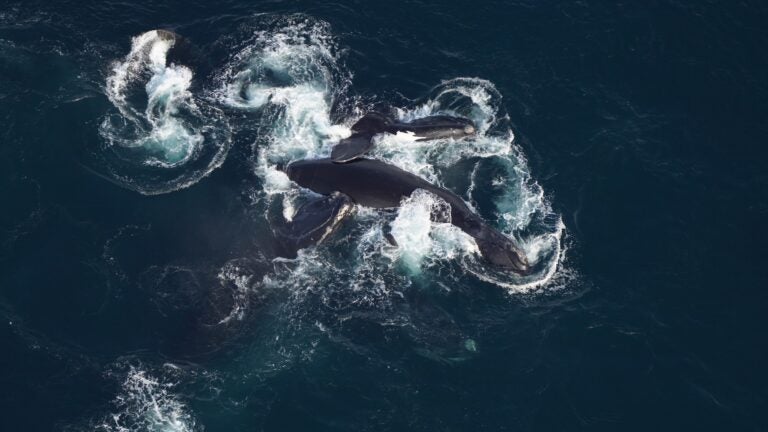
Scientists with the New England Aquarium spotted 82 North Atlantic right whales, close to a quarter of the species’ entire population, in waters off Long Island that are heavily trafficked by ships.
North Atlantic right whales are critically endangered, and the scientists are drawing attention to this grouping due to its size and the fact that the whales were congregating in unusual feeding grounds.
Researchers estimate that there are less than 360 North Atlantic right whales remaining on Earth. The recent sightings occurred at the end of July and into August. They were registered by scientists aboard a series of five aerial survey flights.
Katherine McKenna, a research scientist at the aquarium’s Anderson Cabot Center for Ocean Life, was on several of the flights.
“This mid-Atlantic aggregation is a good reminder that the movement patterns of North Atlantic right whales are always responding and adapting to changing ocean conditions,” McKenna said in a statement. “This multi-month grouping of whales south of Long Island is very unusual.”
The whales have been changing their feeding patterns in recent years, responding to the movements of the plankton that they eat. The recently spotted whales were seen in the Hudson and Block Canyon areas south of Long Island alongside dolphins, manta rays, whale sharks, tuna, and sea turtles. Hudson Canyon lies about 70 miles off New York and New Jersey near the outlet of the Hudson River. Block Canyon is smaller, and located about 50 miles northeast of Hudson Canyon.
This grouping of whales exhibited behavior that indicates they were feeding. Researchers from NOAA first documented the aggregation in May and tracked it through the summer before the New England Aquarium’s team conducted their survey flights, according to a release.
North Atlantic right whales face a variety of threats, most notably from entanglements and vessel strikes. Scientists monitor their populations closely, meticulously cataloging as many individuals as possible in an online database. The animals were pushed to the brink of extinction by the whaling industry of the 19th century. Conservation efforts increased their numbers to reach nearly 500 in 2010, but population numbers decreased over the past decade.
Scientists estimate that more than 85% of right whales have been entangled in fishing gear at least once. Even if whales are freed from the fishing gear, they can sustain serious physical injuries and be negatively impacted by the stress of the entanglement. Females are having fewer calves and are taking longer to have calves, something scientists attribute to chronic entanglements. The whales migrate and feed in coastal areas, also putting them at a high risk for vessel collisions.
A large group of right whales was seen feeding in shipping lanes near Nantucket in February, triggering a voluntary slow speed zone for mariners. Speed restrictions have been found to reduce the risk of lethal vessel strikes. There are no mandatory speed restrictions in place where the recent large group of whales was seen near Long Island. Several of them had visible propeller wounds.
NOAA is considering expanding vessel speed restrictions to better protect the whales along the East Coast. New England Aquarium scientists have been advocating for these changes. Some locals have raised concerns about the impact this could have on high-speed ferry services to Nantucket.
Get everything you need to know to start your day, delivered right to your inbox every morning.





To comment, please create a screen name in your profile
To comment, please verify your email address
Conversation
This discussion has ended. Please join elsewhere on Boston.com