
Sign up for the Today newsletter
Get everything you need to know to start your day, delivered right to your inbox every morning.
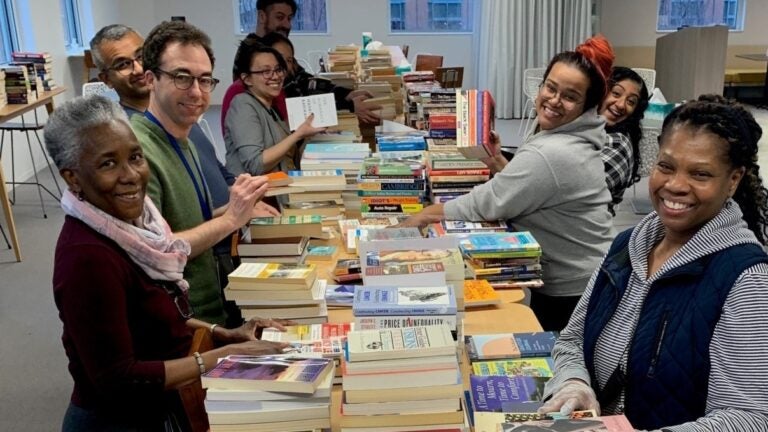
Access to education in prisons is proven to reduce recidivism, and when opportunities in correctional facilities are lacking, an incarcerated person could turn to a good book.
However, “the carceral system makes books very difficult to acquire,” says Kelly Brotzman, the executive director of the Prison Book Program. “[Books] take on an elevated importance that non-incarcerated people don’t often appreciate.”
Brotzman said regulations vary greatly across facilities in Massachusetts and beyond, putting up barriers for her organization to get books into the hands of people who are incarcerated.
PBP is based in Quincy, but the organization sends books through the mail to prisons and jails in all 50 states, Guam, and Puerto Rico — all free of charge. The group fills requests for job training books, novels, puzzle books, dictionaries, and even commercial driver’s licenses study guides.
“It’s a mental escape. It’s a way in which they can put the difficulties of prison life to the side for a moment,” Brotzman told Boston.com, adding that “people are writing to us for carpentry, plumbing, electricianship, not because they want to mess with their facility, but because they’re very clear-eyed about their prospects should they ever see release.”
Incarcerated people looking to get a certain book can utilize facilities’ libraries — which are generally stocked with cheap, out-of-date books — or rely on loved ones to send requested books into their facility, Brotzman explained.
Alexander Bolling, who’s currently serving two life sentences at North Central Correctional Institution in Gardner after being convicted in a double murder, spent time at the recently closed MCI-Concord and MCI-Shirley.
“DOC libraries will have something on most topics, but [it’s] usually … outdated. If I want to read a new release then I’d have better luck leaning on a sibling, a mentor or a program like PBP,” Bolling wrote to Boston.com, adding that the fiction and science fiction sections are better kept up to date.
Bolling said he’s relied on his siblings for books over the past 17 years he’s been incarcerated. Since discovering PBP, he’s been able to request books for a specific topic and receive suggestions from the organization.
“Early on in my sentence reading was basically how I kept my sanity,” said Bolling, who completed a bachelor’s degree through the Emerson Prison Initiative in 2022. “Over the years I became involved in academic programming which took up most of my reading hours, but I’ve always made time for reading unrelated to school.”
Restrictions on receiving books in prison vary not only by state, but by facility, according to PBP. The organization has been around since 1972, allowing for some “legacy status” at facilities. Despite that, some states — including in New England — can be picky about the books they receive.
Many jails in Massachusetts run by sheriff departments — including the Plymouth County Correctional Facility and the Hampshire County Jail — don’t accept books from PBP, according to the organization’s internal database.
Prisons run by the Massachusetts Department of Correction vary widely, according to Brotzman. MCI-Framingham allows hardcover books but is very picky about their “new book only” policy.
MCI-Norfolk accepts new paperbacks only, while the maximum security prison Souza-Baranowski in Lancaster accepts new and used paperbacks, according to PBP.
When asked about regulations for books coming into prisons, the Massachusetts Department of Correction referred to general prohibitions relating to any incoming mail and property.
“All publications must come directly from the publisher, a book club, a bookstore, or from the Prison Book Program. People incarcerated there may possess a maximum of ten books/magazines/newspapers,” their policy reads.
John Odgren, who is also incarcerated at NCCI for life after a murder conviction, told Boston.com he’s received dozens of books from PBP, from friends and family, and through the AbeBooks online. He said his collection of science fiction would “shame most libraries.”

“Thankfully, the guards don’t crack down on me, because they know it’s really good for my mental health to have all these books, despite the rules against clutter, so I exist in a sort of state of perilous equilibrium,” he wrote. He also praised NCCI’s library, which he’s contributed his finished books to over the years.
FMC Devens, a federal medical center in Ayer, accepts hardcovers but not manga, according to PBP. They also previously rejected two books — “Guyland” and “My Struggle.”
According to federal policy, wardens can reject books that describe the use or construction of weapons, could aid an escape, describe procedures to create drugs or alcohol, are written in code, encourage criminal activity or violence, or are sexual.
Brotzman said in New England, other states like Maine and Connecticut have facilities where they can’t send books, either because they aren’t approved vendors or because of Connecticut’s strict “new book” policy.
“It’s really hard when a whole state goes ‘new only,’ and right now that’s the case with Connecticut and Wisconsin,” she said. “We’ve had a number of packages get returned from Connecticut that said, ‘Oh, signs of wear,’ but it’s the postal service. It’s very frustrating when that happens.”
Massachusetts and other parts of New England aren’t necessarily PBP’s main focus, Brotzman said. Due to their location in Quincy, they expedite books for incarcerated people in the region, but their efforts are also focused in Florida, Pennsylvania, and North Carolina.
“It opens people’s emotional worlds up to all kinds of experiences that they haven’t had,” she said. “Your personal development and personal growth as a human being is greatly assisted by reading fiction. I think any kind of reading is associated with just becoming a better person.”

Get everything you need to know to start your day, delivered right to your inbox every morning.



To comment, please create a screen name in your profile
To comment, please verify your email address
Conversation
This discussion has ended. Please join elsewhere on Boston.com