
Newsletter Signup
Stay up to date on all the latest news from Boston.com
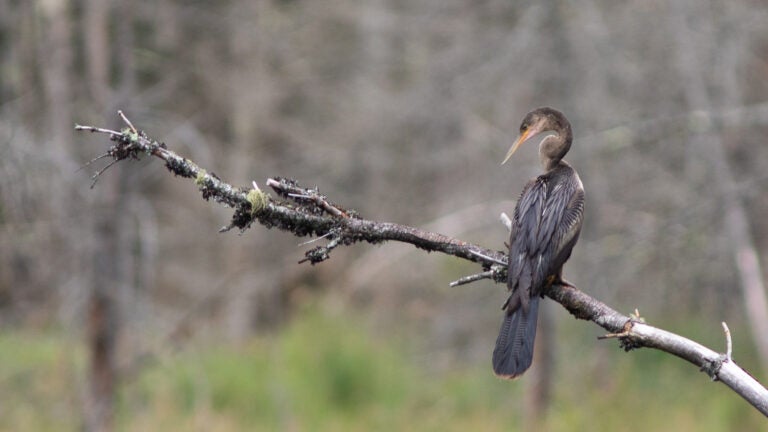
Last week, an avid birder was struck by a southern water bird known as the anhinga or “snake bird,” perched on a log in a flooded meadow.
Located in Somerville, a small town a little over an hour’s drive north of Portland, Tabatha Holt snapped a grainy picture of the anhinga bird spending time near a beaver pond and shared it on social media.
Almost immediately, a debate ensued if the bird was indeed an anhinga or the commonly found cormorant.
However, Maine Audubon staff naturalist Doug Hitchcox was quick to point out that the bird is indeed an anhinga – pointing out the distinctive pointy beak and long neck and tail. It is the first anhinga recorded in Maine.
“It’s the first one,” said Hitchcox. “But it’s the first of more to come. It might be a couple of decades before we see the next, but I would be less surprised.”
When Hitchox saw the social media post, he immediately sprung into action. As a self-imposed liaison for the birding community, he canceled his afternoon meetings and got into a car to find the bird himself, located down a single-lane dirt road.
“It did work out perfectly,” said Hitchcox, who snapped pictures of the bird and helped manage an incoming mob of birders to the area. He said about 80 people saw the bird when it showed up last week.
“This was a really rare bird for Maine, certainly New England,” Hitchcox said.

Hitchcox said the species is slowly expanding its range northward.
Maryland is now the northernmost location where the birds nest, a recent development. You can typically find anhingas in Florida, the Gulf states, and Central America, especially in Brazil.
“They are slowly coming up here,” Hitchcox said.
There are several reasons why this bird might have decided to travel so far north.
Due to climate change, many birds are expanding their range northward. However, other factors are also at play. Water birds experience occasional seasonal abundances, where food sources are good one year and bad the next, dispersing them.
Hitchcox said the popular name associated with the anhinga is the “snake bird.” When the birds are foraging, they stay submerged with their long, twisting necks sticking out of the water.
“It’s really almost off-putting, unsettling like a snake-like movement in the water,” Hitchcox said.
Like the commonly mistaken cormorant, anhingas don’t spread oils on their feathers to make them watertight. Instead, the feathers absorb the water when submerging, making swimming and catching fish easier.
The downside is when anhingas are ready to fly, they need to sit up out of the water with their wings open to dry themselves and warm up.
Some call the position of anhingas holding their wings out to dry the “Dracula pose” because it resembles holding a cape open.
“It’s always a miracle to think about how many anhingas were there before this one,” said Hitchcox. “The odds of us actually finding these rare birds are probably under one percent.”

Stay up to date on all the latest news from Boston.com



To comment, please create a screen name in your profile
To comment, please verify your email address
Conversation
This discussion has ended. Please join elsewhere on Boston.com