
Newsletter Signup
Stay up to date on all the latest news from Boston.com
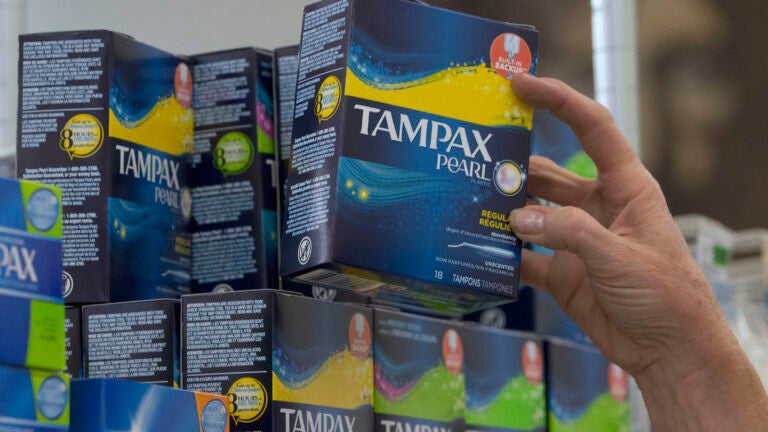
Massachusetts consumers are raising concerns following a recent study that found evidence of 16 different metals in tampons.
Sasha Goodfriend, executive director of grassroots feminist organization Mass Now, said that she has heard from many individuals in Massachusetts who are now scared to use the menstrual products they have at home because they do not know what is in them.
“It’s honestly something that didn’t surprise me,” said Magdelene Barjolo, regional menstrual health consultant for Mass Now. “But it also made me shocked at the fact that these companies have poor compliance and regulatory systems that would enable this sort of thing to happen.”
It didn’t take long for social media users to express their outrage.
@scorpiobishhh Us women can literally not catch a break. #tampax #tampon #femaleempowerment #mybodymychoice #woman #womenshealth ♬ female rage – bel6va
The study, led by a UC Berkeley researcher, detected concentrations of all the metals it tested for, including arsenic and lead, in 30 tampons from 14 different brands. While chemicals have been previously found in period products, this study is thought to be the first to measure and identify toxic metals in tampons.
Goodfriend also said she “wasn’t surprised” when she heard that metals were found in period products.
“Menstrual products and reproductive health have been so under-researched and under-regulated that it makes sense that now that there’s a growing awareness, more research is happening, and that’s leading us to studies like these,” she told Boston.com.
People using these menstrual products may be at a higher risk for exposure to these metals, according to Kathrin Schilling, assistant professor at Columbia University Mailman School of Public Health.
“It would be exciting to see the public call for this, or to ask for better labeling on tampons and other menstrual products,” the study’s lead author Jenni Shearston, a postdoctoral scholar at the UC Berkeley School of Public Health, said in a statement.
For several years, Massachusetts advocates have been pushing for legislation requiring manufacturers of menstrual products in the Commonwealth to provide a list of ingredients to consumers.
“The whole point of the bill is to have a form of transparency so that individuals know what products they are putting into their bodies, and the health risk and health concerns that might arise due to the exposure to products and toxic chemicals,” Barjolo told Boston.com.
But calls to disclose ingredients in menstrual products are not new. Due to a lack of federal regulations, New York and California already require that ingredients be clearly labeled. Mass Now is hoping to create similar laws in Massachusetts.
Barjolo said there should also be stricter regulatory standards for companies creating menstrual products, prohibiting harmful chemicals and requiring thorough testing for them before they hit the market.
Additionally, Barjolo said tampons and pads have a “historical look and design” that should be revisited.
“I think we could develop that product and see what other innovative and safer products and innovative and safer designs could help impact the manufacturing process,” she said.
Barjolo said consumers should “challenge and question” the products they are using.
“When it comes to menstrual products, a lot of things will be marketed one way, but it’s not what it actually seems, so I would definitely say to question it,” she said. “Let your fear drive you into seeking information.”
Although the study does not name the brands that were researched, Goodfriend said menstrual products from Femly, Fihri, Aunt Flow, and Viv for your V are safer alternatives to name brands. Barjolo recommends using reusable products like menstrual cups as well.
Consumers should be looking for chemical-free products that are organic and biodegradable, Goodfriend said.
“Promoting organic and natural alternatives and encouraging the use of organic and natural materials in menstrual products can reduce the exposure of these chemicals,” Barjolo said.
However, Barjolo said that organic products are often more expensive.
“We shouldn’t have to pay extra bucks for safer products,” she said.
Many people do not have the means to buy period products to begin with. In the United States, an estimated 16.9 million people already experience period poverty, or an inability to afford menstrual products. Massachusetts is the 11th most expensive state to purchase period products, costing consumers an average of $10.54 a month for disposable products, according to a study by PlushCare.
“I wouldn’t necessarily say that the higher quality companies are more expensive — that is sometimes the case, but it’s sometimes not the case,” Goodfriend said. “Buying in bulk and creating comprehensive strategies to address menstrual access are the best ways to get the price point for menstrual products down.”
Massachusetts advocacy groups have been urging lawmakers to pass a bill that would provide access to free menstrual products in schools, shelters, and incarceration facilities. At least 12 states already provide free menstrual products in schools, 25 states in correctional facilities, and three states in homeless shelters, according to a recent brief from the National Conference for State Legislatures.
“It’s new to talk about periods in a public setting, and lots of people who’ve never menstruated before don’t know about the impact,” Goodfriend said. “I hope that this new study communicates a sense of urgency to the Legislature around the need to protect Massachusetts consumers by ensuring that manufacturers disclose chemicals that are within our menstrual products.”

Stay up to date on all the latest news from Boston.com



To comment, please create a screen name in your profile
To comment, please verify your email address
Conversation
This discussion has ended. Please join elsewhere on Boston.com