
Newsletter Signup
Stay up to date on all the latest news from Boston.com
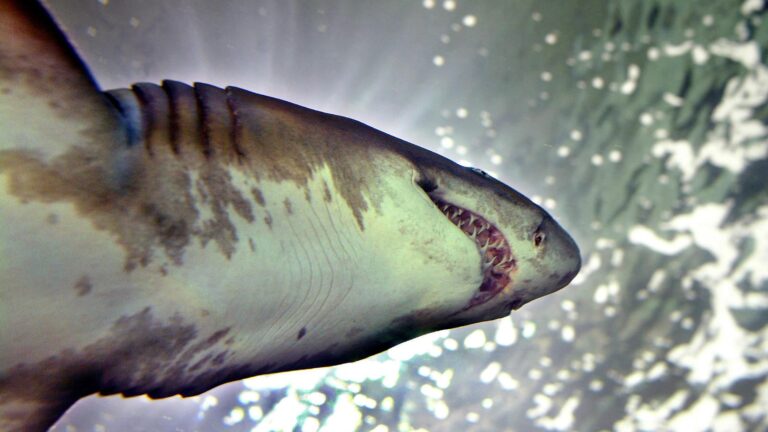
A juvenile sand tiger shark, a protected species in the region, was found with three stab wounds over the weekend and likely died, according to a scientist at the New England Aquarium.
John Chisholm, an adjunct scientist at the Anderson Cabot Center for Ocean Life, said that sightings of the sand tiger shark once, overfished in the region, are becoming more common as the species begins to recover.
In recent years, juvenile sand tiger sharks have returned to the waters off of Massachusetts to feed in while protected from large predators before returning south in the winter.
Chisholm, who also verifies shark sightings through the Atlantic White Shark Conservancy’s Sharktitivy app, said sand tiger sharks are often mistaken for dogfish sharks. Some see dogfish as a nuisance because they tend to overwhelm hot spots for fishing.
Fishermen used to say, “The only good dogfish is a dead dogfish,” said Chisholm.
Young sand tiger sharks, which are 1 to 2 years old, and the more abundant full-grown dogfish sharks are similar in size, which could make it hard to distinguish them.
However, there is one feature that strikes them apart — their teeth.
“Sand tigers have a mouthful of little needle-like teeth,” said Chisholm. “One look at the mouth, and you won’t mistake them for anything else.”
With more sand tiger sharks returning to the region, fishermen must begin recognizing the signs that differentiate them, Chisholm said. If caught, sand tiger sharks must be returned to the water unharmed.
“It’s a good teachable moment to educate fishermen,” said Chisholm. “They are responsible for what they catch and how to identify the species they catch.”
Even though many fishermen justify accidentally killing the sand tiger shark because they thought it was a dogfish, Chisholm says that is still not OK.
“That’s a waste to kill any species whether you are hunting or fishing,” said Chisholm. “You can’t just kill something because you don’t want it or like it. People need to respect these species.”
Sand tiger sharks were heavily overfished in the late 1900s, to the point where only 10 to 30% of the original population was left, according to Ryan Knotek, an associate research scientist at the Anderson Cabot Center for Ocean Life.
Fisheries and recreational fishermen targeted and sold the shark for consumption.
Sand tiger sharks became a protected species in 1997, placing a high level of protection on the species that remain in place.
In the early 2000s, scientists began receiving anecdotal reports of young sand tiger sharks north of Cape Cod. So, they started tagging them using technology similar to “EZPass” to see where they were going.
Last year, the team tagged eight sharks, following a pilot program in the mid-to-late 2010s that found some shark activity in the area.
Scientists discovered that sand tigers gave birth off the coast of Florida and the Carolinas.
“As soon as they give birth, they just jet north,” said Knotek, with some sharks as young as 4 or 5 months old found in Boston harbor.
During the summer in the northeast, young sharks leave larger ones behind to grow in protected waters away from southern predators.
Knotek said that more research is needed to determine how many sand tiger sharks there are.
Along with the Massachusetts Marine Fisheries, Knotek plans to return to the water this summer to tag even more sharks.
First, “it’s crazy they can make that migration as soon as they are born,” said Knotek.
But, it’s even crazier what they had to fight for before they even popped out, he said.
When a female is pregnant, the embryos inside her will outcompete one another for survival by eating each other.
So, by the time they enter the world, “they are legitimate predators,” Knotek said.
Knotek said sand tiger sharks also gulp air to help with their buoyancy. So if a fisherman catches one, they will start to see bubbles burst out of the water because they are “burping out the air they swallow,” he said.
Chisholm said sand tiger sharks are also common in aquariums because they do very well in captivity. Even though they are not vicious sharks, he said it is intimidating when people look at them and see their mouths full of teeth.
They are primarily found in the estuaries along Cape Cod Bay, off the coast of Plymouth and Duxbury and the Boston Harbor along the Saugus River.
Adult sand tiger sharks are also beginning to return to the waters south of Nantucket.
Sand tiger sharks eat fish and smaller sharks and roam along the eastern coast.
Dozens of shark species lurk off the eastern seaboard, but most go unnoticed because they do not harm swimmers.
Chisholm said there are over 500 species of sharks, each with unique characteristics.
“All of them are different and have their own preferences and role to play in the ecosystem,” Chisholm said.

Stay up to date on all the latest news from Boston.com





To comment, please create a screen name in your profile
To comment, please verify your email address
Conversation
This discussion has ended. Please join elsewhere on Boston.com