
Newsletter Signup
Stay up to date on all the latest news from Boston.com
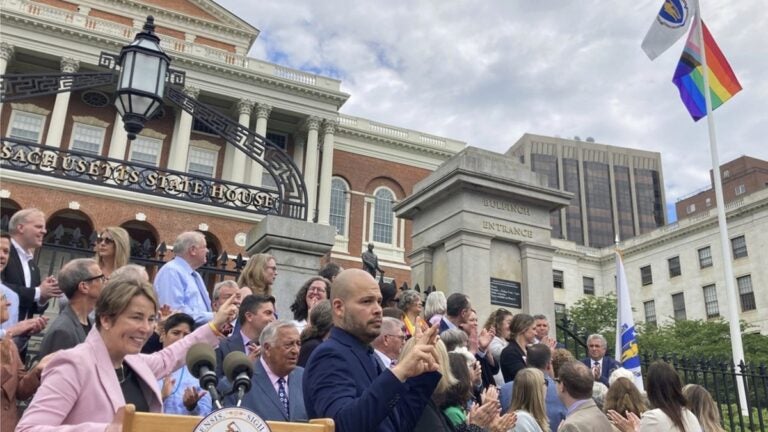
The Massachusetts House of Representatives unanimously passed legislation last week that would update state law to remove barriers preventing some LGBTQ families and those who use alternative methods of reproduction from establishing legal parenthood.
The bill, which was tied to Pride month celebrations by Speaker Ronald Mariano, coasted through the House with a 156-0 vote. It has bipartisan support in the Senate, where it now needs approval.
Massachusetts is the only New England state without such a law, and advocates say that the state has not kept pace with the ways that many modern families are created.
“Today we acted to ensure that if you are a parent, whether a biological parent or not, the law will recognize you as a parent just as society does. This bill will remove one of the last vestiges of the law that treats same-sex parents and parents who engaged in assisted reproduction differently from every other parent. It is a good day for all families in Massachusetts,” Rep. Michael Day, co-chair of the Judiciary Committee, said in a statement after the vote.
The bill gives children born through assisted reproduction technology like in vitro fertilization a clear pathway to establish their parentage. It allows LGBTQ families to establish parentage in the same ways other families can, including through voluntary acknowledgment. The legislation also includes clear standards for establishing parentage through surrogacy.
The bill defines and recognizes “de facto” parents legally. “De facto” parents perform all the duties a typical parent would, but are not biologically related to their children.
Many LGBTQ families have to formally adopt their own children, a process that can be costly and lengthy, to guard against potential parental challenges involving sperm donors and surrogates. This “demeaning” process was outlined in a GBH report last year.
“In the LGBTQ community, by definition, always one of the parents is a non-bio parent. So we’ve got to fix these laws to protect our families because right now the state of affairs is so messed up we actually have to adopt our own children,” co-chair of the GLBTQ Political Caucus Arline Isaacson told State House News Service.
Massachusetts, which prides itself on LGBTQ inclusivity, became the first state in the nation to license and recognize same-sex marriages two decades ago. Proponents have been working to pass legislation like this for years, and in 2021 the editorial board of The Boston Globe called out lawmakers’ “utter lack of urgency” in pursuing its passage. Boston City Council adopted a resolution urging the passage of an earlier version of the legislation around the same time.
In April, Michigan Gov. Gretchen Whitmer signed a similar piece of legislation into law, prompting Gov. Maura Healey and Attorney General Andrea Campbell to put more pressure on the Legislature. Healey is one of America’s first two openly lesbian elected governors.
“Our state parental laws have not kept pace with the diversity of modern-day families, and as other states take the necessary steps to protect families, provide stability for children and advance reproductive and LGBTQ+ rights, it is clear it is well past the time for us to act and pass the Massachusetts Parentage Act,” Campbell said at the time.
Mariano called the existing laws “archaic” at a Pride flag-raising ceremony in front of the State House earlier this month.
“We may be taking up this bill during Pride Month, but I would respectfully submit to my colleagues: this isn’t a bill that is just benefiting the LGBTQ community,” Rep. Sarah Peake said at the flag-raising ceremony earlier this month. “This is a bill that is good for everybody in the commonwealth of Massachusetts.”
The potential restriction of IVF became a national talking point in February, after the Alabama Supreme Court ruled that frozen embryos are children and deserve protection under the law. In Massachusetts, 5.8% of babies born in 2021 were conceived through IVF, according to the Globe. Only Washington, D.C. has a higher rate. Nationally, just 2.3 percent of babies were conceived through IVF.
Citing the Alabama ruling, proponents of the bill said that this “volatile political climate makes it all the more important” for Massachusetts to protect families formed through IVF.
Stay up to date on all the latest news from Boston.com





To comment, please create a screen name in your profile
To comment, please verify your email address
Conversation
This discussion has ended. Please join elsewhere on Boston.com