
Newsletter Signup
Stay up to date on all the latest news from Boston.com
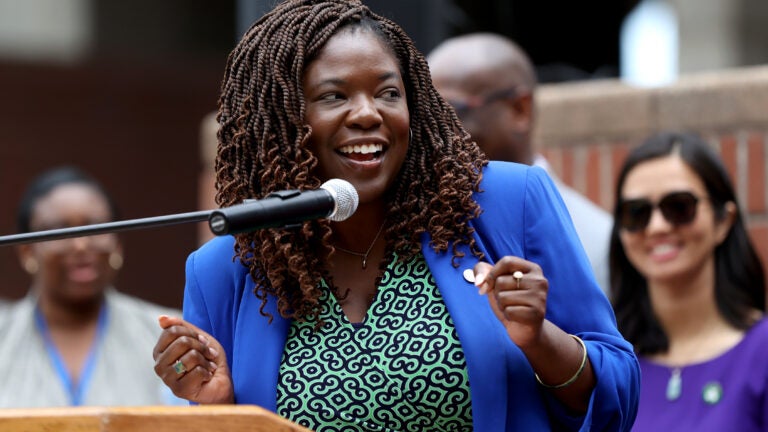
A number of Boston City Council members are supporting a new push to implement ranked choice voting in city elections.
Ranked choice voting is a system where voters rank candidates on their ballots in order of preference. A candidate that receives more than half of the first-choice votes wins, but races without a majority winner are determined by an “instant runoff.” This means that the candidate with the fewest votes is eliminated, and voters who ranked that last-place candidate as their first choice will have their votes count for their second choice. The process then continues until there is a majority winner.
“Our commitment to democracy should be measured by our willingness to adapt and innovate. Adopting ranked choice voting means embracing a method that fosters greater engagement and reduced polarization,” Council President Ruthzee Louijeune said during a meeting Wednesday.
Proponents argue that ranked choice voting increases turnout, stops “gatekeeping,” gives voters more of a voice, and prevents “vote splitting.”
Louijeune introduced the home rule petition, with councilors Julia Mejia and Henry Santana as initial co-sponsors. Councilors Liz Breadon, Tania Fernandes Anderson, Enrique Pepén, Benjamin Weber, and Brian Worrell added their names after some discussion. It was referred to the Committee on Government Operations and will be the subject of future hearings and working sessions.
If enough councilors eventually vote in favor, and Mayor Michelle Wu signs off on it, the petition would be submitted to the state Legislature. If it is approved by lawmakers on Beacon Hill, Boston voters would likely have the final say in a referendum.
“By embracing this inclusive electoral system, we empower voters to express their preferences fully, promoting greater civic engagement and ensuring every voice is heard in our democratic process,” Louijeune said.
Advocates have been pushing for ranked choice voting in Massachusetts for years. In 2020, they succeeded in getting it onto a statewide ballot. But the ballot measure was rejected by voters, with 54.8% voting against it. It would have implemented ranked choice voting for all state and federal elections, with the exception of the presidential race.
After the 2020 vote, Secretary of State Bill Galvin said that the idea was “reasonable” but “complex.” Many voters “didn’t really grasp what it would mean for them,” he said at the time.
The new proposal for Boston would advance four, instead of two, candidates from the preliminary municipal elections for mayor and district city councilor to the general municipal election. Eight candidates for at-large City Council seats would still advance to the general election. In the general election, voters would rank up to four candidates in all contests.
Even major proponents of ranked choice voting acknowledge that the process can seem confusing on paper. A lengthy FAQ is available online from Ranked Choice Boston, a coalition that worked to formulate and promote the new proposal.
Support for ranked choice voting increases as people understand it better, Councilor Santana said.
“Once voters understand the opportunity for greater simplicity and representation in election, support for ranked choice voting grows,” he said.
Despite the statewide failure in 2020, 61.9% of Boston voters did vote in favor of the ballot measure. Louijeune pointed to this fact while advocating for the measure Wednesday.
Many of the most prominent elected officials in Massachusetts have voiced support for ranked choice voting in the past, including Sens. Ed Markey and Elizabeth Warren, Gov. Maura Healey, Attorney General Andrea Campbell, and Wu.
Councilor Ed Flynn said Wednesday that he is opposed to the idea. The current voting process works well, he said, and there is no need to replace it with a more complicated system. Flynn also said that he is worried about the possibility of ranked choice voting enabling outside groups to play a “huge” role in elections.
“Let’s not take the vote away from residents, let’s ensure that residents really have the final vote and the final decision, and let’s not ensure that people can come into Boston from outside and have a major impact through their funding on who gets elected,” Flynn said.
Louijeune said she also doesn’t want to see outside groups hold massive sway over elections, but that ranked choice voting can help prevent this.
Ranked choice voting is used in 60 jurisdictions across 24 states, according to the most recent data made available by FairVote, an organization that works to promote ranked choice voting. Maine uses the system for state and federal primary elections and all general congressional elections. Cities like Portland, Maine, and Burlington, Vermont, use it for some municipal elections. Cambridge has used a version of ranked choice voting for City Council and School Committee seats since 1941.
“I understand, and I know, that change can be difficult,” Louijeune said. “But change can also be better, and better for our city.”
Stay up to date on all the latest news from Boston.com





To comment, please create a screen name in your profile
To comment, please verify your email address
Conversation
This discussion has ended. Please join elsewhere on Boston.com