
Newsletter Signup
Stay up to date on all the latest news from Boston.com
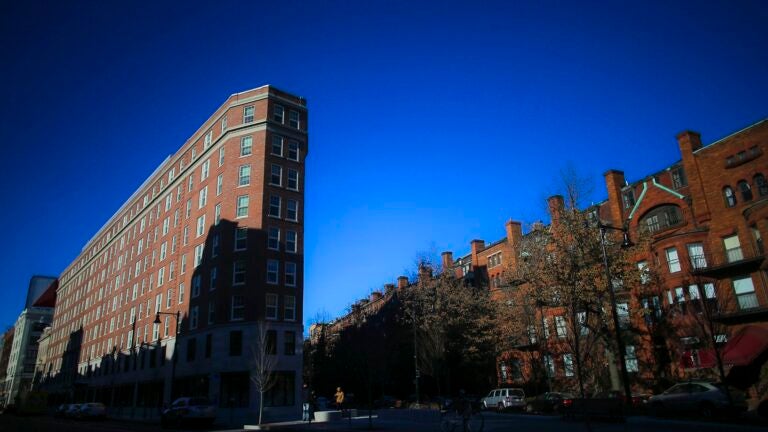
A years-long effort by a Native American tribe and Boston University faculty and students to remove the name of an English colonist from one of the school’s dorm finally bore fruit last week when the university announced the building would be renamed.
The Board of Trustees approved a name change for Myles Standish Hall after the Faculty Council overwhelmingly voted in favor of the change, interim university President Kenneth Freeman wrote in a letter to the council on Thursday. The dorm will be known by its address, 610 Beacon St., at least for the time being.
Community members had asked BU to change the name of the hall because of Standish’s violent history as a colonial military leader. The settler is known for leading the Massacre at Wessagusset, where he attacked members of the Massachusett Tribe under a false pretense of a peace dinner. Several Natives were killed, and Standish displayed the severed head of a man named Wituwamat at the Plymouth colony for several months.
The movement to remove the name, started by the Massachusett Tribe, was a culmination of community efforts and perseverance, said Anna Ward and Laura Jiménez, both lecturers at BU who helped lead the movement.
“It’s not just [Ward] and I,” Jiménez, senior lecturer in language and literacy education and associate dean of equity, diversity and inclusion at BU’s Wheelock College of Education and Human Development, said. “It’s the Massachusett making the request, the students picking it up and going through all those channels, it’s us talking to our peers and going to other colleges. Over and over and over, it was more about educating ourselves and taking away that ignorance on our part and saying, ‘Okay, this is a real issue.’”
The residence hall — a prominent building that serves as the eastern gateway to BU’s main campus — jarred Ward when she first entered campus in the spring of 2022, she said.
“I’m not from the Northeast, but I have an understanding of who this person was, and the importance of our colonial history as it’s been taught to us, and it just surprised me,” Ward, a lecturer in the counseling psychology and applied human development department, said. Ward is a tribally enrolled member of the Osage Nation.
Jiménez, on the other hand, has worked at BU for about 12 years and hadn’t known about the controversy surrounding the name until she saw flyers around the school asking for the dorm to be renamed.
BU itself has no relationship to Standish — the hall was named when the school bought the Myles Standish Hotel in 1925. In his letter, Freeman wrote that “there are no restrictive covenants or gift agreements associated with the Myles Standish name for the resident hall that would be violated by a name change.”
The Massachusett Tribe at Ponkapoag launched the effort to rename the building, which culminated in a petition that garnered over 900 signatures by fall of 2021 (it now has over 1,900 signatures). When it was sent to then-president Robert Brown, he rejected the call to rename the dorm, saying Standish’s “role in the history and founding of Massachusetts, and thus our nation, was significant.”
“I felt angry. I felt like Boston University says that diversity and belongingness and inclusion is very important,” Jiménez said of her reaction to Brown’s refusal to listen to demands. “So here was this issue of equity and inclusive practices … and they were still denied.”
But activists weren’t deterred. Students quickly picked up the call, penning an open letter — which was eventually signed by over 170 student organizations — to the president and Board of Trustees advocating for change.
“If Standish’s actions were seen as detestable by members of his own colony, then why does Boston University find it necessary to celebrate him?” the letter reads. “The glorification of settler colonialism evident in the hall named for ‘Myles Standish’ has an impact on our community.”
Students Adam Shamsi, class of 2024, and Anne Joseph, class of 2025, also published a piece in BU Today outlining reasons for change.
“The name Myles Standish Hall clearly isn’t just an old name inherited from a purchase. It is a symbol of continued oppression. Until President Brown and the Board of Trustees agree not only to change the name of this building, but also implement actionable initiatives to uplift indigenous students, faculty, staff, and local communities, BU is complicit in perpetuating this history of oppression,” Shamsi and Joseph wrote.
Student efforts didn’t get a response from administration, so Ward and Jiménez decided to renew the push last fall.
“I said, what can we do as a college? And so that’s when we wrote the letter, we wrote a motion to present to our own faculty and staff assemblies at the Wheelock College [of Education and Human Development] level,” Ward said.
When Wheelock faculty and staff voted in support of the motion, Ward and Jiménez took the idea to other colleges within BU. The proposal then made it to the BU Faculty Council, who wrote a letter to Freeman requesting a name change in early April.
“…at its May 16 meeting, the Executive Committee of the Board of Trustees voted unanimously to accept my recommendation to change the name of Myles Standish Hall to ‘610 Beacon Street,’” Freeman wrote in the letter to the Faculty Council. “In my recommendation, I referenced the arguments and sentiments reflected in the Council’s recommendation and in the petitions and letters the Council referenced.”
In his letter, Freeman thanked advocates both for and against the name change.
“I wish to acknowledge and thank the many people who advocated for the name change before I became president ad interim, and, particularly, the 170 student organizations who called for the renaming,” Freeman wrote.
Ward and Jiménez said that the win is only a small step forward in making Native people feel more included at BU.
“It should feel better than it does,” Jiménez said, adding that she wants to see historical context about Standish displayed in the building.
“It’s not about erasing history or just forgetting about Myles Standish. It’s making an active choice to not honor him in this way, this very public way, with buildings named after him,” Ward said.
Freeman wrote in his letter that the school will include information at the entrance of the building that “acknowledges the original name of the building and the role of Myles Standish in Massachusetts history.”
Ward and Jiménez added they would like to see BU add an indigenous and native studies major or minor.
“We are a world class, R1 research-heavy university, we are globally known, and yet we don’t have an indigenous studies program,” Jimenez said.
As for the dorm’s name going forward, the Massachusett Tribe suggested in its petition that it be changed to Wituwamat Memorial Hall in honor of the tribal member who was beheaded by Standish. In his letter, Freeman said it would be “helpful to have the option for a donor to name a major, highly visible building.”
“Ultimately, I just hope it’s a deliberate choice and that there’s lots of people involved,” Ward said. “That students, native people from the area feel like they have a say, and I just really hope that it’s an informed decision that doesn’t just land in the hands of the president or a small handful of people.”
Stay up to date on all the latest news from Boston.com



To comment, please create a screen name in your profile
To comment, please verify your email address
Conversation
This discussion has ended. Please join elsewhere on Boston.com