
Newsletter Signup
Stay up to date on all the latest news from Boston.com
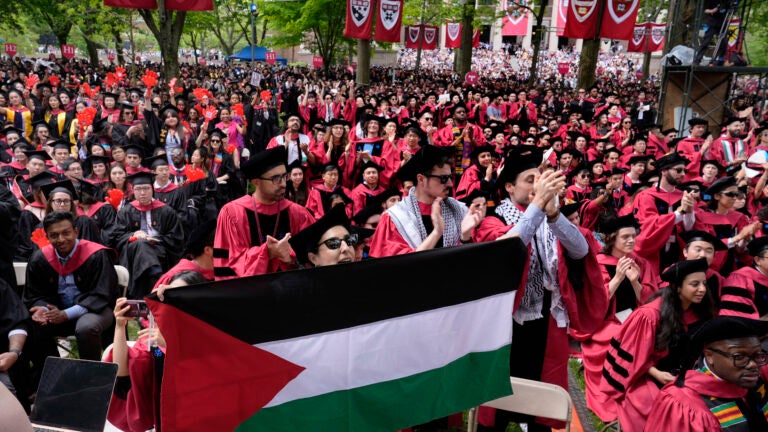
Student encampments set up by pro-Palestinian protesters emerged on college campuses around the country last month, including at several prominent Boston-area universities.
In April, police cleared encampments at Emerson College and Northeastern University, arresting around 200 people. In early May, students at the Rhode Island School of Design occupied part of an administrative building, while police arrested dozens more at UMass Amherst, Dartmouth, and UNH.
The longest-standing encampments in the Boston area occurred at MIT and Harvard. Police dismantled the MIT encampment on May 10, and the Harvard demonstrators agreed to take down their camp on May 14.
Follow below for regular updates on the campus unrest:
A large number of students walked out of Harvard’s commencement ceremony on Thursday morning, according to multiple social media posts and reporting from The Harvard Crimson.
The protesters chanted “let them walk!” as they filed out of Harvard Yard, an apparent reference to the 13 students who were barred from receiving their diplomas over their participation in a pro-Palestinian protest encampment on campus.
Hundreds participated in the demonstration, according to the Crimson. They waved Palestinian flags and displayed hand-painted signs as they called on Harvard to divest from Israel and companies tied to the country. Some of their chants referenced past protest movements in opposition to America’s involvement in Vietnam and apartheid in South Africa. Some faculty members and family joined the walkout.
Chants included “disclose, divest, we will not stop, we will not rest” and “Harvard University, we know what side you’re on, remember South Africa, remember Vietnam.”
The protesters blocked streets in Harvard Square.
Although a significant group of faculty members voted earlier this week to allow the sanctioned students to receive their diplomas, one of the university’s governing boards overruled that decision ahead of commencement. The students being disciplined were still allowed to participate in commencement ceremonies, but were not allowed to receive their diplomas.
The decision to override the faculty, made by the Harvard Corporation, was met with vocal backlash from students and faculty members this week. Organizers promised to take action at commencement ahead of the ceremony.
After the walkout, demonstrators filed into Harvard-Epworth United Methodist Church for what they dubbed the “People’s Commencement.” Members of the Harvard University Band played as graduates, faculty members, and others packed the church.
Several graduates facing sanctions addressed the crowd. A Palestinian flag was draped over the lectern. Certificates were given out which drew attention to the tens of thousands of Palestinians who have been killed in Gaza.
“In honor of the students in Palestine who will not get to graduate because of the ongoing Nakba. We stand up for them and our own students who have been targeted by Harvard University and are unable to graduate today,” the certificate stated.
“By joining this walkout, you all took a stance against the injustice that prevented our classmates from graduating today, and more importantly took a stance against injustice happening to my people in Palestine,” Harvard Law School graduate Lea Kayali told those gathered in the church, per the Crimson.
Even before the walkout, acts of protest dominated Harvard’s commencement. Two planes were seen doing loops over the campus Thursday morning. One displayed the U.S. and Israel flags side by side, the other had the words “Jewish lives matter.”
A “doxxing truck” displaying the names and faces of pro-Palestinian students appeared near Harvard ahead of commencement. It labeled them as “Harvard’s leading antisemites,” the Crimson reported. Another billboard truck criticized members of the Harvard Corporation as a “national disgrace & laughingstock” and criticized the school’s “racist ideology of D.E.I.”
Members of Harvard Faculty and Staff for Justice in Palestine distributed pamphlets advocating for Harvard to divest from “companies that profit from Israel’s occupation of Palestinian land” Thursday morning. The pamphlets, styled as mock commencement programs, highlighted how Harvard has previously divested from holdings tied to South African apartheid, tobacco stocks, and fossil fuels, per the Crimson.
Interim President Alan Garber acknowledged the protests during his remarks at the commencement ceremony. He led those gathered in a moment of silence for those experiencing “fear, dread, grief and anguish” around the world. He acknowledged that there would likely be protests, and said that those who do so have a right to demonstrate. He also said that they have a “responsibility to do so with our community, and this occasion, in mind.”
The Harvard Corporation, the smaller and more powerful of the university’s two governing boards, decided to withhold the diplomas of 13 pro-Palestinian student demonstrators who participated in the protest encampment on campus this spring.
The move is a rebuke to a group of faculty who “overwhelmingly” voted Monday to allow the students to receive their degrees. The students will still be able to participate in commencement ceremonies but will not be able to receive their diplomas Thursday morning.
“Today, we have voted to confer 1,539 degrees to Harvard College students in good standing,” the Corporation wrote in a joint statement to The Harvard Crimson on Wednesday. “Because the students included as the result of Monday’s amendment are not in good standing, we cannot responsibly vote to award them degrees at this time.”
In announcing the news, student organizers with the group Harvard Out of Occupied Palestine vowed to disrupt commencement ceremonies.
“Collective punishment will not slow us down. There can be no peace during Genocide, and we will not rest until Harvard divests,” the group said in an Instagram post. “See you at commencement.”
Protesters dismantled their encampment in Harvard Yard after 20 days. They have been calling for Harvard to cut ties with Israel and advocating for an end to the war in Gaza. Despite the encampment being voluntarily taken down, demonstrations have been ongoing since.
After voting to allow the students to receive their diplomas at a meeting of the Harvard Faculty of Arts and Sciences, a group of faculty members sympathetic to the student protesters said that the sanctions were “unprecedented, disproportionate, and arbitrary … compared to students engaging in similar acts of civil disobedience in Harvard’s history.”
More than 350 professors and 150 staff members from across Harvard signed an open letter urging administrators to allow the students to receive their diplomas. The group of “concerned faculty” outlined their argument against the sanctions in another document this week.
The motion passed at the faculty meeting asserted that the Faculty of Arts and Sciences is the “ultimate disciplinary body” for Harvard College, according to the Crimson.
“Although this process is typically a rubber stamp, it is unclear whether the boards would attempt to override the faculty decision,” the group said in a release.
That decision to override the faculty vote came after the Corporation deliberated late into Tuesday night, per the Crimson. The body, formally known as the President and Fellows of Harvard College, currently consists of 13 members who meet several times a year. It was thrust into the national spotlight last year amidst the controversies that led up to former President Claudine Gay’s resignation.
“Monday’s faculty vote did not, however, revisit these disciplinary rulings, did not purport to engage in the individualized assessment of each case that would ordinarily be required to do so, and, most importantly, did not claim to restore the students to good standing,” the Corporation said in a statement to the Crimson.
The body is already facing vocal opposition from faculty members.
“I’m upset,” Ryan Enos, a government professor, told The Boston Globe. “This was pure hubris by the Corporation. To think a bunch of billionaires that visit Cambridge a couple times a year could tell the professors who educate these students that they know better than them who deserves to earn degrees — the audacity is breathtaking. In my opinion, the Corporation is not worthy of leading the university.”
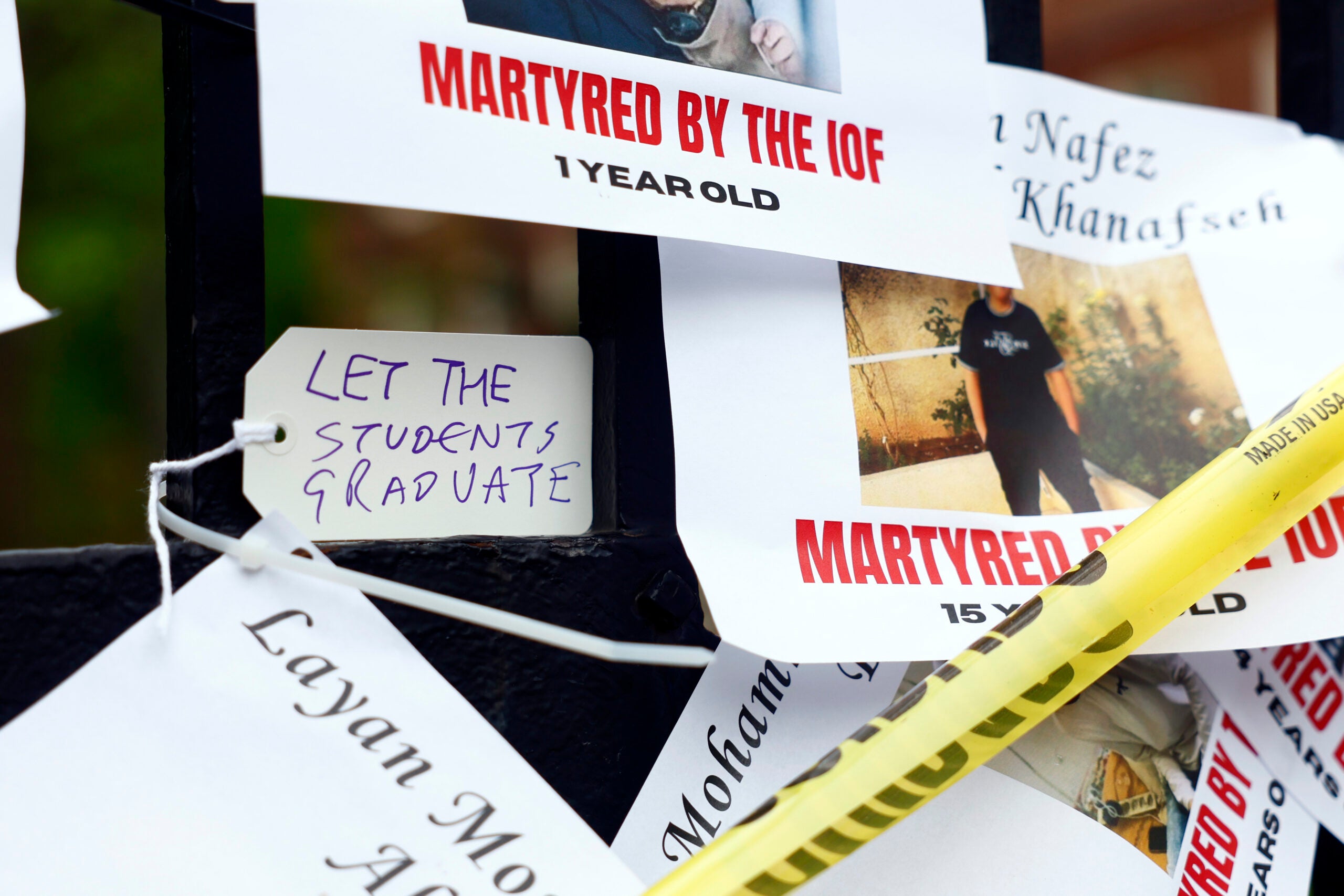
A group of Harvard faculty members “overwhelmingly” voted to allow 13 graduating seniors who had been disciplined for participating in a pro-Palestinian encampment to receive their degrees at commencement this week. The vote occurred at the Harvard Faculty of Arts and Sciences degree meeting Monday. The undergraduate commencement ceremony is scheduled for Thursday.
The 13 student protesters had been told by administrators that they would possibly have to wait as long as three more semesters to receive their degrees, according to a release from faculty members sympathetic to the protesters. The vote was a “striking rebuke” to the Harvard administrators that were pushing for strong punishments, they said.
Students from Harvard Out of Occupied Palestine, the group behind the encampment, said over the weekend that five undergraduate students have been ordered to withdraw from Harvard College and that more than 30 were placed on probation. The faculty said Monday that two students were not discussed at the meeting because they are slated to graduate after the fall 2024 semester. There are 20 students remaining on probation, according to the faculty, as their cases were not eligible for evaluation during the degree conferral meeting. Some of those facing punishment are Rhodes Scholar recipients, The Harvard Crimson reported.
The Harvard Board of Overseers and the Harvard Corporation “may” need to approve the final list of students set to receive degrees, the faculty said.
“Although this process is typically a rubber stamp, it is unclear whether the boards would attempt to override the faculty decision,” the group said in a release.
The motion approved at the faculty meeting on Monday cited Harvard’s governing statutes and asserted that the Faculty of Arts and Sciences is the “ultimate disciplinary body” for Harvard College, per the Crimson. Harvard’s governing boards gather each year on the day before the undergraduate commencement ceremony, so a final decision on the matter of the 13 graduating seniors will likely happen on Wednesday.
The encampment was set up in Harvard Yard by students calling for the university to cut ties with Israel and advocating for an end to the war in Gaza. It lasted 20 days in total, until demonstrators agreed to dismantle it last week.
At the time, interim President Alan Garber said that he would ask Harvard’s individual schools to “promptly initiate applicable reinstatement proceedings” for all who had been placed on involuntary leaves of absence. Garber vowed to ask the disciplinary boards within each school to “evaluate expeditiously, according to their existing practices and precedents, the cases of those who participated in the encampment.”
Many students and faculty members say that the sanctions being levied on the protesters are disproportionately punitive. More than 1,100 undergraduates signed a petition urging Harvard to overturn the disciplinary actions, HOOP said. At least a dozen student groups echoed these calls, the Crimson reported. More than 350 Harvard professors and almost 150 staff members signed an open letter urging the university to allow students who engaged in peaceful protest to be allowed to graduate.
The faculty and staff members said that the students were being sanctioned “in an unprecedented, disproportionate, and arbitrary manner compared to students engaging in similar acts of civil disobedience in Harvard’s history.”
Garber’s letter from the day the encampment was dismantled “does not speak to the outcome of disciplinary processes, rather it indicates he would encourage disciplinary bodies to move their processes forward expeditiously, in line with their existing precedents and practices,” Harvard spokesperson Jason Newton said in a statement.
The faculty defending the protesters outlined their reasoning in another document. They accused administrators of making procedural errors, ignoring precedent, inconsistently disciplining those involved, and misleading the Harvard community. The group concluded that there is no “evident educational justification” for the sanctions other than as a deterrent to future protests.
History Professor Alison Johnson and Latin American Studies Professor Steven Levitsky expounded on what they call “‘the Palestine exception’— a markedly lower tolerance for pro-Palestinian speech than for other speech” in an op-ed for the Crimson.
“These sanctions undermine trust. Students and faculty acted based on the widespread understanding that the university would facilitate prompt graduation, as had been stated in direct communications from the President,” the faculty said in a release.
Multiple Massachusetts universities held commencement ceremonies over the weekend, with some student protesters staging walkouts and other demonstrations regarding the Israel-Hamas war.
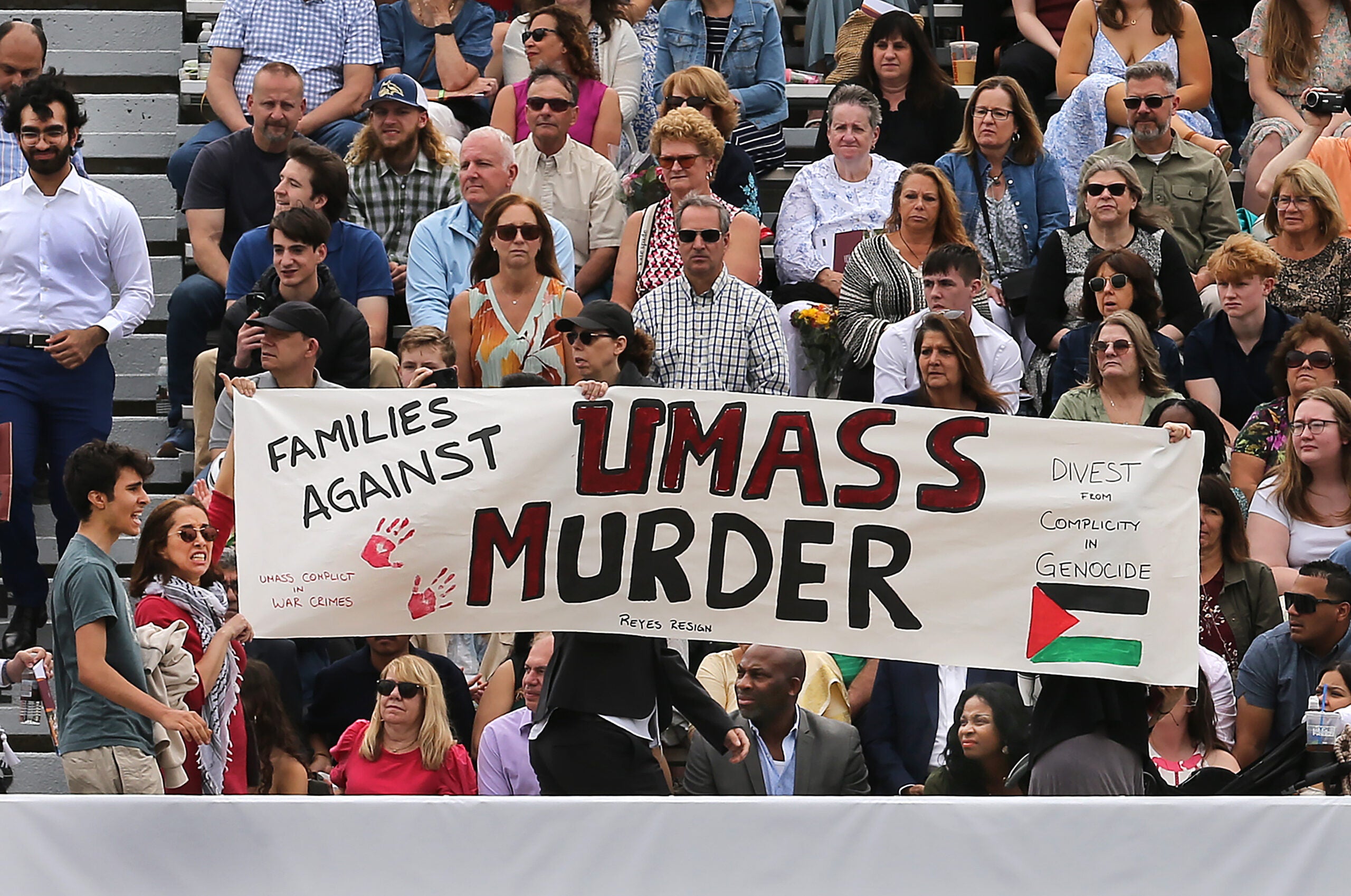
At UMass Amherst, disruptions occurred almost immediately. Several dozen students waved Palestinian flags as they walked out of McGuirk Alumni Stadium near the beginning of one ceremony. Multiple people in the bleachers unfurled a banner with the words “Families Against UMass Murder.” Chancellor Javier Reyes, who had been about to speak, paused for a couple minutes as he heard boos from some members of the crowd, The Boston Globe reported.
Reyes has been under fire for his handling of a protest encampment set up earlier this spring. He called in police to dismantle the encampment, and some students and faculty have responded by calling for his resignation. High-profile author Colson Whitehead was initially scheduled to speak at the UMass commencement ceremony, but withdrew over objections to the police response.
Reyes spoke broadly about the protests.
“I am heartened by the passion of this generation and your desire to actively work toward creating a better world. Your advocacy challenges us to explore new perspectives and create new understandings,” he said.
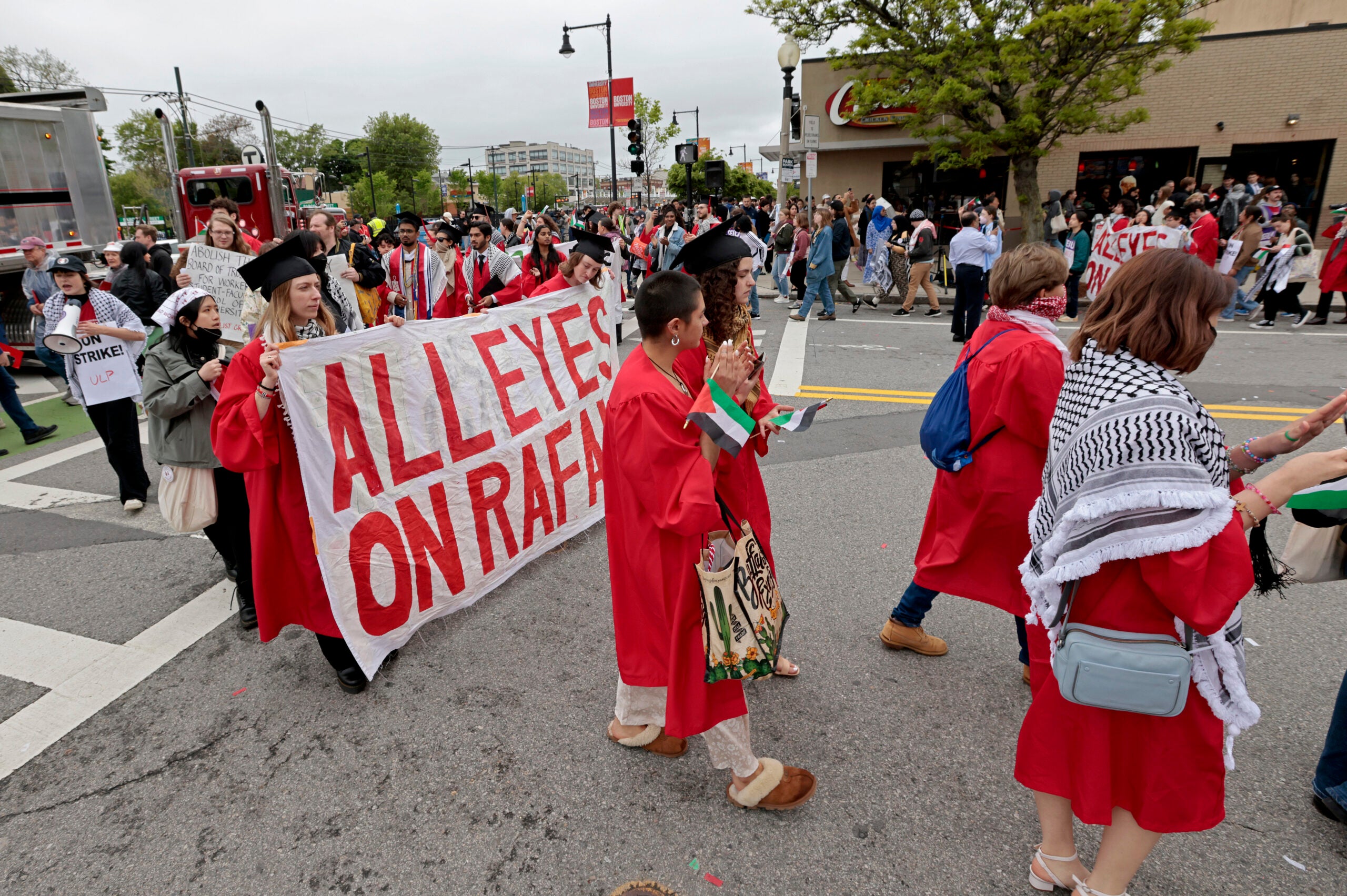
During Boston University’s commencement ceremony at Nickerson Field, about 100 students displayed Palestinian flags and hand-painted signs as they walked out. They reconvened with members of the BU Graduate Workers Union outside the field to demonstrate against Israel’s continued occupation of Gaza.
“Frankly, we believe the university has failed to respond,” Faisal Ahmed, a BU graduate who walked out, told the Globe. “So we decided to vote with our feet.”
A similar scene played out at Tufts University, which had been the site of another protest encampment that was voluntarily dismantled earlier this month. About 100 graduates walked out to join other demonstrators who protested for about an hour, according to The Tufts Daily. They said that there would be “no business as usual” as they continued to call for a divestment from Israeli companies.
Fiona Hill, a senior fellow at the Brookings Institution, spoke at the Tufts ceremony. She broadly touched on politics, remarking on the eagerness of some to support authoritarian figures and the importance of combating disinformation.
“We’re all privileged to graduate from college and with this privilege comes responsibility,” she said, per the Daily. “What you all do now with your degree is not just for you but for everyone else in the future.”
At Brandeis University, a school with a strong Jewish Identity, more than one graduate walked across the stage to receive their diploma while wearing keffiyeh scarves. Keffiyehs have become synonymous with the pro-Palestine movement.
Documentary filmmaker Ken Burns, like other commencement speakers, did not directly delve into the politics of the Middle East. He did wade into domestic politics, blasting former president Donald Trump and labeling him “the opioid of all opioids,” per the Globe.
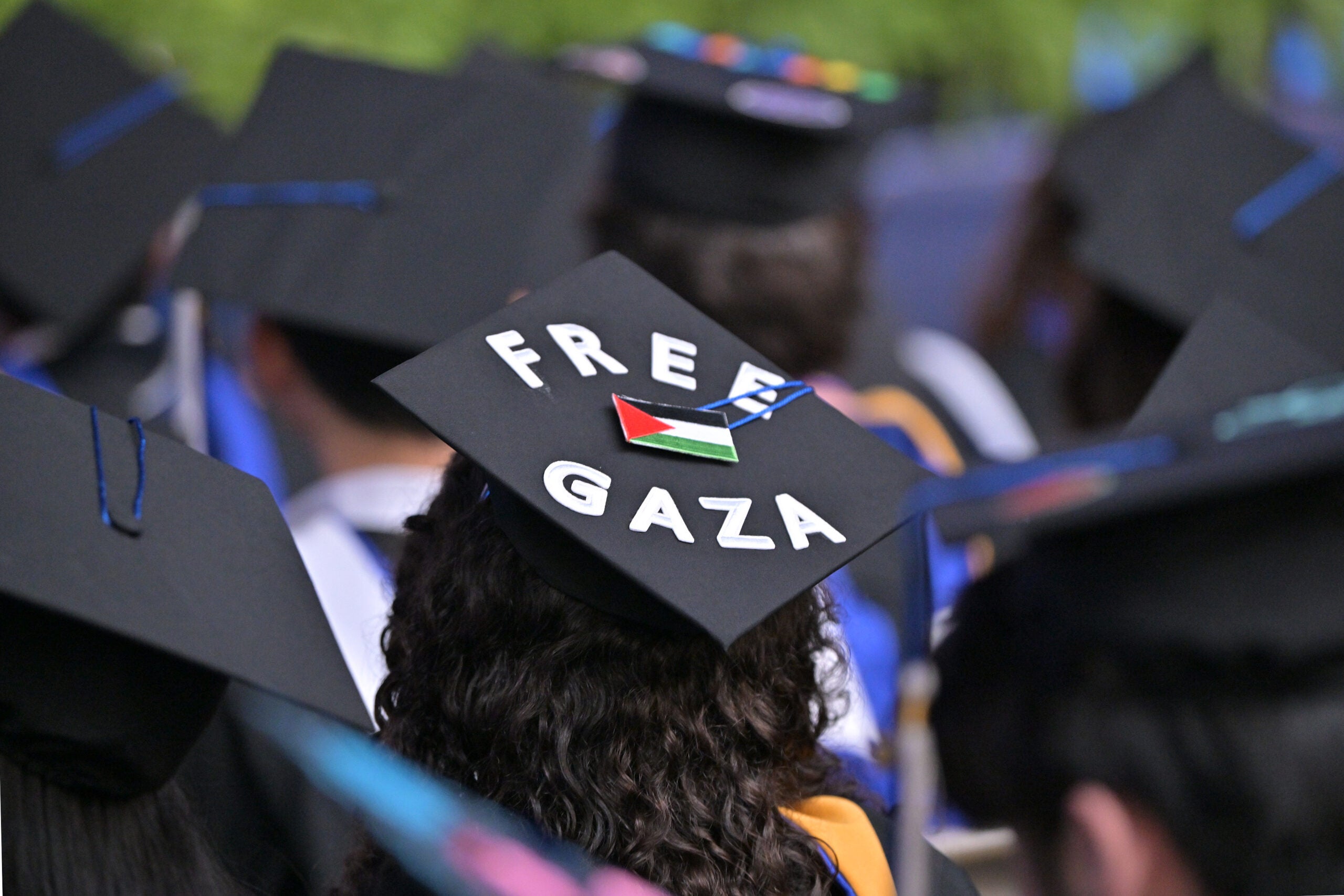
U.S. Rep. Jake Auchincloss says some of Massachusetts’s college campuses, including his alma mater, Harvard University, need to do more to address antisemitism amid protests over an ongoing war in the Middle East.
In response to a question on Fox News on Sunday about whether Auchincloss believes these schools are violating federal law, and whether federal funds should be withheld, he said, “It needs to be on the table.”
“Harvard and other universities have, unfortunately, become ransacked by antisemitism. I have seen it in my conversations with Israeli and Jewish students,” Auchincloss added.
Last month, the Anti-Defamation League gave several colleges in the state poor or failing grades for their response to a rise in antisemitic behavior on campus. In response, Auchincloss demanded those schools provide information on what they are doing to combat the problem.
Auchincloss told Fox News that Harvard and other universities need to create a culture of open discourse, free speech, and mutual respect where everybody, regardless of nation of origin, sex or race, can have a suitable learning environment.
“Right now, Harvard is failing,” Auchincloss said.
After the ADL released the report, Auchincloss sent letters to the eight poorly performing universities with a C or worse and asked them for an action plan regarding their response to the nationwide uptick in antisemitism by May 17, which they have provided, he said.
Letters were sent to Boston University, Northeastern University, Wellesley College, and Williams College, each of which received a C, and Harvard University, MIT, Tufts University, and UMass Amherst, which all received an F.
Brandeis University and Amherst College were the only two of the 10 Bay State universities examined to receive a B or better.
Auchincloss’s office and the ADL are reviewing those plans over the summer to make sure the schools return in the fall with “their house in order.”
Dozens of Harvard University students were disciplined for their role in the 20-day encampment, a move protesters say breaks the university’s promise to reinstate students involved with the Harvard Out of Occupied Palestine encampment.
The Harvard Palestine Solidarity Committee, a student organization suspended last month, agreed to end their encampment last Tuesday. They said that 12 students were barred from graduating and another 28 were placed on probation or suspension for participating in the Harvard Out of Occupied Palestine encampment. The group said all students facing disciplinary action are undergraduates.
Harvard’s commencement ceremony is Thursday, May 23.
Harvard President Alan Garber wrote at the encampment’s disbandment that the university’s individual schools are responsible for disciplinary processes.
“I will ask that the Schools promptly initiate applicable reinstatement proceedings for all individuals who have been placed on involuntary leaves of absence,” Garber wrote. “I will also ask disciplinary boards within each School to evaluate expeditiously, according to their existing practices and precedents, the cases of those who participated in the encampment.”
The organization wrote on Instagram that if the university followed “precedent” when disciplining students, there would be no charges or minor discipline. They referenced campus protests against South African apartheid and fossil fuels from 1986 to 2016.
The group is also circulating a petition for undergraduates to sign.
“The precedent is clear: drop the charges and do not heavily discipline students for calling for disclosure and divestment,” they wrote. “If Harvard won’t live up to their promises, we see no reason to live up to ours.”
A spokesperson for Harvard referred to Garber’s letter in a statement on Saturday.
“It does not speak to the outcome of disciplinary processes, rather it indicates he would encourage disciplinary bodies to move their processes forward expeditiously, in line with their existing precedents and practices,” spokesperson Jason Newton said.
A week after police dismantled a pro-Palestinian tent encampment at MIT, the college’s Hockfield Court was home to a musical celebration of Jewish joy that also served to “honor … those who died on October 7th.”
Dubbed “We Will Dance Again,” the event — planned by the MIT Israel Alliance and MIT Hillel in collaboration with other colleges all over Boston — featured a series of musical acts and was inspired by the Supernova Sukkot Gathering, the festival where hundreds died during the Hamas attack last fall.
Free for students — more than 1,200 had reserved tickets — the event included an appearance by Israeli DJ Daniel Vaknin, a survivor of the festival attack.
“We managed to survive, and we managed to stand here in front of you to celebrate life again,” he told the crowd, The Boston Globe reported.
“It feels really Israeli,” Brookline High student Peleg Yadinsaid Yadin, an Israel native, told the Globe. “There’s always antisemitism and anti-Zionism protests, and finally there’s something for Israelis.”
View images from the event below:


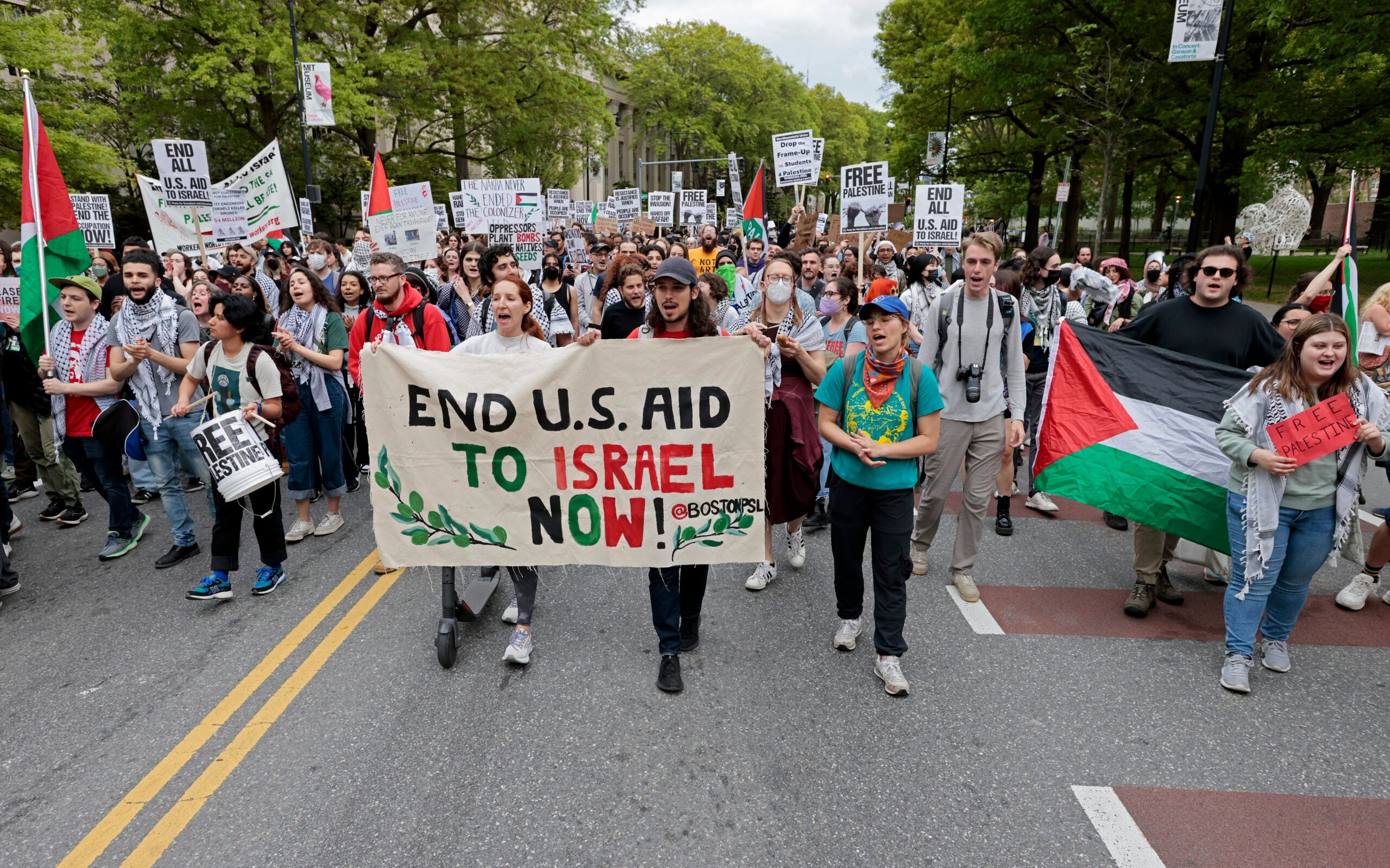
Although the encampment set up by pro-Palestinian demonstrators at MIT was dismantled last week, the student protesters and their allies are continuing to put pressure on the university.
A series of connected demonstrations took place Wednesday. In the afternoon, about 40 people gathered in front of the Cambridge officers of Elbit Systems, a company that builds a variety of military equipment.
Protesters blamed the company for being complicit in Israel’s actions in Gaza, where tens of thousands have been killed amid what President Joe Biden has labeled “indiscriminate bombing.” While Biden has since paused one shipment of bombs to Israel, other shipments of weapons continue to flow.
Later on Wednesday, protesters held a rally commemorating the Nakba, the violent displacement of Palestinians during the 1948 Arab-Israeli war. This “dwarfed” a counter-protest across the street, organizers said on social media.
“We have to continue to fight in spite of everything that we faced,” Nishad Gothoskar, a fourth-year graduate student at MIT, told The Boston Globe. “It shows the incredible resilience of the students here.”
By 5:15 p.m., the rally became mobile. Hundreds of people walked down Massachusetts Avenue and onto Vassar Street. They stopped in front of a parking garage where multiple MIT student protesters were arrested last week, according to the Globe.
Around an hour later, the demonstrators gathered in front of MIT President Sally Kornbluth’s home to chant “Free Palestine.” They then moved to Harvard Bridge.
Dozens of counter-protesters waving American and Israeli flags followed the group, per the Globe. They tried to interact with the pro-Palestinian demonstrators, but police formed a moving wall between the two groups.
Similar demonstrations are likely to continue. MIT student organizers are planning to “deliver” their demands to Kornbluth at another rally on Friday. More than 2,000 people have signed a petition demanding that administrators reverse all disciplinary measures dealt to protesters since last October 2023 and refrain from issuing any extra discipline to MIT community members for protesting.
In a special session of the Faculty Senate, UMass Amherst Chancellor Javier Reyes and other school leaders defended their handling of a pro-Palestine encampment set up by student protesters on campus last week.
After police were called in to break up the demonstration, 130 people were arrested. This included students, faculty, and people from the wider community who now face charges including trespassing, failing to disperse, and resisting arrest. They are being arraigned this week in Eastern Hampshire District Court, according to the Northwestern District Attorney’s office.
At the time, Reyes said that calling in law enforcement was a “last resort.” On Tuesday, in front of the hundreds of people who attended the meeting, Reyes said that concern for the “safety and well-being” of all on campus prompted his actions. He did not explicitly apologize or respond to calls for his resignation, The Daily Hampshire Gazette reported.
Students looking to draw attention to the suffering of Palestinians in Gaza at the hands of Israel initially set up an encampment in late April. It was dismantled by the demonstrators the next day, with UMass administrators telling them that they could continue to use the space for protest but needed to take down their tents. Organizers said that UMass officials threatened them with “police violence and academic sanctions.” They set their encampment back up about a week later.
Groups like the ACLU of Massachusetts and the Massachusetts Teachers Association have blasted Reyes for his decision to call in police. Pulitzer Prize-winning author Colson Whitehead dropped out of his role as keynote speaker at commencement because of his opposition to the police response. Some of those arrested have accused police of using excessive force. A petition is circulating calling for his resignation, and the school’s Student Government Association passed a vote of no confidence in his leadership.
Reyes and other administrators spoke over shouts and other noises from the audience as they justified their decision-making. Police were only called in after a 90-minute meeting between demonstrators and administrators where Reyes promised to explore the possibility of having UMass Amherst divest from companies involved in the Israel-Hamas war, the Gazette reported. Wooden pallets were brought to fortify the encampment, leading to Reyes’ assessment that the issues at play involved campus safety, not simply questions of free speech.
“To be clear, we hoped for a peaceful and collaborative outcome,” Reyes said, per the Gazette. “As chancellor, one of my responsibilities is to do everything I can for the safety of the entire campus.”
Reyes said he lacked the unilateral authority to meet some of the protesters’ demands but pledged to work with the Faculty Senate and the Student Government Association to adjust the Code of Student Conduct.
Multiple staff members spoke out against Reyes and the police response. Laura Briggs, of the Women, Gender, and Sexuality Studies department, said she was “horrified.” UMass Librarian Alison Messier said she was not sure if she wanted to be at the university if people are feeling unsafe. Brenda Bushouse, of the School of Public Policy, said her daughter was bruised by police as they broke up the protest, per the Gazette.
Members of the University of New Hampshire Faculty Senate approved a resolution Monday calling for the school to investigate the events surrounding a pro-Palestine rally on May 1. Student protesters attempted to erect an encampment on campus as part of that rally, prompting a police response that resulted in 12 people being arrested.
Members of the Faculty Senate called the response from police and UNH administrators “disproportionate” in the resolution. They claimed that administrators failed to “directly communicate” with members of the UNH community before, during, and for more than 16 hours after the police response.
The Faculty Senate requested a “transparent investigation” into the events surrounding the May 1 rally, and that the investigation include the body’s Campus Planning Committee. Faculty members also called for UNH to host a community forum to discuss the specifics of the rally and general policies regarding student-organized public assembly.
The motion passed with 38 votes in favor, eight against, and four abstentions.
“UNH Police continue to examine the evidence surrounding these cases and will make a determination in the coming weeks. We’ll work with faculty senate leadership over the summer to determine how best to proceed with the request for a review,” a UNH spokesperson said in a statement.
On April 29, administrators were alerted to plans being formulated by student organizers about setting up an encampment. Over the next two days, representatives from the school’s Office of Student Life and the UNH Police Department told student protesters that they may exercise their right to free speech, but that an encampment would not be tolerated, according to a timeline of events provided to the Faculty Senate by UNH leaders. The organizers told police and school leaders on the morning of May 1 that they had no plans to erect an encampment.
At about 1:15 p.m., UNH President Jim Dean spoke with Gov. Chris Sununu. By 3 p.m., State Police told UNH Police that they would be on hand “at the order of the governor,” according to the timeline.
The rally began at 5 p.m., and about 100 protesters were gathered in front of Thompson Hall by 6 p.m. Protesters encircled a flagpole, linked arms, and erected tents around 6:30 p.m. Students were told at this time that they would be arrested if the tents were not taken down, according to the timeline established by administrators.
UNH Police Chief Paul Dean tried to enter the circle in an attempt to de-escalate the situation, school officials said. Both the student protesters and a professor emeritus have said that his actions actually escalated tensions.
Between 7:10 and 7:30 p.m., Chief Dean continued to speak with protesters, warning them that they would be arrested if they did not disperse. He urged organizers to take down their tents, according to the timeline. In response, demonstrators set up more tables and tents to “fortify” the encampment.
Members of the state police arrived in riot gear just after 7:30 p.m. and began confronting protesters. They threw objects at the officers, who in turn used non-lethal pepper balls to “control the crowd,” UNH said. A total of 13 UNH Police officers and 18 state police officers were involved.
The tents were being occupied by three or four people each. Police found water, food, and other supplies inside, leading them to believe that the demonstrators were “absolutely” planning to establish a long-term encampment, according to the timeline.
A petition is circulating online demanding that all charges be dropped against the protesters, that an independent investigation take place, and that administrators meet with student protesters in good faith to discuss their demands. It has been signed by at least 175 people, including many faculty members.
Tensions remained high a week after the incident, when protesters organized a walkout to reiterate their demands. This led to a tense but nonviolent standoff with counterprotesters.
Another rally was scheduled for Wednesday afternoon.
The protesters who were arrested last week as police cleared a pro-Palestinian encampment at UMass Amherst are being arraigned this week in Eastern Hampshire District Court.
A total of 130 people were arrested. This included students, faculty, and people from the wider community, according to Northwestern District Attorney David E. Sullivan’s office. On Monday, 21 people appeared before a judge inside a Belchertown courtroom and pleaded not guilty on charges including trespassing, failing to disperse, and resisting arrest. Not every person arrested faces all three charges.
Groups of about 20 people will be arraigned each coming day until all have appeared in court. Sullivan’s office said that the arraignments could run into next week. Most of the cases were continued to early July for pretrial conferences.
“We respect the right of people to speak out and engage in political protests as is fundamental to our democracy. At the same time, we understand the university may take steps to safeguard everyone on the campus,” Sullivan said in a statement.
Last month, an encampment at UMass Amherst was briefly set up before being peacefully dismantled by demonstrators the next day. Student organizers said they were “threatened with police violence and academic sanctions.” The camp was erected again soon after.
Chancellor Javier Reyes asked for police intervention after negotiations with the demonstrators broke down. He described calling for help from the police as a “last resort.”
Reyes and other UMass leaders faced a vocal backlash for involving police, including from the ACLU of Massachusetts and the Massachusetts Teachers Association. The UMass Student Government Association “overwhelmingly” passed a vote of no-confidence in Reyes. Some of those arrested accused police of using excessive force.
“Police threw people to the ground, knelt on people’s necks, rushed into peaceful crowds, broke protestor’s bones, and dogpiled arrestees,” organizers wrote in a petition to oust Reyes.
Prosecutors are working to obtain and review police reports and body camera footage from the operation, Sullivan’s office said.
Colson Whitehead, a high-profile author who was scheduled to be the keynote speaker at UMass Amherst commencement, canceled his speech about a week before the ceremony. Whitehead called the decision to bring in police officers to deal with peaceful protesters “a shameful act.” The ceremony is now scheduled to proceed without a commencement speaker.
“We understand there is significant community interest in these cases, particularly as there are similar protests taking place around the country. The Northwestern District Attorney’s Office will seek just resolutions for each case individually, with prosecutors taking into account the specific facts around each arrest,” Sullivan said in a statement.
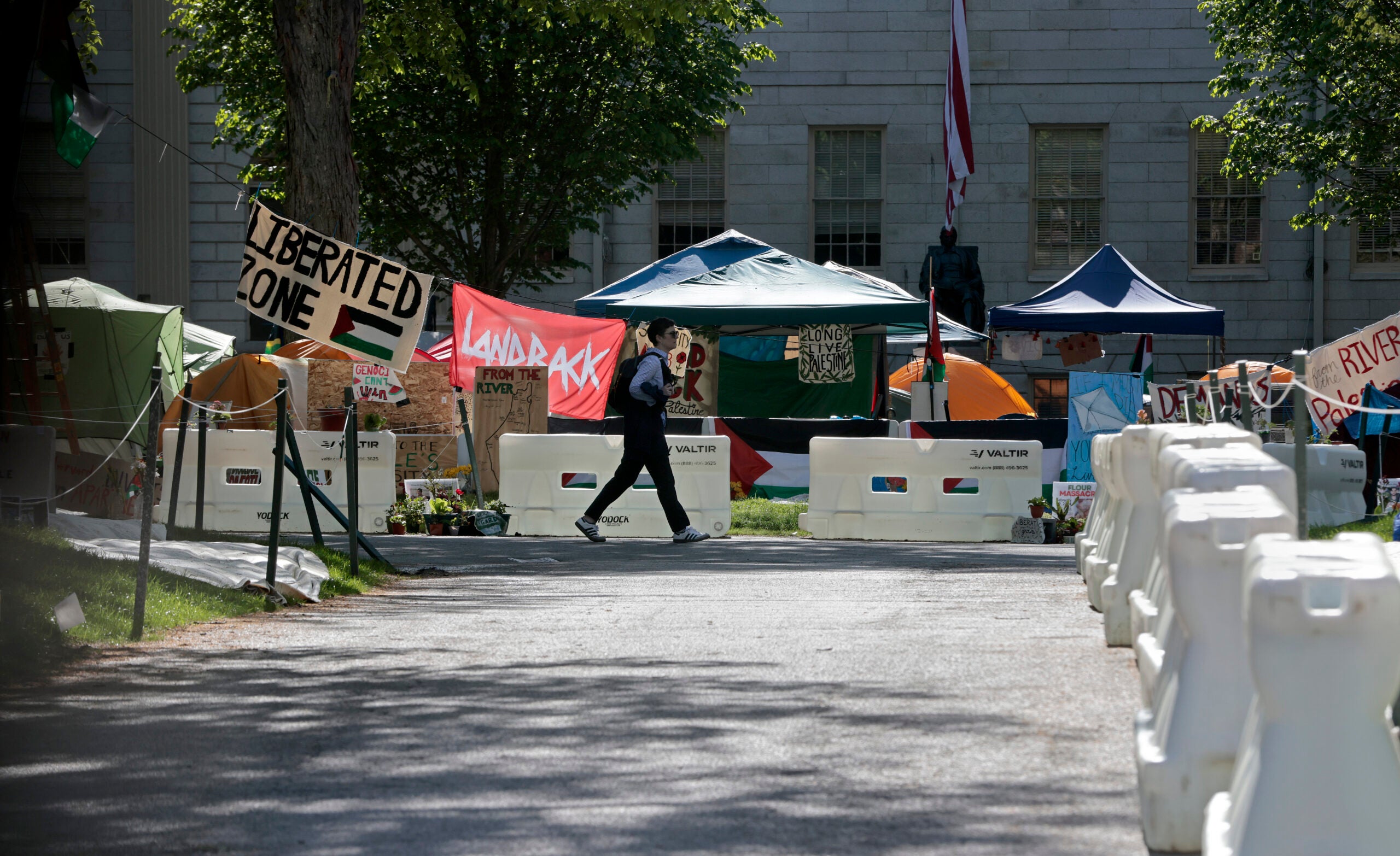
The pro-Palestinian student protesters who have been camped out in Harvard Yard for weeks announced Tuesday that they have agreed to peacefully end their demonstration. The news comes a week before commencement festivities are set to kick off.
“Encampments are a tactic — a big and beautiful one — in a larger strategy of divestment. Here at Harvard, we believe the utility of this tactic has passed, and we have decided to re-group and carry out this protracted struggle through other means,” students organizers with the group Harvard Out of Occupied Palestine wrote in an Instagram post Tuesday morning.
The encampment lasted 20 days in total, as student protesters and their allies called for Harvard to cut ties with Israel and advocated for an end to the war in Gaza.
As recently as Saturday, the demonstrators hosted others from around Boston to block roads in Harvard Square with a large rally. Footage posted to social media showed some protesters scaling the gates around Harvard Yard.
Harvard administrators did not call in police to break up the encampment, avoiding the physical confrontations that occurred at nearby schools like Emerson and Northeastern. Instead, the university closed Harvard Yard to those not affiliated with the university and threatened the students with “involuntary leave.” Those placed under this designation would have been barred from residing in Harvard buildings or sitting for exams, and forced to leave campus until they were reinstated.
Talks with interim President Alan Garber and other Harvard leaders broke down last week, and the school began following through on issuing suspensions. More than 20 students were suspended and more than 60 were referred for “further disciplinary charges,” according to HOOP.
“For three weeks, Harvard mobilized all its resources to quietly choke us out,” the group said.
As students moved out of the dorms near Harvard Yard, police “became the dominant presence,” they added, likening the situation to a “surveillance state.”
In an agreement to end the encampment, administrators agreed to “retract” these suspensions, student organizers said in their announcement. School officials also offered to hold future meetings with students about divestment from Israel and the possibility of creating a Center for Palestine Studies at Harvard.
The demonstrators continued to blast Harvard and its leaders while vowing to continue to make their voices heard.
“We are under no illusions: we do not believe these meetings are divestment wins. These side-deals are intended to pacify us away from full disclosure & divestment. Rest assured, they will not,” they wrote.
The students began dismantling the encampment Monday night into Tuesday, The Harvard Crimson reported. They continued to calmly take tents down Tuesday morning, as workers nearby constructed a temporary stage and strung up banners in preparation for commencement.
“The Harvard Liberated Zone ruptured our understanding of what we believed to be possible at an institution that serves as the rotten heart of a dying empire,” the students said in their announcement. “It brought the student intifada to a school that trembles at the very word. And it grew our organizing power such that we can only come back stronger in our fight for Palestine.”
The lock on the main gate to Harvard Yard was intentionally cut Saturday by someone from inside the yard, Harvard police said, during a pro-Palestine demonstration when more than a hundred protesters were outside the gates.
The university police said officers responded to Johnston Gate around 7 p.m. on May 11, where they found a cut lock and a bag inside Harvard Yard containing bolt cutters. Police said it was intentionally cut in an attempt to let in the protesters, many of whom were not affiliated with Harvard.
Harvard police said that officers immediately secured the gate, and “there was no breach of the yard.” The demonstration on Saturday took place outside the yard’s gates before protesters marched through Harvard Square to Peabody Street, The Boston Globe reported.
Harvard University spokesperson Jason Newton said there have been many other indications of attempts to cut the lock and open the gates since the Yard has been closed to visitors starting April 21.
“This concerning incident comes at a time when there are increasing reports from frontline staff of harassing and intimidating behavior by participants in the encampment protest,” Newton said in a statement. “These reports are not only from staff carrying out ID checks and other work to enforce policies, but also from staff while going about routine duties.”
Harvard Palestine Solidarity Committee, which was suspended by Harvard last month, did not return a request for comment immediately Monday evening.
Harvard University apologized to a student journalist who was wrongfully sent an involuntary leave notice, which bars students continuing the encampment from sitting for exams, residing at Harvard, and being on campus.
The Harvard Crimson reported that their reporter, who was covering the pro-Palestinian encampment on Harvard Yard “infrequently,” was sent a notice on Friday.
The university said in a statement that the accidental notice was rectified immediately, and the student was issued an apology.
“A Harvard Crimson reporter covering the activity in the Yard submitted to an ID check earlier this week, part of the College’s routine check for Harvard IDs for all affiliates gathered around the encampment,” a spokesperson said. “This student received an involuntary leave message today as their status as a Harvard Crimson reporter was not communicated to the College.”
The Crimson wrote that their reporter received one of 21 notices sent to protester organizers, despite the student identifying themselves as a reporter with a press badge and verbally when they presented their ID at the protest.
“While the suspension was quickly lifted after The Crimson contacted the University, it was nonetheless an alarming violation of due process and student press freedom,” Crimson President J. Sellers Hill wrote, according to the college paper.
More than two weeks after police swept into an encampment at Emerson College and arrested more than 100 people, demonstrations regarding the Israel-Hamas war were a steady presence at the school’s commencement ceremony.
Journalism professor Michael Brown, who served as Grand Marshal, was the ceremony’s first speaker. He was interrupted almost immediately by loud chanting, which was met by boos from other members of the crowd gathered in Agganis Arena Sunday.
“I’m here for the graduates of 2024. You are the class that didn’t have a high school graduation. We’re going to have a graduation today,” Brown said, to applause. “This has always been my favorite Emerson event. My favorite Emerson event because you go off into the world and have to be adults.”
As student protests swept the world last month, Emerson students camped out for four days in an alleyway at the college’s campus in downtown Boston, calling for a ceasefire in Gaza, a broader respect for Palestinian rights, and for the school to cut any ties with the Israeli government.
In a chaotic late-night scene, Boston Police in riot gear dispersed the student protesters. Many were arraigned on charges including trespassing and disturbing the peace. Some accused the officers of using excessive force.
In the aftermath, Boston Mayor Michelle Wu said she and Police Commissioner Michael Cox made the decision to call in police, as the act of protest was violating a city ordinance prohibiting encampments. She said that the protesters were given opportunities to disperse but “wanted to get arrested.” The city is reviewing hundreds of hours of body camera footage from the incident.
Emerson President Jay Bernhardt has faced much of the criticism from student protesters. Tensions linger from March, when 13 student protesters were arrested outside Bernhardt’s inauguration ceremony. In the wake of the arrests at the encampment, the student government unanimously approved a resolution calling for his resignation, but the colleges’ Board of Trustees stood by him.
Some students tore off their robes and threw them at Bernhardt’s feet during the commencement ceremony. One walked across the stage with her hands raised in a rude gesture towards him. Another, with hands dyed red, brought proceedings to a halt as they tried to shake Bernhardt’s hand, The Boston Globe reported.
“It was a hard graduation to be at. I appreciate the courage and the voice of our students, and speaking up for what they believe in,” Mneesha Gellman, a political science professor, told the Globe. “I also hope that we can find ways to steer that energy toward the larger decision-makers in the world.”
Other acts of protest included a student throwing their diploma across the stage, and another who draped a Palestinian flag over the podium, per The New York Times. As the ceremony ended, about 50 students left the recessional line to stay on the arena floor. They attempted to chant “free Palestine” over the drummers playing the graduates out.
“It’s been a tumultuous time for sure. But Emerson students like to use their voice, and I think the school tried their best to listen to what the students had to say,” graduate Noah Matalon told the Globe. “I’m just glad that we were able to get through the ceremony [and] people were able to get their voices heard.”
Sorry. This form is no longer available.
Massachusetts Institute of Technology and Harvard student protestors are being prevented from graduating and evicted from their housing, according to The Boston Globe.
Dan Zeno, an MIT graduate student, was barred from attending classes and evicted from campus housing, along with his wife and 5-year-old daughter, according to the paper.
“My daughter is the most important thing. … We’re trying to keep a sense of normalcy for her,” Zeno told the Globe.
Zeno is a 35-year-old Air Force Veteran in MIT’s Sloan School of Management MBA program.
“The level of risk we are taking on is nothing compared to what Palestinians are going through in Gaza. Children are being intentionally starved as a military strategy. This is a super urgent situation,” he said.
Students have been suspended, evicted, have had their fellowships canceled, and their research halted, according to the Globe. However, students say that has not made them waiver in their belief and vigor for the cause.
A response rally was held on MIT’s campus Friday, bringing crowds and signs that read “Drop the charges,” “We deserve respect,” and other slogans, according to a video posted by MIT Graduates for Palestine, Boston Coalition for Palestine, and others.
The student encampment was dismantled and students were arrested, according to the Globe, making MIT the third Boston-area college to forcibly remove and charge students for their involvement with a Pro-Palestine encampment. Students were mostly charged with trespassing, according to reports.
An image of the lawn where the encampment took place was posted by the MIT Graduates for Palestine and MIT Coalition Against Apartheid.
Harvard University began suspending students who refused to leave the area containing the encampment Friday, according to The Boston Globe.
Kojo Acheampong, a sophomore at the school, was suspended.
“Obviously there’s a moment of shock. It’s like, ‘Oh, it’s actually happening.’ You’re making calls to your family members and they’re going crazy,” Acheampong, a computer science student and one of the organizers of the encampment, said.
In a similar fashion to MIT activists, students are not deterred by these disciplinary actions.
The caption of a post on Saturday from the Harvard Out of Occupied Palestine group reads, “HARVARD WON’T NEGOTIATE; WE DON’T CARE WE’RE HERE TO STAY.”
The University of Vermont removed its 2024 commencement speaker, according to the Burlington Free Press, in alignment with demands from pro-Palestine student protestors.
U.S. Ambassador to the United Nations Linda Thomas-Greenfield was previously chosen as the university’s commencement speaker. However, because she vetoed resolutions calling for a ceasefire in Gaza on three separate occasions, student protestors demanded canceling the invitation.
As of May 8, the UVM Students for Justice in Palestine or @uvm.sjp on Instagram elected to “dissolve the Palestine Solidarity Encampment at UVM” after 10 days.
“In 10 days, we have forced the cancellation of the U.N. Ambassador Linda Thomas-Greenfield as 2024 commencement speaker and achieved a limited disclosure of endowment information,” reads part of the student group’s statement on Instagram.
Thomas-Greenfield’s removal as the speaker was one of five demands from student protestors and the subject of a rally held on April 29, according to Burlington Free Press.
“After their years of hard work and commitment to success, they deserve a weekend of ceremony and celebration befitting their accomplishment. It is with regret that I share that our planned speaker, Ambassador Linda Thomas-Greenfield, will not be joining us to deliver the Commencement address,” said UVM President Suresh Garimella in an email about graduating students.
According to the Students for Justice in Palestine, the demands included disclosing all financial investments from the UVM endowment, divesting from all weapon manufacturers, Israeli companies, and companies involved in the occupation of historic Palestine, the academic boycott of Israeli institutions, canceling Thomas-Greenfield as the commencement speaker and “amnesty for all students in engaged in protests.”
Pro-Palestinian student organizers at Harvard University said early Friday morning that “mass suspension” was “imminent” after negotiations between them and interim President Alan Garber failed.
A back-and-forth between the two sides apparently kicked off this week when Garber threatened “involuntary leave” to the student protesters who continue to camp out in Harvard Yard.
“Disciplinary procedures and administrative referrals for placing protesters on involuntary leave continue to move forward,” a spokesperson for Harvard said Friday morning.
The encampment was set up by students more than two weeks ago to “call for an end to Harvard’s moral and material complicity in the ongoing genocide of the Palestinian people.” After police dismantled a similar encampment at MIT early Friday, the demonstration at Harvard appears to be the last major pro-Palestinian encampment left on a Boston-area campus.
Administrators responded by closing Harvard Yard to those not affiliated with the university. So far, they have not called in police to break up the demonstration.
But with commencement ceremonies fast approaching, Garber said Monday that the encampment must be dismantled and outlined the repercussions that student protesters would face. Those who continue to participate in the encampment would be referred for “involuntary leave,” meaning that they may not continue to reside in Harvard buildings, may not sit for exams, and must leave campus until they are reinstated.
Garber blamed the encampment for a number of disruptions and safety concerns in his letter earlier this week.
“The right to free speech, including protest and dissent, is vital to the work of the research university. But it is not unlimited,” Garber wrote. “The encampment favors the voices of a few over the rights of many who have experienced disruption in how they learn and work at a critical time of the semester.”
Student organizers said that the threats were Garber’s first acknowledgement of the encampment. He then used “backchannels” to “meet informally” with liaisons for the group known as Harvard Out of Occupied Palestine.
The demonstrators said that they asked for Garber to “begin negotiations on disclosure and divestment,” something they characterized as the “bare minimum.” Garber’s response, according to the students, was to reiterate the threats outlined in his letter Monday.
“Garber shut down our most basic demands, making clear that the meeting was not a negotiation, but merely a ‘conversation.’ All he would concede was the possibility for more ‘conversations’ — not negotiations — conditional on the immediate removal of the encampment,” students from HOOP wrote in an Instagram post.
The meeting between Garber and protesters occurred Wednesday night at the behest of Garber, a Harvard spokesperson told Boston.com. The meeting was “not a negotiation of protesters’ demands,” the spokesperson confirmed.
“As he has and will continue to do with other groups, in the conversation President Garber listened to the students’ perspectives on their concerns and goals. He reaffirmed the University’s commitment, as an institution where debate and discussion are central to our mission, that there would be more opportunities for constructive dialogue on these issues across our community in the coming months,” the spokesperson said in a statement.
Garber offered to facilitate a meeting with the students that would include a member of the Corporation Committee on Shareholder Responsibility and other Harvard officials for the purpose of addressing questions about the endowment, the spokesperson said. However, this offer was contingent on the protesters voluntarily dismantling the encampment.
Garber told the students that the endowment will not be used “as a political tool,” and that future meetings with administrators would not be considered while the encampment and “disruption to the educational environment remains,” according to the spokesperson.
Students made a counteroffer with four “tangible asks” aimed at moving Harvard “forward on transparency and ethical investment.” Garber rejected that counteroffer and the possibility of future negotiations, HOOP said.
This week, more than 300 Harvard professors signed a petition urging Garber and other university leaders to engage in “meaningful dialogue” with the protesters instead of issuing escalating threats of disciplinary action. The faculty members began drafting a letter to Garber on Monday after he called for the protesters to disperse.
A group of alumni aligned with the protesters also exerted pressure on administrators this week. In an op-ed for the Crimson, a collective known as Harvard Alumni for Palestine announced that its members would withhold all their donations for the university while also withdrawing their consent for Harvard to use their names, images, and likenesses.
“Students daring to protest in defense of Palestinian right to life should be celebrated, not oppressed,” the alumni wrote.
In the wake of the failed negotiations, demonstrators vowed to stay in their tents Friday.
“To every person in Palestine struggling towards freedom: we learn our steadfastness from you,” they said on social media.
Police dismantled a pro-Palestinian tent encampment at MIT early Friday.
Video showed police roaming through the MIT encampment. Police in riot gear arrived around 4 a.m., encircled the camp and gave protesters about 15 minutes to leave. Ten students who remained were arrested, the university’s president said. A crowd outside the camp began gathering and chanting pro-Palestinian slogans but were dispersed by 6 a.m.
The move comes several days after police first attempted to clear the camp only to see protesters storm past barriers and restore the encampment, which includes about a dozen tents in the heart of the campus in Cambridge.
Before removing the encampment, MIT earlier in the week had started suspending dozens of students involved in the encampment, meaning they wouldn’t be able to take part in academic activities nor commencement.
Protesters insisted the move would not stop them from demanding that MIT end all ties to the Israeli military.
“This is only going to make us stronger. They can’t arrest the movement,” Quinn Perian, an undergraduate student at MIT and organizer for MIT Jews for Ceasefire, said. “We are going to continue and won’t back down until MIT agrees to cut ties with the Israeli military. MIT would rather arrest and suspend some students than they would end their complicity with the genocide going in Gaza.”
The encampment had been up for at least two weeks and especially angered Jewish students, who have held counterprotests nearby. They covered a lawn with small Israeli flags and put up posters of some of the people abducted by the militants in the attack that ignited the war in Gaza.
MIT President Sally Kornbluth, working to strike a balance between recognizing the suffering in Gaza and concerns about the “safety of our community,” had warned Monday the encampment would have be removed.
In a letter acknowledging Tuesday’s arrests, she wrote that her responsibility is “to make sure that the campus is physically safe and functioning for everyone … and that everyone feels free to express their views.” The encampment, she wrote, “increasingly made it impossible to meet all these obligations.”
— Associated Press
Colson Whitehead, a Pulitzer Prize-winning novelist who was scheduled to be the commencement speaker for University of Massachusetts Amherst in a little more than a week, canceled his speech after the school’s administration called in police to break up a pro-Palestine encampment on campus.
“Calling the cops on peaceful protesters is a shameful act,” Whitehead wrote in a BlueSky post, saying he sent the message to UMass administration on Wednesday. “I have to withdraw as your commencement speaker.”
A spokesperson for Whitehead confirmed that he would not be speaking at commencement.
The school said in a statement to Boston.com Thursday that the ceremony, scheduled for May 17, would proceed without a commencement speaker.
“We respect Mr. Whitehead’s position and regret that he will not be addressing the Class of 2024,” the statement reads.
Whitehead’s announcement follows the arrests of more than 130 people — over half of whom were students — on the UMass Amherst campus Tuesday night. In the following days, the school’s student government association passed a vote of no confidence in Chancellor Javier Reyes and the ACLU released a statement condemning the arrests.
Students for Justice in Palestine, the campus group at the school that organized the encampment, called the arrests “bloody” and “violent” in posts on Instagram. Several campus organizations also condemned the arrests, saying they were “horrified” by the actions taken against peaceful protesters.
“I give all my best wishes and congratulations to the class of ‘24 and pray for the safety of the Palestinian people, the return of the hostages, and an end to this terrible war,” Whitehead wrote in the post.
UMass Amherst Chancellor Javier Reyes asked police officers to break up an encampment set up on campus by pro-Palestinian protesters Tuesday night, resulting in the arrests of more than 130 people. In the wake of that decision, the UMass Student Government Association “overwhelmingly” passed a vote of no-confidence in Reyes and his administration Wednesday.
“Chancellor Reyes’s unconscionable decision to issue hundreds of police officers upon the UMass campus caused irreconcilable harm to the UMass community,” the resolution read.
The SGA said that Reyes “denied amnesty” to 57 students arrested for their peaceful protest. He is responsible for the “unjust arrest and abhorrent brutalization” of more than 150 students, faculty, and staff members, the resolution said.
The UMass Amherst encampment was originally erected last week to urge UMass to divest from defense contractors working with the Israeli government and from the state of Israel itself. Demonstrators dismantled it after coming to an agreement with administrators. It was set back up early this week in response to the Israeli military operations in the city of Rafah. Reyes outlined his justification for calling in police to break up the encampment in an email to the UMass community.
Reyes and other university leaders met with student negotiators for more than an hour-and-a-half to discuss their demands, he said. Reyes asked the students to once again dismantle their camp and engage in further discussions.
“Demonstrators rejected our offers for continued civil discourse to help bridge our differences and refused to dismantle their encampment,” Reyes wrote. “Let me be clear – involving law enforcement is the absolute last resort.”
In a series of Instagram posts, student organizers documented the police response. They called it a “bloody attack on our peaceful demonstration” and accused officers of police brutality.
“Police threw people to the ground, knelt on people’s necks, rushed into peaceful crowds, broke protestor’s bones, and dogpiled arrestees,” student organizers wrote in a petition to oust Reyes.
On Wednesday, Reyes said that 132 people had been arrested, including about 70 students and six faculty members. He met with students, faculty, and other stakeholders Wednesday to discuss the police response and asked members of the student government to “convene a special meeting” so that administrators “can engage in dialogue and answer questions about this challenging episode.”
UMass President Marty Meehan backed Reyes, telling The Boston Globe in a statement that Reyes is a “dedicated and thoughtful chancellor who is deeply committed to our students and their education, well-being, and safety.”
About 250 people gathered on Wednesday for a rally outside the university’s student union building, the Globe reported.
The Massachusetts Teachers Association, which represents 117,000 members across the state, condemned the actions of Reyes and his leadership team.
“The use of force to silence protests is antithetical to the reason why universities – and especially public universities – exist,” MTA President Max Page and Vice President Deb McCarthy said in a statement. Page is a professor of architecture at UMass Amherst.
The ACLU of Massachusetts also denounced the use of police to break up the encampment. The group called attention to reports that officers may have attempted to shield their actions from members of the press and legal observers.
“When universities choose to involve police in nonviolent demonstrations, it escalates tensions and creates unacceptable safety risks for all students, faculty and community members,” Executive Director Carol Rose said in a statement.
Following the release of full-page newspaper ads condemning the recent pro-Palestine protests on college campuses, New England Patriots owner Robert Kraft has issued another rejoinder in his efforts to “Stand Up to Jewish Hate.”
“Don’t Bring Hate to the Protest” is the title of a video released Tuesday by the Foundation to Combat Antisemitism, which Kraft founded in 2019 to help address what he saw as rising hate against Jews in the United States.
In the video, which first aired during Tuesday’s NBA playoff game between the Celtics and the Cleveland Cavaliers, images of peaceful protests are juxtaposed with more disturbing scenes of mangled Israeli flags and signs with violent slogans. “Scream till you’re red in the face, but don’t scream at the Jewish kid walking to class,” advises the narrator.
An alum of Columbia University, Kraft has been previously outspoken about the protests that began on April 17. A week after the school’s encampment was erected, and subsequently forcefully quashed, Kraft announced he would halt donations to Columbia.
Watch the video below:
On Monday, a chaotic scene unfolded where pro-Palestinian student protesters at MIT broke down barricades and reentered their encampment in response to a deadline administrators had set to clear the area. MIT officials threatened disciplinary action, and are now following through.
“As a consequence of events that have already occurred, dozens of interim suspensions and referrals to the Committee on Discipline are now in process,” Chancellor Melissa Nobles said in a brief letter to the MIT community Tuesday.
The encampment was erected on the Kresge Lawn near Massachusetts Avenue about two weeks ago by students calling for Palestinian rights, a cease-fire in Gaza, and for MIT to break ties with the Israeli military.
Any student known to be participating in the encampment is facing repercussions, Nobles said in a note to the community Wednesday.
MIT President Sally Kornbluth told students on Monday that they must leave the encampment peacefully by 2:30 p.m. Nobles outlined the possible repercussions for those who ignored the demand, which included interim academic suspensions and interim full suspensions.
Both prohibit students from participating in academic, commencement, and co-curricular activities for the rest of the semester. Those faced with a full suspension are also barred from living in MIT residence halls or using dining halls. They must leave campus immediately. It was not clear Wednesday how many students were receiving full suspensions and how many were receiving academic suspensions.
Last week, Kornbluth told students that the encampment needed to be dismantled. A few days later, a group of faculty members urged administrators to not call in police and to prioritize negotiations with the demonstrators.
In announcing the deadline on Monday, Kornbluth said that the encampment was becoming a serious safety concern.
“The threat of outside interference and potential violence is not theoretical, it is real: We have all seen circumstances around encampments at some peer institutions degenerate into chaos,” she wrote.
Only a handful of people remained inside the encampment after the deadline on Monday afternoon. But that evening, protesters pushed down metal barricades and reentered the encampment. Hundreds of demonstrators encircled the camp and linked arms, vowing to keep the protest going.
Nobles specifically cited the events that occurred on Monday in announcing the disciplinary actions.
“As we have said repeatedly, such action is necessary to ensure the safety of our community,” Nobles wrote.
Older updates can be found here.
Stay up to date on all the latest news from Boston.com



To comment, please create a screen name in your profile
To comment, please verify your email address
Conversation
This discussion has ended. Please join elsewhere on Boston.com