
Newsletter Signup
Stay up to date on all the latest news from Boston.com
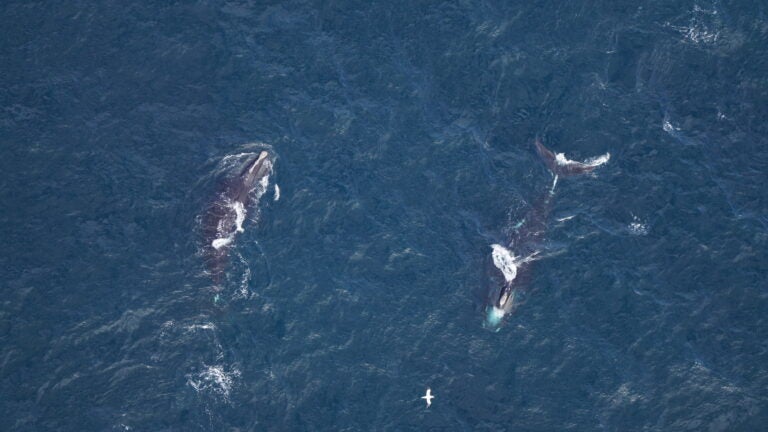
Large groups of North Atlantic right whales were recently spotted in shipping lanes near Nantucket, prompting officials to ask mariners to decrease their speeds there.
North Atlantic right whales are some of the most endangered whales on Earth. There are only 360 individuals remaining, including fewer than 70 reproductively active females, according to NOAA.
A total of 31 right whales were spotted. Scientists from the New England Aquarium onboard an aerial survey plane spotted a group of them feeding about 35 miles east of Nantucket on Feb. 20. Four hours later, a second group was seen 20 miles east of Chatham. The spots where the whales were seen overlap with shipping lanes going into and out of Boston, according to a release from the aquarium.
The sightings were a rare treat for researchers.
“Right whales only surface feed under specific conditions, so we felt really lucky to document them this winter. Many of the whales identified so far are adults, including several calving females who have given birth in recent years,” Katherine McKenna, an assistant research scientist in the Anderson Cabot Center for Ocean Life at the New England Aquarium, said in a statement. McKenna was aboard the flight.
Aerial survey teams actually first detected a gathering of right whales on Jan. 31 and have monitored their movements around the Cape and Islands since then.
Researchers maintain an exhaustive catalog of hundreds of right whales, which can be identified by scars and unique patterns of rough skin called callosities. They are given distinctive names based on these features. Scientists at the aquarium highlighted an adult female named “Caterpillar,” who bears the mark of a vessel strike that occurred seven years ago.
Right whales were hunted to the brink of extinction by the end of the 19th century, and human interactions are still their greatest threat. Vessel strikes and entanglements in fishing gear are the leading causes of North Atlantic right whale mortality, according to NOAA.
Earlier this month, a 1-year-old female that was known to have traveled to Massachusetts waters was found dead off the coast of Georgia. In January, a 3-year-old female washed ashore near Joseph Sylvia State Beach on Martha’s Vineyard. The former died of a vessel strike, the latter had a fishing rope embedded in its tail, officials said.
The recent sightings triggered a voluntary slow speed zone, which recommends that mariners reduce their speeds to 10 knots in the area where right whales have been seen. This will remain in effect until March 7.
The whales were seen in an area known as the Great South Channel, which is subject to a mandatory slow zone from April 1 to July 31. Whales seen there outside of this time period are only protected by temporary, voluntary measures, according to the New England Aquarium.
Scientists with the aquarium regularly conduct aerial surveys to monitor the locations of right whales and other marine animals. Seeing right whales feed in the Great South Channel was unexpected for this time of year. It is typically a popular feeding spot in warmer months, but the animals do not typically feed there during the winter.
“We know a lot about right whales, but they still surprise us all the time,” Orla O’Brien, an associate research scientist at the Anderson Cabot Center, said in a statement.
More than a year ago, NOAA published proposed rule changes that would expand seasonal speed zones and better protect the right whales. One of the New England Aquarium’s top scientists testified before Congress last year about the benefits of the proposed changes. The aquarium urged the Biden Administration on Monday to release a final decision on the changes immediately, and urged Congress to allow them to be implemented.
“Even one human-caused mortality puts the species at risk of extinction,” Jessica Redfern, the aquarium’s associate vice president of ocean conservation science, told lawmakers last summer.
Stay up to date on all the latest news from Boston.com




To comment, please create a screen name in your profile
To comment, please verify your email address
Conversation
This discussion has ended. Please join elsewhere on Boston.com