
Newsletter Signup
Stay up to date on all the latest news from Boston.com
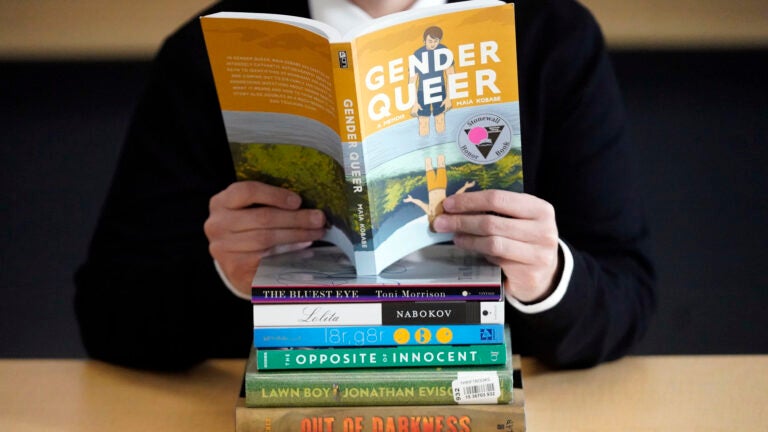
Police searched a classroom in Great Barrington for an illustrated book last month, leading to a teacher’s leave of absence over a book centered on queer identities.
“Gender Queer,” one of the most banned books in the country according to Pen America, wasn’t found in the teacher’s room after a parent complaint prompted the search, the Berkshire Eagle reported.
In Westport, a high school teacher was suspended last year after a parent complained about a Margaret Atwood short story.
Professional librarians and lawyers painted a picture of fear and turmoil for lawmakers last week when testifying about a bill “regarding free expression.” The bill would clarify that certified school library teachers choose materials for libraries, while detailing a process for challenged materials that would keep books on the shelves during a review process.
Professionals from the Massachusetts Library Association, the Massachusetts Board of Library Commissioners, Boston Public Library, the American Civil Liberties Union of Massachusetts, the Massachusetts Family Institute, and Massachusetts teachers gave testimonies to the Joint Committee on Education on how book bans affect teachers and parents.
Book challenges are on the rise across the country and in Massachusetts, with more than four times the amount of challenges from 2021 to 2022.
Bonnie McBride, a teacher librarian at Fenway High School in Mission Hill, emphasized to lawmakers that school libraries do not contain pornographic books. McBride has a master’s degree in library science.
“These bills will provide security so the school librarian can focus on creating the best library possible, rather than worrying about book bans that erase the identities, ideas, and experiences of our students,” McBride told legislators. “By supporting these bills, you are showing us that you trust us as school librarians so that we can continue to create joyful communities of readers.”
The bills in the House andSenate would secure students’ right to receive information “determined to be appropriate for inclusion in school libraries by school library teachers.”
The selections, which by law would be “based on their professional training and not on political or personal views,” could be overruled by a school committee vote after a public hearing and a review committee, which would include school personnel and the superintendent.
The vote would need to be based on “clear and convincing evidence” that the material does not have “any educational, literary, artistic or social value or is not age appropriate for any children who attend the school,” according to the bill.
Ruth Bourquin, one of the senior managing attorneys at the ACLU of Massachusetts, told lawmakers that parents do not have the right to censor materials in public schools.
“Please do not be fooled or bullied by assertions that there are materials that are obscene or pornographic in school libraries,” Bourquin said. “This is not accurate as a matter of fact or law. The law in both Massachusetts and the United States requires that you determine whether things are obscene or pornographic by looking at materials as a whole and judging whether or not they have literary and educational value.”
Sam Whiting, a staff attorney with the Massachusetts Family Institute, said that the bill would restrict local school committees.
“Regardless of whether they meet the technical legal definition of pornography, I think you’ll have to agree that they are not appropriate for minors,” he said. “Some school committees need the right to say no to sexually explicit content.”
Republican state Rep. Kelly Pease ended the testimony with his own thoughts and by reading a gay sex scene from “All Boys Aren’t Blue,” a young adult non-fiction “memoir-manifesto.”
“If that made you feel uncomfortable, it makes me feel uncomfortable, then I ask that a book should not be in any school where there are children not old enough to buy pornographic material,” he said. He said the decision should remain with local school officials. He said librarians should prioritize LGBTQ+ books about relationships over sexually explicit materials.
State Sen. Jason Lewis asked Pease if he had read the whole book.
“I have not, I will be honest,” Pease replied. “I read some parts of it, and I did read about 20 pages of the “Gender Queer” book which, that particular book, at least 20 pages I looked at, did not look like it was age-inappropriate.”
“Maybe we should both read the whole book,” Lewis responded.

Stay up to date on all the latest news from Boston.com




To comment, please create a screen name in your profile
To comment, please verify your email address
Conversation
This discussion has ended. Please join elsewhere on Boston.com