
Newsletter Signup
Stay up to date on all the latest news from Boston.com
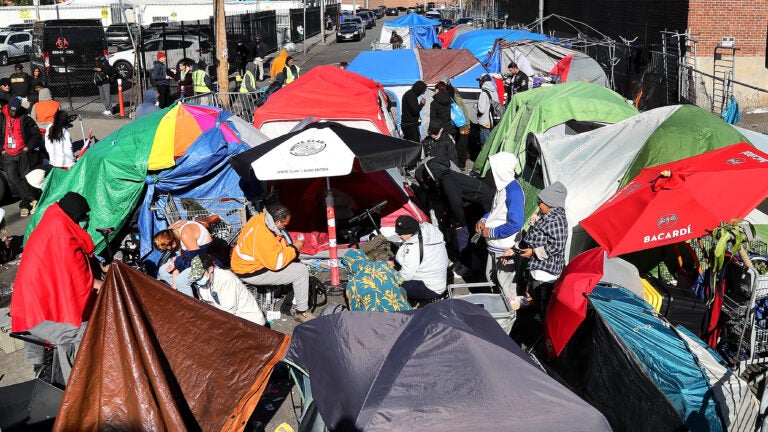
A nonprofit is reporting a decrease in HIV cases among Boston’s homeless population, indicating their efforts to combat a pandemic-era outbreak are working.
The Boston Health Care for the Homeless Program, an institution working with homeless Bostonians on the ground at Mass. and Cass, said they’ve seen a dramatic decrease in HIV cases amongst their patients.
“The majority of those folks were coming through our doors one way or another,” the program’s Director of HIV Services Dr. Jennifer Brody said. “It’s building on those relationships to do more HIV prevention and treatment work.”
The outbreak, reported by the Department of Public Health in 2021, mostly affected unsheltered people who inject drugs. More than 100 people were diagnosed within the first two months of 2021.
Brody said by March 2022, as many as 170 cases were identified.
“Most of those patients, the 170 that were reported by the state, we had seen 117 of them come through our doors as one of the main treaters of homeless people living with HIV,” Brody said.
Brody said the program slowly logged fewer and fewer diagnoses, all while continuing to care for HIV-positive, unsheltered people. In 2021, their peak number of cases was 62. Twenty people were diagnosed in 2022, which was followed by a “remarkable drop” to five cases the following year.
With the help of city and state partners, the Boston Healthcare for the Homeless Program continued to be the main provider for homeless people living with HIV as the outbreak became apparent.
“We started dramatically expanding our street-based outreach,” Brody said.
The Program first brought HIV medication to unsheltered patients who didn’t have access to treatment. Their pilot quickly proved effectively, bringing patients’ high virus levels down to undetectable levels, significantly reducing the risk of transmission.
From there, Brody said, their success hinged on trust. Working at the street level, especially the program’s overdose response team, helped to build relationships and rapport between the Program’s staff and Mass. and Cass’s population.
They were able to administer more tests and more PrEP – an HIV-prevention medication to reduce the likelihood of getting the virus.
Brody’s patients are mostly people of color, unsheltered, living with addiction, HIV-positive, and sometimes formerly incarcerated.
“We’re living through structural, institutional, interpersonal, and internalized racism, and so all of these stigmas and all of these experiences of oppression are acting at once,” Brody said. “There’s a lot of well-earned mistrust.”
Brody said they worked to maintain confidentiality while working on the street. The program also enrolled peers to advocate for PrEP with graphic tees that said “ask me about PrEP.”
“We had to be really thoughtful about how we engage with people so we tried to have an approach where, in the public health parlance, we talked about being ‘status neutral,’” Brody said. “We’re providers who do the same care for everybody, regardless of whether you have HIV or not.”
As of Nov. 1, homeless encampments at Mass. and Cass were cleared as part of the city’s new approach to the growing number of tents in the area. Since then, Brody said the program has lost touch with a lot of their patients.
“The work that we were doing, particularly in the Mass. and Cass area, has been significantly disrupted,” she said. “We are waiting with bated breath to see if we’re going to see a resurgence in numbers because of changes in the way that the city is approaching unsheltered homelessness and substance use disorders in this community.”

Stay up to date on all the latest news from Boston.com





To comment, please create a screen name in your profile
To comment, please verify your email address
Conversation
This discussion has ended. Please join elsewhere on Boston.com