
Newsletter Signup
Stay up to date on all the latest news from Boston.com
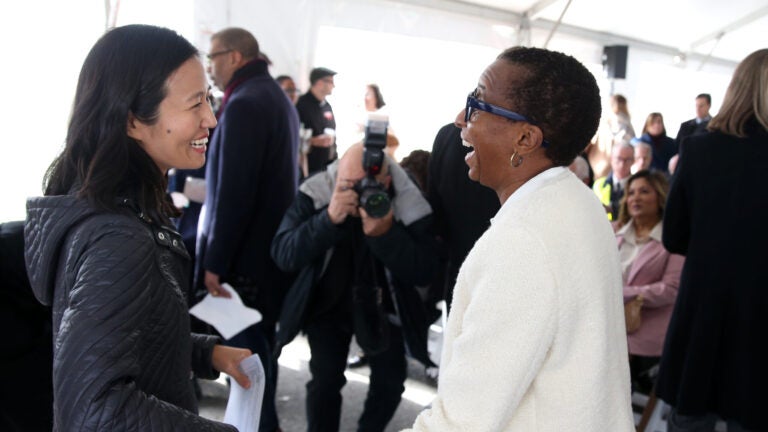
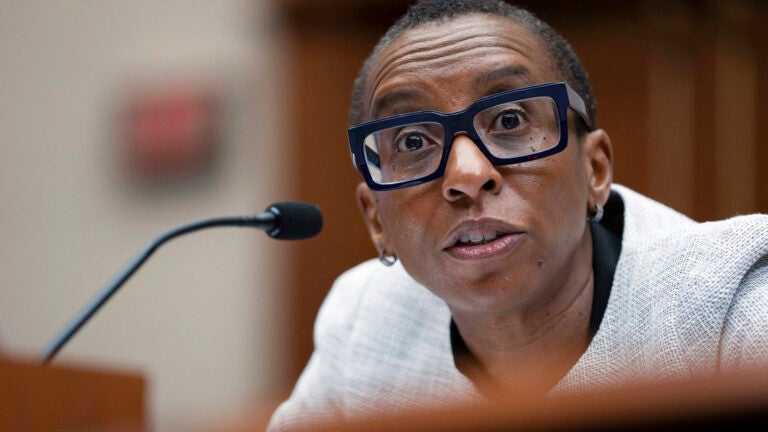
Boston Mayor Michelle Wu responded to the resignation of Harvard President Claudine Gay Wednesday, largely defending the former leader of her alma mater. Wu said that racial bias played a role in the controversies that engulfed Gay, who is Black, over the past month.
“I’m just really saddened by how the whole thing played out,” Wu said when asked about Gay’s resignation Wednesday morning during an appearance on the “Java with Jimmy” program.
Gay resigned Tuesday, writing to members of the Harvard community that she had consulted with the board that governs the university before making the decision. Gay said she was stepping down so that Harvard can “navigate this moment of extraordinary challenge with a focus on the institution rather than any individual.”
Gay was thrust into the national spotlight in early December after a congressional hearing where she failed to say unequivocally that calls for the genocide of Jews on campus would violate Harvard’s conduct policy. Gay testified alongside University of Pennsylvania President Liz Magill and MIT President Sally Kornbluth in response to campus protests and reports of antisemitism increasing due to the Israel-Hamas war. Magill also resigned in the wake of the hearing.
Gay later apologized, telling The Harvard Crimson that calls for violence against Jews or any religious or ethnic group have no place on campus.
“She’s even personally said that the words that were used in different settings were not the best ones that could have been used,” Wu said of Gay. “I think anyone who’s in a position of leadership has a growth curve and a learning curve, just being a few months into a role like that takes a lot. I don’t think anyone is trying to defend certain aspects of what happened but it’s hard not to put the whole picture together, and to look at the dynamics of what happened and how personally this was based, how much racial bias was definitely connected to this.”
Gay’s academic bona fides were publicly called into question last month after conservative activists and publications said they found multiple instances of alleged plagiarism committed by her. Harvard reviewed the allegations and said it found “examples of duplicative language without appropriate attribution” in Gay’s 1997 doctoral dissertation. The university also found “inadequate citation” in two of Gay’s published academic articles.
“No one here is defending plagiarism or antisemitism or whatever it is that some folks are trying to say this is about,” Wu told host Jimmy Hills. “But when you look at who has been doing the pushing, and when you look at who has been generating the constant, constant media noise about it, it is the very same folks who are celebrating now that they’ve been trying to get rid of DEI in universities for a while now.”
Wu was referencing the efforts of conservative officials and pundits across the country to eliminate diversity, equity, and inclusion programs in higher education.
Wu, a 2007 graduate of Harvard College and a 2012 graduate of Harvard Law School, spoke at the university’s Class Day in 2022.
Last fall, rumors swirled that she was offered a job at Harvard and was debating whether to step down before her first term as mayor ended. Wu responded by saying that there was “no chance” she would abandon the role of mayor. She is expected to run for reelection, and will lay out priorities for the next year during the annual state of the city address on Jan. 9.
In her interview Wednesday, Wu acknowledged the media’s role in framing debates about free speech on campus and how much fault lies with leaders like Gay. She also noted that leaders like herself and Gay know what they are signing up for when they pursue prominent, public-facing roles.
She urged members of the public to remember that there is “a human being and a family at the core of this” and said that clips of Gay’s testimony should be considered in a wider context.
“I know whatever I say here is going to get taken and try to be twisted out of context by certain people too, because that is the world we live in right now. But I simply don’t believe that three minutes of a video clip, especially in a certain setting where you’re in a place where people are putting you in a ‘gotcha’ moment, that that should define everything,” Wu said.
Wu said that she does not know Gay well, but had interacted with her a couple of times. She was excited about Gay’s plans for the relationship between Harvard and the city of Boston, as well as Gay’s desire to make Harvard more inclusive.
Wu and her team are aware of an environment where “certain leaders and certain people” have to face more questions than others about anything that they do, she said.
“Those of us who have come up have always had to know how to work twice as hard, ten times as hard, just to make it through,” she said. “This start to 2024 really is a big reminder that these dynamics are entrenched and we still have a lot in front of us.”
Sorry. This form is no longer available.
Stay up to date on all the latest news from Boston.com




To comment, please create a screen name in your profile
To comment, please verify your email address
Conversation
This discussion has ended. Please join elsewhere on Boston.com