
Newsletter Signup
Stay up to date on all the latest news from Boston.com
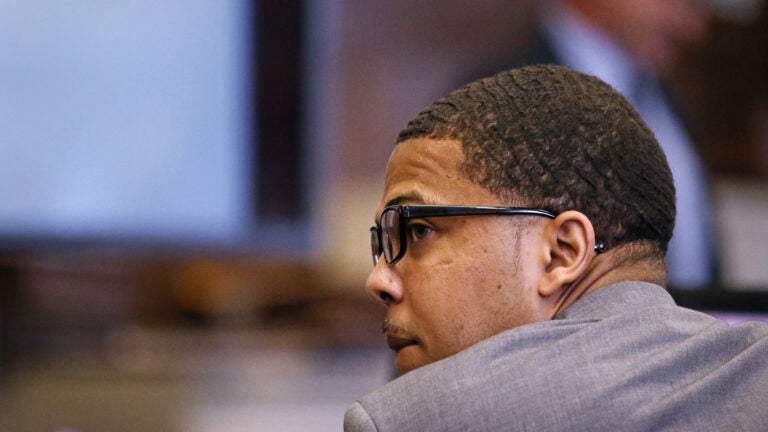
William Omari Shakespeare, the man convicted of killing 31-year-old Marcus Hall outside a Mattapan barbershop while Hall’s young son was inside, is set to stand trial again.
The Supreme Judicial Court, in a unanimous opinion filed late last month, ruled that the testimony of another man should have been admitted as evidence. Therefore, Shakespeare’s murder conviction and related firearms convictions were overturned and a new trial was ordered.
Here’s what to know about the case:
Just before noon on June 14, 2016, Hall brought his 4-year-old son to a barbershop near the corner of Blue Hill Avenue and Morton Street for a haircut. The shop was a social hotspot for the community, with locals frequently coming in to socialize. Shakespeare, a regular at the shop, had gotten there earlier that morning, according to court documents.
Shakespeare and Hall immediately began talking; neither appeared to be laughing or joking. Hall apparently told Shakespeare that he had been trying to contact him by phone. After talking for a minute, Hall walked to the back of the shop and out a rear door. Shakespeare followed him. One of the barbers working said that they had to close the back door because there was a loud argument taking place, according to court documents.
After a few minutes, Hall could be seen on surveillance footage entering the shop again appearing “preoccupied.” He left again, briefly returned, and used his cell phone for a while, which struck one of the barbers as unusual. Around 12:13 p.m., Hall walked to the back of the shop, seemed to look out the back door, then walked out the front door.
A few minutes later, a man named Mark Edwards entered through the back door. He appeared to greet the barbers, look out the front to where Hall was, turn around, and walk back out of the rear door while on his cell phone. Edwards was not a regular client of the barbershop, according to court documents.
Just before 12:20 p.m., Shakespeare reentered the shop through the back door. Hall was seen putting down his phone and walking to the back of the shop towards Shakespeare. One of the barbers heard Shakespeare say “let me talk to you” to Hall. They both stepped out the back door.
Within five seconds, Hall appeared to lunge forward and then moved back to the doorway. A barber in the shop testified that he heard a loud bang and saw Hall fall against the door. Hall looked at the barbers in the shop briefly, appearing “scared,” before going back out the back door, and was “shot almost immediately,” according to court documents.
The barbers heard multiple gunshots. One of them grabbed Hall’s son and moved him to the front of the shop, then another barber brought the child to a shop next door. Two of the barbers called the police, while a third went to the rear parking lot and saw Hall on the ground. He was still breathing, and the barbers tilted his head forward to try to prevent him from choking on his own blood. They called 911, but Hall died before an ambulance arrived, according to court documents. He had gunshot wounds to his head, chest, and legs.
Police tracked a car they believed to be driven by Shakespeare leaving the shop’s parking lot around noon. It was seen driving around nearby before parking on a street near the shop around 12:17 p.m.
Police created a “wanted” flyer containing images of Edwards and Shakespeare. On June 20, Edwards walked into a police station and said he had been informed that he “was wanted” because of the flyer. During an interview with police, Edwards appeared “nervous and concerned” that he was wanted in connection with the shooting, court documents say.
He voluntarily gave his cell phone to police, but said he sold marijuana and therefore had deleted a lot of data from the phone. He said he had received a call from a person named “Taj” on the day of the shooting, which caused him to leave the shop. He was unable to produce a cell phone number for “Taj,” and police could not identify “Taj.” Edwards was also unable to provide police with his own cell number, according to court documents. He was released after the interview.
Shakespeare, a resident of Dedham at the time of the shooting, was found and arrested in New York City on Jan. 31, 2017.
Edwards was shot and killed on May 13, 2017. There were no suspects for that murder at the time of this trial.
Before he was killed, Edwards testified to a grand jury that he was at the barbershop on the day of the shooting only between 9 and 9:30 a.m. This was “demonstrably false” as proven by surveillance footage, according to court documents. Lawyers for Shakespeare never confronted Edwards about his contradiction in court, and a judge ruled that Edwards’ testimony was considered hearsay and would not be read to jurors. Shakespeare and his lawyers argued that Edwards was Hall’s killer, but Shakespeare was eventually convicted of the crime.
After his conviction, Shakespeare and his lawyers filed an appeal, arguing that the evidence he committed the killing was insufficient and that Edwards’ testimony should have been admitted, as it supported Shakespeare’s “third-party culprit defense,” according to court documents.
“We conclude that it was error to prohibit counsel from introducing Edwards’s grand jury testimony and that such error was not harmless beyond a reasonable doubt. As a result, we must reverse all the defendant’s convictions, as his convictions on the firearm charges were intertwined with his murder conviction,” Justice Elspeth P. Cypher wrote in the ruling.
Stay up to date on all the latest news from Boston.com


To comment, please create a screen name in your profile
To comment, please verify your email address
Conversation
This discussion has ended. Please join elsewhere on Boston.com