
Newsletter Signup
Stay up to date on all the latest news from Boston.com
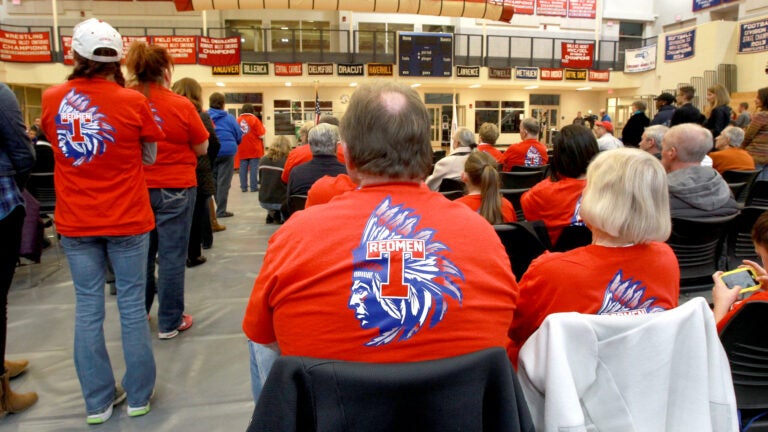
Advocates are asking the state to impose a ban of Indigenous American imagery in public school mascots, a move that would force at least 23 schools to retire their Native American mascots.
Bill S.245/H.477, brought forward by state Sen. Joanne Comerford, D-Hampshire, Franklin and Worcester, and Rep. Brandy Fluker Oakley, D-Boston, was heard in the Joint Committee on Education on Monday. The bill, with versions in both the House and the Senate, has been filed each year since the 2019 session but has failed to become law each time.
Rhonda Anderson, a Iñupiaq-Athabascan Indigenous American and Western Massachusetts representative for the Massachusetts Commission on Indian Affairs, testified to the committee about schools “stubbornly attached to controlling our native identities, which they are using against our wishes.”
Anderson said more than 90 public schools used Indigenous American imagery in their name or mascots 25 years ago. Now, 23 schools continue to use Native American mascots, including the Billerica Memorial Indians, the Tewksbury Redmen, and a number of schools who use the Warriors, according to the New England Anti-Mascot Coalition.
This bill looks to take the decision out of the hands of individual communities.
“In recent years, some school committees have voted on the right side of history, acknowledging the harm of these mascots to native and nonnative students and recognizing that mascots are not educationally sound,” Anderson said.
Since 2020, several public schools in Massachusetts have made changes to their mascot, logo or nicknames, including at Foxborough High School, where they removed a stereotypical Native American image while keeping the nickname Warriors last month.
On Monday, advocate Faries Gray spoke about Foxborough and the student petition that sparked some outrage among parents, students, and alumni.
“This is the place where it has to happen,” Gray said of the Legislature. “We can’t continue to go to these schools, and these kids can’t continue to stand up for something they believe in like this, which they can see clearly is racism, and be harassed.”
Fluker Oakley and Comerford both spoke at the Joint Committee of Education as well, explaining that all students are affected by the stereotypical mascots, not just Native Americans. In 2005, the American Psychological Association called for the immediate retirement of all mascots and symbols relating to Indigenous Americans.
“These mascots are teaching stereotypical, misleading, and too often insulting images of American Indians,” former APA President Ronald F. Levant wrote. “These negative lessons are not just affecting American Indian students; they are sending the wrong message to all students.”
Rep. Kelly Pease, R-Hapden, asked the advocates in the meeting if they think the mascots and nicknames are “racism.”
“You don’t think it is a time to highlight your heritage and make it an education because the school is looking at it?” he asked.
Both Gray and Anderson reiterated that the mascots are stereotypes; Gray said his Massachusett tribe was made up primarily of fisherman and farmers, as opposed to warriors.
“There are tremendous ways to honor us and educate. No education comes with this Indigenous mascot, it’s just a picture,” Gray said. “Mascots are typically assigned to animals or mythical creatures, but we’re a living people, we’re not somebody of the past. We’re living people, we’re not mythical creatures, and we’re not animals.”

Stay up to date on all the latest news from Boston.com





To comment, please create a screen name in your profile
To comment, please verify your email address
Conversation
This discussion has ended. Please join elsewhere on Boston.com