
Newsletter Signup
Stay up to date on all the latest news from Boston.com
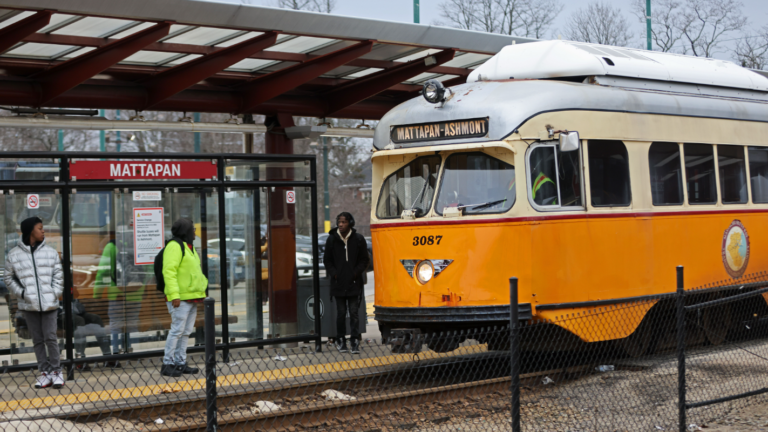
After years of discussion and stalled progress during the pandemic, the MBTA’s promised revitalization of the Mattapan Line is finally getting underway.
On an eight- to 10-year timeline, the T will begin by refurbishing all of the existing trolleys on the line, and eventually replace them with light rail vehicles like the ones currently running on the Green Line. The Mattapan Line stations will get safety and accessibility improvements like larger, higher platforms and new lighting, benches, walkways, and street crossings. The tracks themselves will get safety upgrades.
Riders have been calling for this overhaul for years. The circa-1945 trolleys that run on the 2.6-mile between Ashmont, where the Red Line ends, and Mattapan Station are the oldest operational vehicles in the MBTA system. The trolleys exude vintage charm, but they’ve deteriorated over their decades of use and need repairs. They also pose serious accessibility challenges, and their vulnerability to weather damage makes them unusable in heavy snow.
Jarred Johnson, executive director of the Boston-based transit advocacy group TransitMatters, said the proposed upgrade is an important, positive step — that’s been a long time coming. “This was the smart option 20 years ago,” he said.
The T presented the broad strokes of its long-term plan for the Mattapan Line to the public in spring 2019, promising improvements to accessibility and reliability. The short-term trolley refurbishments — which will extend their usable lives by about a decade, according to MBTA spokesperson Lisa Battiston — had gotten underway the previous year and were due to be finished in 2020.
Then the pandemic struck, and progress on the Mattapan Line ground to a halt. Fast forward to 2023, and two trolleys have been fully refurbished, one is nearly refurbished, and the remaining two are “in the early stages of refurbishment,” according to Battiston.
As far as the long-term station improvements and transition to light rail are concerned, Battiston said the T is in the “early stages of design,” having completed conceptual designs and cost estimates for six of the eight stations on the line. Conceptual designs for Ashmont and Mattapan stations, which anchor the line at each end, will take more time because they’re bigger and more complex, Battiston said.
So far, the T has committed $127 million to the project, with $12.2 million of that allocated to the trolley refurbishments, Battiston said. In spring 2019, the agency estimated the total cost of the project — including refurbishments, station redesigns, and the eventual switch from trolleys to light rail — to be $190 million.
The Mattapan Line served about 6,600 riders per day pre-pandemic, according to the MBTA. (Today, that number has fallen to about 3,800.) Its riders live primarily in Milton and Mattapan. Residents of Mattapan, in particular, have accused the T for years of deprioritizing their majority-Black, lower-income neighborhood.
Johnson said that the delays in the Mattapan Line project are symptomatic of bigger problems at the MBTA — an “astronomical amount of need” across the system, not enough money to go around, and a state legislature that is “afraid to talk about new revenue for public transit.”
Johnson pointed to the T’s 2024-2028 capital investment plan, which projected that the agency’s annual capital funding would drop from almost $2.7 billion pre-2024 to $1.85 billion in fiscal year 2024. In fiscal year 2033, the T projects it will only pull in $1.08 billion of capital funding. Part of the gap comes from a withdrawal of state funding as projects like the Green Line Extension and the South Coast Railway reach completion.
The T has also lost project management capacity, Johnson said, noting the February departure of John Dalton, who has been credited with rescuing the Green Line Extension project from years-long stagnation.
When those systemic issues converge and T service becomes unreliable, Johnson said, people in wealthier suburbs find other ways to get around.
“That impact falls on low-income communities,” he explained. “We’re going to see disproportionately poor folks, folks of color, be the ones who are impacted by that … It means that there’s going to be a grandmother, a senior, who is either unable to use the Mattapan trolley or who has a hard time getting up and down those stairs, because of the failure of of our region, and our state, to really invest in public transit capacity and solve these problems that we’ve known about for years.”
Since the Mattapan Line transformation will take several years — spanning multiple legislative sessions and gubernatorial terms — to see through to completion, Johnson said constant pressure on elected officials to invest in the MBTA is critical.
“Project-by-project advocacy [by legislators] just isn’t cutting it,” Johnson said. “No one is talking about, how are we solving this whole picture?”
Stay up to date on all the latest news from Boston.com




To comment, please create a screen name in your profile
To comment, please verify your email address
Conversation
This discussion has ended. Please join elsewhere on Boston.com