
Newsletter Signup
Stay up to date on all the latest news from Boston.com
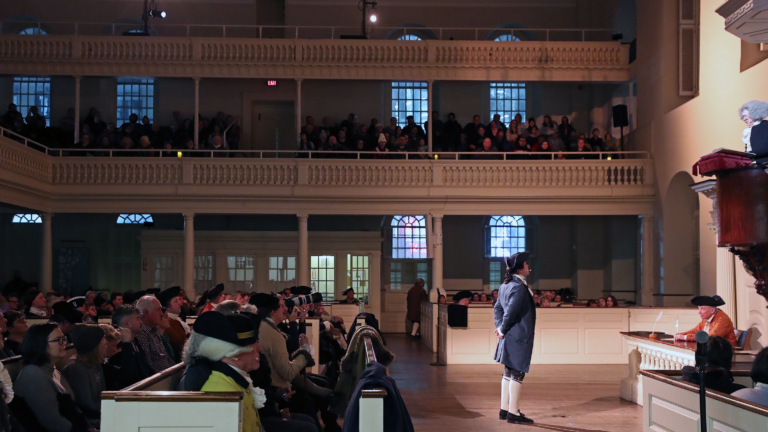
Sen. Ed Markey was at the Old South Meeting House on Friday morning to celebrate a restoration of the Boston landmark in time for the 250th anniversary of the Boston Tea Party, with the help of $480,000 in federal funding.
Built in 1729 by Puritans, the Old South Meeting House is best known as the site of a historic 1773 debate over Britain’s tea tax that culminated in Samuel Adams’s signal to the Sons of Liberty to begin the Boston Tea Party. They departed from the meeting house and headed to Griffin’s Wharf, where they jettisoned 342 chests of tea into the Boston Harbor.
The meeting house also operated as a church until 1872. Its congregants included Phyllis Wheatley, who published a book of poetry while she was enslaved by Boston’s Wheatley family. Her sculpture stands near the meeting house’s entrance. Paul Revere and Benjamin Franklin also worshiped there.
The meeting house has stood for nearly three centuries, but recent years have treated it particularly harshly. Flooding from hurricanes Henri and Ida in 2021 deteriorated its steel framing and brick masonry, leaving the house in need of “urgent preservation and conservation work,” according to Markey’s website. The federal dollars he and Sen. Elizabeth Warren helped secure will be used to repair existing damage and storm-proof the building for the future.
Revolutionary Spaces, the nonprofit that maintains the Old South Meeting House and the nearby Old State House, first announced the restoration project in February.
“This preservation and conservation work will address critical climate control and efficiency measures at the Old South Meeting House, helping to ensure the building is maintained for generations to come,” Markey said at the time.
“We are immensely grateful that our partners in government recognized the importance of this critical work at Old South Meeting House,” added Nate Sheidley, Revolutionary Spaces President & CEO.
Revolutionary Spaces noted in its February announcement that “the federal funding will be matched 50/50 with public and private monies.”
The house was nearly demolished in 1872, but a group of prominent Bostonians — including Ralph Waldo Emerson, Julia Ward Howe, Henry Wadsworth Longfellow, and Louisa May Alcott — fundraised enough to save the property. It was the first major conservation effort for a public building of historical significance in the United States, according to the meeting house’s website. It opened to the public as a museum five years later, in 1877.
Stay up to date on all the latest news from Boston.com





To comment, please create a screen name in your profile
To comment, please verify your email address
Conversation
This discussion has ended. Please join elsewhere on Boston.com