
Newsletter Signup
Stay up to date on all the latest news from Boston.com
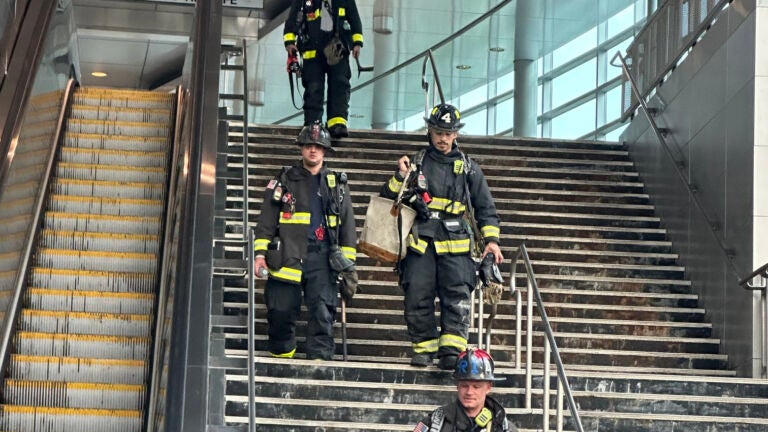
Last week, firefighters struggled to put out a fire at a Red Line station after they discovered that a key fire safety system at the station was faulty. The incident brought increased scrutiny of the MBTA‘s fire safety inspections.
Now, new reporting from The Boston Globe reveals that the agency is not only checking fire safety systems less often than is standard, but that it isn’t subject to the state’s fire safety code.
On Thursday around 5:45 a.m., firefighters responded to Charles/MGH to put out a small fire that started under a train.
The situation became much more difficult when they realized that one of the station’s standpipes — an extension of the hydrant system that brings water into buildings — was cracked and non-functional.
Without an easy source of water to connect hoses to, firefighters resorted to hauling cans of water and fire extinguishers upstairs to the scene, which significantly hampered the speed at which they were able to put out the fire.
After the incident, reporters asked the MBTA when it last inspected the standpipe. Ultimately, the Globe reported, it is unclear when it was last checked, but the most recent record of it being inspected is from 2019 when it was pressure tested and passed inspection.
State law requires most building owners to inspect standpipes every year, as is recommended by the National Fire Protection Association.
Despite this, the MBTA told the Globe that it only inspects standpipes as needed.
This practice is legal, the Department of Fire Services told the Globe. Under state law, state agencies such as the MBTA (and their buildings) are not subject to the state’s fire safety code, the Globe reported.
The Globe also reported that the city’s fire department said it “is empowered to ensure the T complies with standpipe testing requirements,” but didn’t specify what, if any, power it may have to ensure that standpipes are inspected.”
MBTA General Manager Phillip Eng reportedly told the Globe that it is working on a program that includes yearly, visual inspections of standpipes.
“But that’s just the one component of the stations. We’re going to do a whole top-to-bottom in terms of how we’ve been doing things in the past and how we need to do things moving forward,” he said.
In May, Eng announced he was creating a new “chief of stations” position at the MBTA, who will be responsible for keeping T stations in good condition. Eng said Tuesday that he will be announcing who will fill the role “very shortly,” the Globe reported.
The announcement came after two dangerous incidents occurred at Harvard station due to station deterioration. In one incident, a woman was injured by a falling support brace. In the other, a ceiling panel fell and almost hit a rider.
Read the full story at The Boston Globe.
Stay up to date on all the latest news from Boston.com




To comment, please create a screen name in your profile
To comment, please verify your email address
Conversation
This discussion has ended. Please join elsewhere on Boston.com