
Newsletter Signup
Stay up to date on all the latest news from Boston.com
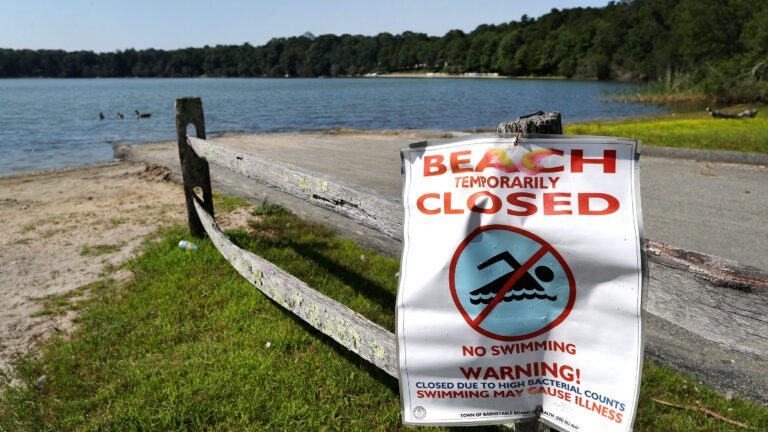
With a recent string of notably warm days, summer in Massachusetts is finally in full gear. But many residents seeking relief from the heat, from Nantucket to the Berkshires, are being warned to stay away from their local swimming spots due to unsafe water conditions.
The state currently says that 70 Massachusetts beaches have dangerous water that could cause illness. That includes Constitution Beach, Malibu Beach, Savin Hill Beach, and Tenean Beach in Boston. The list was last updated on Friday.
When water quality at a beach is found not to be safe, officials are required to notify the public. While the locations remain accessible, beachgoers will likely see signs warning them to stay out of the water.
More than 1,100 public and semi-public beaches in Massachusetts are monitored regularly for bacteria, according to the Department of Public Health. Most of the beaches currently classified as dangerous find themselves on the list because of what officials call “bacterial exceedance.”
Since pathogens, which directly make people sick, are hard to measure in the water, the DPH relies on the “indicator organisms” Enterococci and E. coli. Once officials get a read on the levels of “indicator organisms” in a body of water, they can predict pathogen levels.
An exceedance occurs when levels of Enterococci and E. coli have exceeded what officials have deemed safe for that beach. Most beaches are listed as unsafe when they experience two exceedances in consecutive days, but some beaches with a history of multi-day exceedances must be added to the list after a single exceedance.
Water can become contaminated from a variety of sources, including stormwater runoff, malfunctioning septic systems, sewer overflows, and animal waste.
Nine of 70 beaches are currently listed as unsafe due to “algae/cyanobacteria” advisories. Cyanobacteria, or blue-green algae, can multiply quickly under the right conditions. This causes harmful algal blooms, usually in the summer and early fall. The algae releases toxins, which can make people and pets sick, and has been known to cause fatalities among dogs.
Some beaches are tested only monthly, while some are tested daily, per federal guidelines. Testing frequency is determined by how popular a beach is and whether or not it has a history of unsafe water conditions.
A full list of the beaches with unsafe conditions can be found online.
Stay up to date on all the latest news from Boston.com





To comment, please create a screen name in your profile
To comment, please verify your email address
Conversation
This discussion has ended. Please join elsewhere on Boston.com