
Newsletter Signup
Stay up to date on all the latest news from Boston.com
Engineers at MIT have developed an incredibly absorbent version of material commonly found in disposable diapers that could potentially help communities ravaged by drought and make air conditioners more energy-efficient.
Hydrogels are transparent, rubbery materials that are known to retain large amounts of water. Aside from their use in diapers, hydrogels are also useful for producing contact lenses, hygiene products and wound dressings.
The team at MIT created an extra-absorbent hydrogel that is able to pull water from the air in even the most desert-like conditions, according to MIT News.
To do this, researchers infused the hydrogel with lithium chloride, a specific type of salt. They found that they were able to put more salt into the hydrogel that previously thought possible, and that the salt-infused gel retained “unprecedented” moisture levels in all sorts of environments, according to MIT.
Researchers say that this new hydrogel offers tantalizing possibilities because it can be mass-produced quickly.
“We’ve been application-agnostic, in the sense that we mostly focus on the fundamental properties of the material,” Carlos Díaz-Marin, a researcher at MIT, told the school’s news outlet. “But now we are exploring widely different problems like how to make air conditioning more efficient and how you can harvest water. This material, because of its low cost and high performance, has so much potential.”
The gel could theoretically be used to passively harvest water in the desert and regions experiencing drought. It would be set up to continuously absorb water vapor, which could then be condensed and used as drinking water.
Scientists envision it also being used as a dehumidifying element in air conditioning units, which would make them consume less energy.
The team at MIT’s Device Research Lab set out to find materials that would be useful for harvesting water from the air. They narrowed their focus to hydrogels, and dug up past research that concerned mixing various types of salt with hydrogels. Lithium chloride can absorb more than 10 times its own mass in moisture, according to MIT. It is so absorbent that, if left in a pile, water vapor would automatically pool around it.
“It’s the best of both worlds,” researcher Gustav Graeber told MIT News. “The hydrogel can store a lot of water, and the salt can capture a lot of vapor. So it’s intuitive that you’d want to combine the two.”
In most previous studies, researchers soaked hydrogels in salty water for 24 to 48 hours. The hydrogels gradually absorbed more salt over that time, eventually giving scientists a salt-infused hydrogel that could then be used to soak up water. Past experiments did not yield samples that could absorb a lot of water.
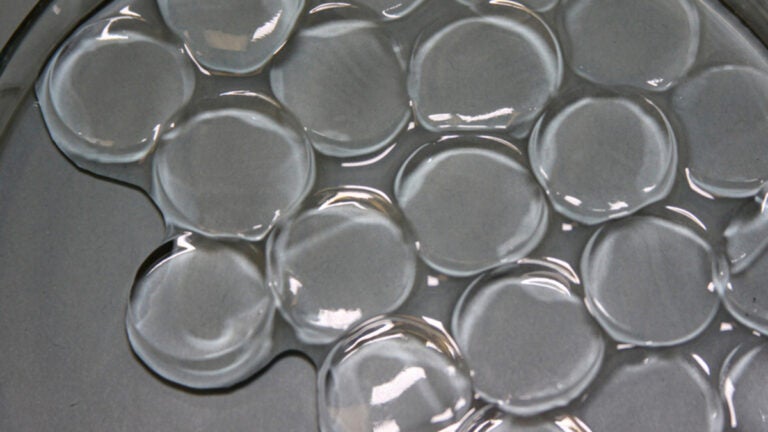
It turns out that the missing ingredient was time. The team at MIT cut up thin disks of hydrogel, dropped them in lithium chloride solutions, and waited. They were taken out each day to be evaluated before being returned to the solution. In the end, researchers found that hydrogels became infused with more salt if simply given more time, according to MIT News.
The salt-infused hydrogel samples were then used in a series of absorption tests in a range of humidity conditions. They highlighted that, at an extremely-dry 30% relative humidity, the gels absorbed 1.79 grams of water per gram of material, a record according to MIT.
“Any desert during the night would have that low relative humidity, so conceivably, this material could generate water in the desert,” Díaz-Marin told MIT News.
Now, the team is focusing on figuring out how to speed up the process.
Stay up to date on all the latest news from Boston.com





To comment, please create a screen name in your profile
To comment, please verify your email address
Conversation
This discussion has ended. Please join elsewhere on Boston.com