
Newsletter Signup
Stay up to date on all the latest news from Boston.com
Word on the street is that Massachusetts is no fun. At least, that’s what Sen. Julian Cyr said he’s been gathering based on the lack of talk about how exciting the state is.
“I think we do have a fun problem,” he said at a recent hearing for the Joint Committee on Consumer Protection and Professional Licensure.
At the same meeting, he proposed bringing back a happy hour on drinks as one step in the process of helping the state “get our groove back,” while making it more “alluring” and “attractive.”
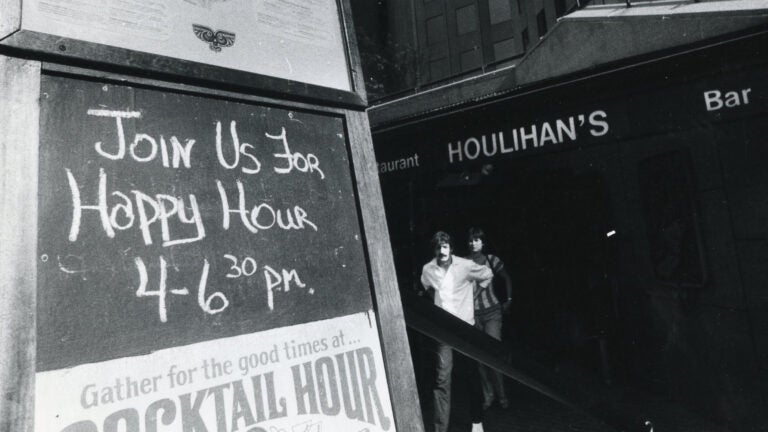
Happy hour has been a decades-long issue in the state. Time-limited discount drinks were banned in 1984 due to drunk driving incidents, and now more than four decades later, Massachusetts is the only state to still prohibit happy hour, according to Cyr. He cited Illinois and Kansas, which lifted their happy hour bans over a decade ago, as examples of states where there were no increases in traffic-related fatalities afterward.
Last year, Cyr renewed efforts to bring back happy hour through the economic development package, which the Senate approved as an amendment. It was then he said that “the idea caught fire.” Now, he’s proposed a bill to bring it back.

Not everyone seems to think the return of happy hour is the right move for the state. The House, in particular, does not seem thrilled, Rep. Tackey Chan told the State House News Service.
“I’ve not received a lot of interest from our colleagues to do happy hours at the moment,” he said last month. “That could change as we have conversations going forward, but as of last cycle and thus far this cycle, I’m waiting for input and I haven’t heard a large outcry to have it put in place.”
The Massachusetts Restaurant Association is also weary of the bill. Last year, MRA President and CEO Stephen Clark told WBZ that “most restaurants we talked to don’t want to see the return of happy hour.”
He also wrote in a letter to lawmakers that the MRA was completely against a return of happy hour and they thought it would cause “skyrocketing costs” for liquor liability insurance.
Becky Iannotta, a spokesperson for Mothers Against Drunk Driving, told Boston.com in an email that they oppose lifting the ban on happy hour and any efforts to weaken laws that aim to limit drunk driving.
“MADD supports state agencies and legislatures that pass clear and comprehensive guidelines which prohibit practices associated with excessive alcohol consumption and calls upon the hospitality industry to voluntarily end all practices associated with excessive alcohol consumption,” she wrote.
Despite the opposition, Cyr has a list of restaurants whose owners are in favor of the proposed law, and JB Blau is one of them. He owns three restaurants on Martha’s Vineyard and told Boston.com that he thinks bringing back happy hour — with safety clauses — would help his business immensely.
Since the pandemic, he said things have been tough on small businesses, and having a happy hour during the off-hours of the day could help entice more patrons to stop by. He added that restaurants might be open for 12 hours of the day, but that doesn’t mean there are paying customers around at all times.
“Of those 12 hours, you really only have that peak dining time for maybe two or three hours per day,” he said. “The rest of the day you’re filling in, but your staff is there, your costs are there, your fryers are still on, your flames are on, the grills are still on, you’re still paying rent.”
Blau said it’s also important that there are protections in place to ensure the law is not abused. For example, he said there could be a sunshine clause so that if drunk driving incidents increase within a year, the law would expire. Another idea, he said, is to make sure there are limits on how discounted alcohol can be.
“So you couldn’t just give alcohol away, it couldn’t be ridiculously underpriced. But I think if you set up some guidelines and you allowed alcohol to be discounted at a reasonable rate, it helps the consumer and it helps the owners, and the staff particularly,” he said, adding that food and drink costs are so high at restaurants right now because owners want to be able to pay their employees a livable and fair wage.
Some businesses in the commonwealth, like Yard House in Boston, have happy hour-style discounts on food in lieu of alcohol options. But Cyr and business owners say that this isn’t as profitable.
Chris Hartley, founder and co-owner of Provincetown Brewing Co., said that businesses on the Cape like his that deal with seasonal travel aren’t able to meet their “bottom line” on food discounts during the off-season.
“Having the option there is really nice, especially when you’re trying to drive business in a slower period,” he said. “It just seems like kind of an unnecessary limitation that we have.”

Participating in happy hour would be optional for businesses, Cyr said. Those that are not comfortable partaking could choose not to, and the bill proposes that municipalities would also get to use their own discretion when considering whether they want to adopt happy hours.
“For certain cities and towns, this might not be right, but this is a tool that we can help get people back in our main streets and downtowns, that are really struggling with foot traffic,” he told Boston.com in a phone call after he spoke at the hearing. “This is really a tool that some cities and towns and some businesses may wanna avail themselves of.”
Times have also changed a lot since the 1984 ban was introduced, Cyr said. Now, there are ride-sharing apps like Uber and Lyft, and people have phones to call or text. Cyr added that public transportation and “a real shift in culture related to binge drinking and certainly drunk driving” all lead him to think happy hour might work out.
Chan told SHNS he remains unconvinced, though. He said there were plenty of taxis available when he was younger, and the T was also around.
“So while I appreciate a new generation of arguments, they tend to forget that everything you talk about today was there then but in a different form,” he said. “I mean, the T ran really good when I was a child. I’m just saying.”
Yuki Cohen, owner of Methuselah Bar in Pittsfield, said she would love to be able to offer patrons discounted drinks from 5 p.m. to 7 p.m. on some of the slower days of the week. Being from New York City, she added that she has experienced happy hour, and “it draws a crowd.”
To those who object to happy hour and fear it will lead to unsafe drinking, she said that is something bartenders would be on the lookout for.
“That’s something we are always aware of,” she said. “We would always be on high alert to make sure that our patrons and everybody is drinking safely and responsibly.”
Cyr said he feels like “momentum is really building on this issue,” and he’s aware that happy hour is not going to be a “panacea” for the state’s “fun problem,” but it could be a step in the right direction.
Stay up to date on all the latest news from Boston.com


To comment, please create a screen name in your profile
To comment, please verify your email address
Conversation
This discussion has ended. Please join elsewhere on Boston.com