
Newsletter Signup
Stay up to date on all the latest news from Boston.com
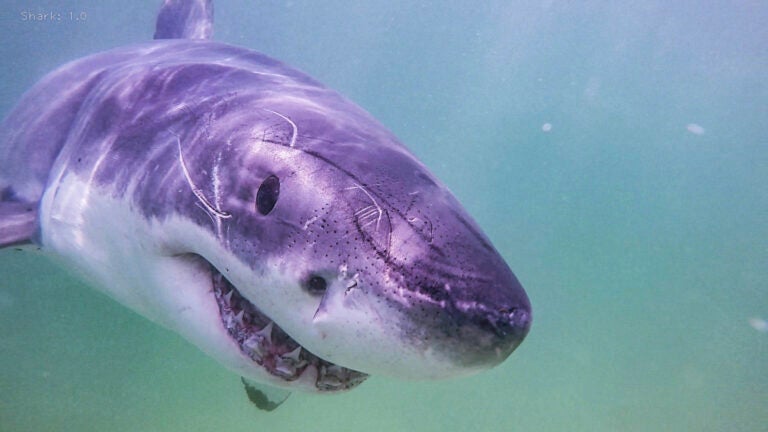
It’s about to be peak swim season on the Cape, and in a Tuesday press conference, the Atlantic White Shark Conservancy said that many people still don’t realize New England has great white sharks that will go in the shallow waters where humans swim.
To change that, the conservancy has been ramping up its educational programming.
Greg Skomal, a senior fisheries biologist with the state Division of Marine Fisheries, said at the press conference that he doesn’t think “it’s any secret” that there have been five attacks since 2012 in the state. He added that three of those attacks resulted in bites to humans, and one in 2018 was fatal.
“With white sharks doing what they naturally do — hunting their prey in shallow water — we get overlap with human activities,” he said.
Megan Winton, a fisheries scientist at AWSC, said educating the local communities about white shark behavior and population is key to changing people’s perceptions — and sometimes misconceptions — about these animals.
“Lifeguards we’ve worked with have mentioned that they used to think that white sharks occurred every once in a while, but now they realize that they’re essentially a constant presence off their beaches in the summer and in the fall, which is really powerful,” she said. “That’s a big shift in perception.”
There are multiple ways the conservancy tracks sharks, including technology and self-reporting. Winton said citizens can get involved by downloading the Sharktivity App and reporting their own sightings, or monitoring others.
AWSC, the state, and National Geographic have also all invested in equipment as part of a live-tracking system that some of the towns use to give immediate updates on where white sharks are in the nearby swimming waters, Skomal said. These are costly, though, at around $16,000 per receiver.
However, he said the system is a helpful tool — although not foolproof — in notifying lifeguards if there are sharks present. There are also camera tags AWSC has started using to videotape shark movement.
“It’s really like we’re getting smartphones to white sharks,” Winton said. “We can see exactly what they’re doing, which is huge. The whole point of using this technology here is to get a better understanding of their predatory behavior.”
She added that the sharks are basically collecting their own data.
The conservancy has also done some experimentation with drones, which Winton said is something that will continue this summer. She said they want to get an understanding of how helpful drones will actually be.
All of these tracking resources help educate visitors and residents about the shark population, so they can make informed decisions about their swimming practices, she said.
“A lot of people almost take it for granted that everybody who comes to visit the Cape knows that sharks occur here and that they occur close to the beach,” Winton said, adding that many people have no clue.
She said she recently overheard a conversation between two people who were remarking about there being a white shark warning for a beach, and she took the time to talk to them about her research.
A recent study using drones on California beaches showed that humans and sharks will be in the same waters 97% of the time in the Pacific. However, Winton said these sharks aren’t hunting for seals and food like the ones in New England, so they’re not entirely comparable.
“It’s a little bit of a different scene,” she said.
Marianne Walsh, education director at AWSC, told Boston.com that people seem to be becoming more and more interested in the shark population off Massachusetts beaches. She said the conservancy holds events year-round at schools and in communities to give people a chance to ask questions about the great whites.
She added that there has been a 3,000-person increase in museum attendance — overlooking the COVID years — which has led to a second museum. The museums are in Chatham and Provincetown.
Walsh added that the goal is to appeal to everyone.
“We realize that people of all ages are heading to the beaches in the summer season, so our programming is designed to really engage and try to capture the attention of all ages,” she said.
Additional information about great white sharks is available on the conservancy’s website.
Stay up to date on all the latest news from Boston.com




To comment, please create a screen name in your profile
To comment, please verify your email address
Conversation
This discussion has ended. Please join elsewhere on Boston.com