
Extra News Alerts
Get breaking updates as they happen.
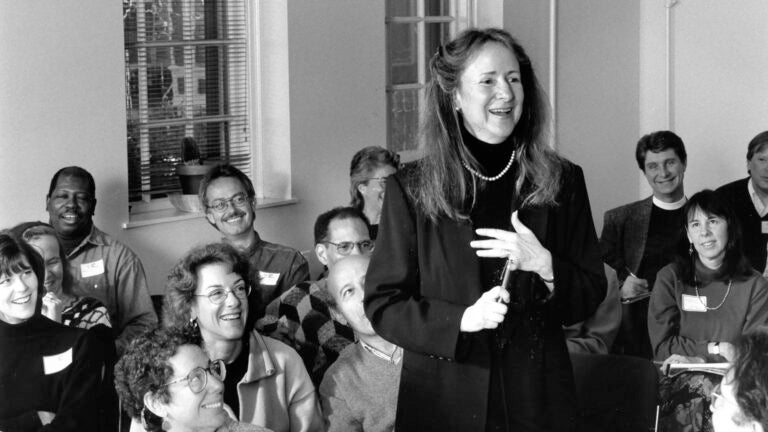
Margot Stern Strom, a schoolteacher who became one of the first American educators to design a formal curriculum for the study of the Holocaust, helping her students in the 1970s – and then classrooms across the United States and around the world – find parallels between the past and the moral questions of their time, died March 28 at her home in Brookline, Mass. She was 81.
Her death was announced by Facing History and Ourselves, the nonprofit educational organization she co-founded in 1976. She had pancreatic cancer and dementia, said her daughter, Rachel Fan Stern Strom.
For more than a generation after the end of World War II, American schools did not generally address the Holocaust in the manner familiar to many students today: the explanations for Hitler’s rise to power in Germany in the 1930s; the recounting of the horrors he visited upon Jews across Europe, who were stereotyped and marginalized before they were deported and then murdered by the millions; and the questions, however impossible to answer, about what you would have done had you been present at the time.
For years, many teachers considered the Holocaust too painful to explore in the classroom. Those who might have wished to broach the topic had few tools at their disposal.
They could offer their students Anne Frank’s “Diary of a Young Girl,” but her account of her time in hiding does not, and could not, bear the full story of the Holocaust; the diary ends three days before Anne’s arrest, leaving her death at age 15 in Bergen-Belsen unspoken.
There was no Holocaust museum yet in Washington where schools could send their classes on field trips, no Hollywood movies like “Schindler’s List” to help draw the students’ interest. And many teachers, as Strom said she discovered of herself, were poorly educated on the topic.
Strom was teaching eighth-grade language arts and social studies in Brookline when she and a fellow teacher, William Parsons, attended a workshop about the Holocaust in the mid-1970s that awakened her to the gravity of the problem.
“We discovered that although we both held graduate degrees in history, we had been students who were victims of the silence on the Holocaust,” she later wrote in an essay. “And now, as teachers, we were perpetuating that silence.”

They set about developing a Holocaust curriculum – the basis for what became Facing History and Ourselves – and introduced it at their school in 1976.
It was not the first Holocaust curriculum used in the United States; at least two other programs preceded it earlier in the 1970s, according to Thomas Fallace, a historian of education and professor at William Paterson University in Wayne, N.J. But Strom and Parsons “certainly had the most lasting impact in that Facing History and Ourselves is still around today,” he said in an interview.
Aimed at middle- and high-schoolers, the program is notable – and, in some circles, controversial – for its expansive approach to history. In addition to survivor testimony from the Holocaust, it has included personal accounts of the genocides that took place in Armenia in 1915-1916, in Cambodia in the 1970s and in Rwanda in the 1990s.
Facing History curriculum has also sought over the years to relate themes drawn from the study of the Holocaust to topics including the U.S. atomic bombings of Hiroshima and Nagasaki in Japan at the end of World War II and the My Lai Massacre in Vietnam. Crucially, it invites students to make connections between the Holocaust and the injustices that they might witness in their own lives.
They might find linkages, for example, between the ancient prejudices that gave rise to Nazism in Germany and those that have allowed racial injustices to persist in the United States from slavery through Jim Crow segregation and lynchings to modern-day police brutality. They might be invited to reflect on homelessness in their own city and whether they had perhaps been bystanders to the suffering of their neighbors, much as many Europeans were to that of Jews.
Facing History and Ourselves has defended itself against an array of criticism. In the 1980s, the organization was denied federal education grants after an outside evaluator criticized its curriculum for failing to sufficiently represent the perspective of the Nazis and the Ku Klux Klan.
“What in the world is the view of the Nazis, that it’s good to murder people?” Strom remarked at the time.
Years later, Speaker Newt Gingrich (R-Ga.) selected the evaluator, Christina Jeffrey, for the post of historian of the U.S. House of Representatives but swiftly fired her upon learning of her earlier remarks.
Phyllis Schlafly, the conservative activist, denounced Facing History curriculum for employing “psychological manipulation, induced behavioral change and privacy-invading treatment.”
The curriculum was also criticized by scholars including Deborah E. Lipstadt, a professor at Emory University now serving in the Biden administration as an ambassador and special envoy to monitor and combat antisemitism.
“The thinking behind Facing History needs to be examined more closely because it has become perhaps the most influential model for teaching the Holocaust in the United States and yet is deeply flawed,” Lipstadt wrote in the New Republic in 1995.
She described the goal of Facing History – to help students reflect on their own moral decision-making – as “commendable.” But she expressed concern that the comparisons made by the curriculum were at times flawed. The Holocaust, she argued, was a singular event.
“Teachers of the Holocaust and writers of curricula on the topic must be scrupulously careful of imparting the message that at its heart the Holocaust is just one in a long string of inhumanities and that every ethnic slur has in it the seeds of a Holocaust,” Lipstadt observed. “There are important distinctions to be made, and Facing History and Ourselves, in its ambitious attempt to engage in moral education by teaching about the Holocaust, at times obscures more than it reveals.”
To critics who argued that Facing History and Ourselves led teachers too far astray from the events of that Holocaust, or that it waded out of historical and into political waters, Strom insisted that her approach was not only right but necessary.
“We believe in a strong point of view,” she told The Washington Post in 1995. “We believe there is a difference between right and wrong. Textbooks for the most part avoid the question. We decided to look at one piece of history in depth and then say, ‘Where are the universal connections?'”
Margot Stern was born in Chicago on Nov. 10, 1941, and was 5 when she moved to Memphis, where her parents, both Jewish, operated a furniture store that catered largely to African Americans.
Strom grew up witnessing the cruelties of Jim Crow segregation. Thursdays, she recalled, were “colored day” at the city zoo; on any other day, African American children could not partake of its pleasures. Prejudice touched Strom as well: Only one Jewish cheerleader at a time was permitted on the high school team.
While her parents raised her in the spirit of the civil rights movement, any discussion of race or racism, in her experience, was suppressed into silence at school.
“‘Bad history” was best forgotten,” she wrote. “The Civil War was the War Between the States and we were taught how the South won the major battles. In my Tennessee history class I did not learn who lost the Civil War.”
“My teachers did not trust us with the complexities of history,” she continued. “The dogmas were more secure, more comfortable. My classmates and I were betrayed by that silence. We should have been trusted to examine real history and its legacies of prejudice and discrimination and of resilience and courage.”
Strom received a bachelor’s degree in liberal arts and sciences from the University of Illinois Urbana-Champaign in 1963. She began her teaching career in Skokie, Ill., before eventually settling in Massachusetts, where she was hired at Runkle public school in Brookline.
Strom received a certificate of advanced study in human development at Harvard University’s Graduate School of Education in 1977. During her studies at Harvard, on the encouragement of her superintendent, she attended the Holocaust workshop with Parsons. He later became chief of staff at the U.S. Holocaust Memorial Museum.
Strom was married for 53 years to Terry Strom, a noted transplant physician. He died in 2017. Besides her daughter, of Brooklyn, survivors include a son, Adam Strom of Brookline; a brother; a sister; and four grandchildren.
Strom served as executive director of Facing History and Ourselves until her retirement in 2014. The group has reached millions of students, with more than 400,000 educators in over 100 countries using its materials in their classrooms today, according to a spokesperson.
“I knew that I did not want to be another link in a conspiracy of silence,” Strom wrote. “I wanted to honor my students’ potential to confront history in all of its complexity, to cope, and to make a positive difference in their school, community, nation, and the world.”
Get breaking updates as they happen.



To comment, please create a screen name in your profile
To comment, please verify your email address
Conversation
This discussion has ended. Please join elsewhere on Boston.com