
Newsletter Signup
Stay up to date on all the latest news from Boston.com
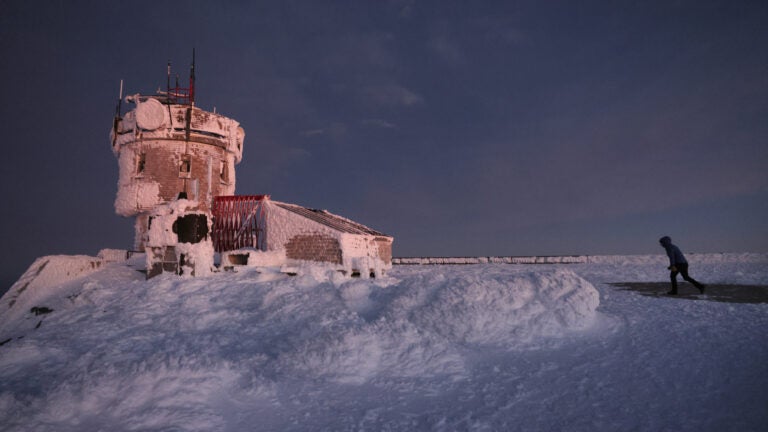
When arctic air enveloped New England in dangerously cold, sub-zero temperatures in early February, Newton resident Ira Seskin was dismayed.
Not for the reason you might expect.
Not, for instance, because it was so frigid outside that officials urged residents to stay indoors.
But because to the north, high atop the summit of Mount Washington in New Hampshire, a record-setting wind chill of minus 108 degrees was recorded.
“I was so upset that they had the record wind chill and I wasn’t there to enjoy it,” Seskin told Boston.com.
Seskin is, he stressed, a “winter person.” And just days before the record-breaking cold, the 71-year-old had been on the summit at the Mount Washington Observatory, where he has served as a volunteer for decades.
“I got down on Wednesday; Saturday is when they had that incredible cold weather,” he said. “So I was saying, if I’d stayed that week, I’d see another record.”
He has been making the trip to the top of Mount Washington since about 1990. For one or two weeks a year he stays at the weather observatory where he, along with a rotating crew of fellow volunteers, helps maintain the living quarters used by the weather station’s staff, who also stay on the mountain a week at a time, and guests.
While the scientists are taking hourly weather observations, leading educational programs, and performing research, Seskin and the other volunteers are busy doing what they can to keep the observatory running smoothly.
They clean bathrooms, change the bunk rooms after a group leaves, and vacuum rugs, among other housekeeping tasks.
“Volunteers are the support team to keep the summit team functioning and try to minimize stress for maintaining the facility so they can do their science,” Seskin said.
Jay Broccolo, director of weather operations at the observatory, estimated that the summit has 30 to 40 returning volunteers.
Many, like Seskin, have been participating in the program for 20 years, others for five to 10.
“What the volunteers don’t necessarily know is that they provide the observers a sense of [normalcy] and sanity,” Broccolo said.
That is especially true of their biggest responsibility, which is to cook meals for the scientists and the other guests who may be at the weather station.
Broccolo said the goal is to have a family-style meal once a day, which is only aided by the fact that so many of the volunteers have been returning to the mountaintop for so many years and consider it their home.
“It provides a sense of almost family up on the summit,” he said. “And the only thing I can stress is how much the winter — the volunteer program in general, but especially our winter returning volunteers are appreciated. Food is such a big motivator, and sometimes you’re working your butt off during a storm and then the volunteers come up with a plate of cookies. … It’s just heartwarming.”

Cooking is a task that Seskin embraces with verve.
“I’m a foodie; I’ve always been a foodie,” he said.
He’s been in the food business since his first job at 16, pegging lobsters in Maine. After graduating college with a degree in food science, he worked in the restaurant industry, running contract commissaries in the Boston area and eventually opening a deli in Newton.
But after discovering the challenge of getting consistent product from one of his suppliers, he made the switch to doing quality control and quality assurance in food manufacturing.
By the time Seskin retired in September, he’d worked for years as a food safety assessor, traveling across the country to inspect food manufacturing plants.
“I loved what I did,” he said. “I was wicked passionate about what I did. But I’d leave on a Monday morning or a Sunday night and get home on a Friday night or a Saturday night. It was 100 percent on the road, 50 weeks a year. And that is tough.”
Throughout his years on the road and working in food safety, once or twice a year Seskin still would make the trip up to Mount Washington for his shift as a volunteer on the summit.
“How it happened is still kind of a mystery,” he said. “I’ve always been a member of OBS, why? Because I’m a weather weenie. Is that a bad word? I don’t know. I’m a geek [and] dweeb … all rolled up into one unique person. But I’ve always been interested in weather.”
Even before becoming a volunteer, he was no stranger to the mountain. He’s climbed it (and taken the Cog and been up the auto road) and done other hiking in the White Mountains.
But the thread of his time as a volunteer stretches back decades to a previous longtime volunteering gig, working at the WGBH Channel 2 auctions.
Back then, he said, the auction would always have a donation from the observatory — a snowcat ride up and down.
“At the time, and I’m talking 25 plus years ago, those things were always overbid going to oblivion, going for $500, $600 way back then,” Seskin said. “And I’m saying, ‘This is not going to work if I were to bid on this.’”
When he read in the observatory’s magazine, Windswept, that they were establishing a volunteer corps, he was sold.
“I said, ‘Sign me up! I want to be part of this!’” he recalled. “And I have been ever since.”
For a long stretch, Seskin would spend one week as a volunteer on the summit during the summer and one week in the winter. In addition to the work on the summit, summer volunteers also help run the observatory’s museum.
“The summer is where we kind of test out volunteers if they want to return for the winter,” Broccolo said. “Because you can’t really get people down in the winter, so our volunteers that come up in the winter tend to have been coming around for several years at least.”
Seskin’s wife of more than 40 years, Ann, used to volunteer alongside him on the mountain. They’d go up together as a team.
Her health now prevents her from making the trip, and Seskin sticks with just one week in winter so he can “get the best out of it.”

Seskin describes himself as a “seat of the pants cook,” which is why he has so much fun as a volunteer on the mountain.
What is in the observatory’s pantry and fridges week-to-week dictates what he and the other volunteers are able to work with, he said. You have to be comfortable working in tight quarters with limited resources, be willing to go with the flow.
“You never know if they’re going to be out of something or run out of something,” he said.
Sometimes, if inspiration strikes him ahead of his visit and he knows the summit isn’t likely to have the ingredients he needs (like corn husks to make tamales), he’ll bring what he needs with him.
Every once in a while he likes to do a showpiece meal or a surprise treat for fun.
In January, that treat was whoopie pies, which he’d never made on the summit before.
“I saved it for one of the Edutrips,” he said. “People are paying for an experience on the summit, both educationally and recreationally, so I like doing a little razzle dazzle up there just to give them a better experience. Your interaction with them is also a major part of your being a volunteer up there. Taking pressure, somewhat, off the observers who are there doing their work like clockwork. Because it’s kind of like a military operation up there; everything’s done by time, on time.”
Comfort foods — pizza with a good crust, macaroni and cheese — and “all the sweets that you can bake” are always welcome at the observatory, Seskin said.
“I’ve never been up there when, if I made some brownies or some cakes or fudge, it didn’t disappear pretty quickly,” he said.
Cooking and baking on the summit do require some adjustments to take into account the higher atmosphere — the summit is 6,288 feet above sea level. For baking, that means things expand faster. Meanwhile, water boils at a lower temperature.
“It’s pretty much second nature for me these days because I’ve been up there 30-some years,” Seskin said.
It is the cooking and what follows — the camaraderie of being around a table with everyone for dinner — that he loves about volunteering.
“It’s the ultimate, ‘What’d you do today? What were the good things, bad things?’” he said. “And the observers certainly use mealtime as a discussion platform. … It’s kind of cool. You won’t see people texting during meals up there because you’re engaged in something called conversation. It’s a very wonderful experience.”
That sense of companionship — of having the volunteers there to talk to — benefits the observatory staff, according to Broccolo.
“A lot of [the volunteers] are older and they have a lot of experience and wisdom and know a lot more information than they lead on,” he said. “So it’s fun to pick their brains, if you are wise enough to understand that they’re wiser. And there’s just so many different opinions. Every week is a new set of volunteers, so it’s really great and a good learning experience for a lot of the younger observers, too.”
Being on the mountain itself and witness to the weather also keeps Seskin coming back, year after year.

One July, he recalled being woken up by a pinging sound outside the observatory.
It was pavers on the observation deck being lifted up and smashed into the building during a storm that was rolling through.
All that day, he said everyone in the building found themselves standing, watching the charts. Winds reached 156 mph, which Seskin noted is still the observatory’s summer record, and as the front came through, snow was blown against the windows.
“Being part of nature, from a safe distance in those cases, is a lot of fun,” he said. “But you have to have a healthy respect for the mountain.”
Volunteering up there, he said, is not for everybody. You need to love and appreciate both the White Mountains and the work that is being done by the researchers on the summit.
“I’m not bragging, they kind of want people like me,” he said. “I’m hoping I’m still doing it for 10 years, and they’re calling me like ‘volunteer emeritus.’ That would be a cool title. I’ve never been an emeritus before.”
Once you do arrive, the minute you set foot on the summit, you’re part of the tradition of the mountain, Seskin said.
“I love the mountain,” he said. “And I’ll be going up there as long as my two legs can still carry me.”

Stay up to date on all the latest news from Boston.com


To comment, please create a screen name in your profile
To comment, please verify your email address
Conversation
This discussion has ended. Please join elsewhere on Boston.com