
Newsletter Signup
Stay up to date on all the latest news from Boston.com
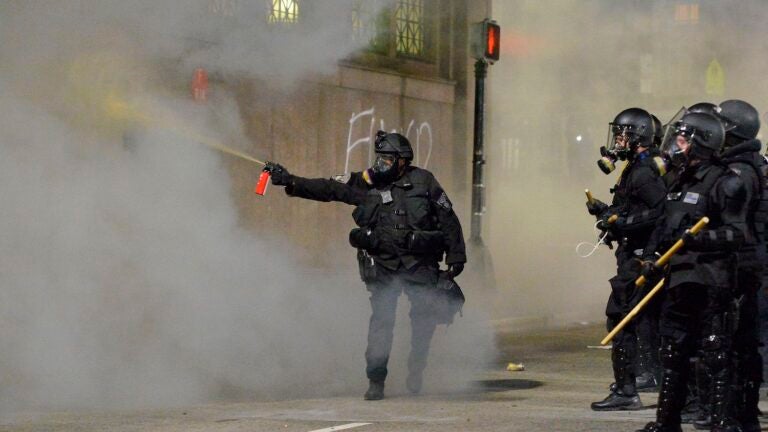
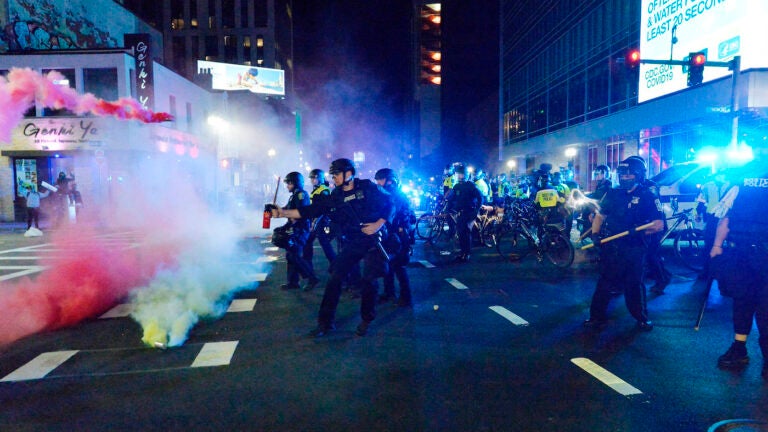
The regional law enforcement network known as MetroLEC says it is no longer providing support to Boston police at planned events, pointing to a city law passed last year restricting when authorities can use crowd control agents such as tear gas, rubber bullets, and pepper spray.
Metropolitan Law Enforcement Council President and Westwood Police Chief Jeffrey Silva told Boston 25 News the law presents a “catch 22” situation for officers, who are trained to use those tactics in certain incidents.
“We just simply could not send our officers into that situation,” Silva said.
But Boston City Councilor Ricardo Arroyo, who co-sponsored the ordinance, said the law doesn’t take options away from law enforcement.
“To me, it does essentially the bare minimum in ensuring that Boston residents have the ability to exit a location before an indiscriminate (weapon) is fired upon (them),” Arroyo, who is also a candidate for Suffolk County district attorney, told Boston.com recently.
The law, approved by a narrow 7-5 vote by the Boston City Council and signed by then-acting Mayor Kim Janey last spring, prohibits police from using chemical crowd control agents and kinetic impact projectiles on crowds of more than 10 people.
The exception is those weapons may be used only if a police supervisor at the scene personally witnesses acts of violence or property damage and has determined other methods of de-escalation will not work to quell the crowd.
Police must then give two separate warnings at least two minutes apart over a loudspeaker before deploying them.
Some lawmakers, including Arroyo, originally wanted the council to go further in banning outright the use of certain agents, citing that pepper spray and tear gas are banned in warfare under the Geneva Protocol of 1925.
“If giving a warning before you use that is a bridge too far, I think that’s unreasonable,” Arroyo said, responding to MetroLEC’s decision.
Former Boston City Councilor Andrea Campbell, now a candidate for Massachusetts attorney general, was a co-sponsor of the ordinance last year. A spokesperson for Campbell declined to comment.
MetroLEC is comprised of 48 local departments, who work together and share resources in emergencies and when needed.
Boston is not a member of MetroLEC, although Boston police and MetroLEC frequently coordinate support as necessary, according to Boston 25 News.
Despite its decision regarding planned events, MetroLEC will still support Boston authorities in emergencies.
Silva did not return requests for comment, but he told the news station the ordinance passed by Boston officials makes it difficult for MetroLEC officers to operate.
“These situations are dynamic. They change in an instant,” Silva said. “And so officers need to have available to them, the various tools they need to deal with it. So, to come up with a bright line rule, saying officers can’t act in a certain way consistent with their training, consistent with their policy is very problematic for the officer, it’s something we can’t effectively manage.”
Former Boston Police Chief Dan Linskey told the outlet that it’s “scary that Boston is losing these resources that have been vital in keeping our community safe.”
“If outside agencies have decided they are not going to send those trained, equipped resources, Boston is going to need to find them somewhere. Because it wasn’t like they were overkill,” Linskey said. “They were absolutely needed.”
What impact, if any, the change could have on law enforcement staffing at next month’s Boston Marathon is unclear, although, according to Arroyo, the law only applies to protests and public demonstrations.
Arroyo also noted the law was already in place in October, when runners participated in a rescheduled race due to the COVID-19 pandemic.
“I trust the ability and the professionalism of our Boston police officers to secure the Boston Marathon and the partners who are continuing to assist,” Arroyo said. “MetroLEC is certainly not the only, or even the main, source of support that Boston receives.”
Mayor Michelle Wu’s office deferred comment on this story to Boston police, who did not respond to a media inquiry last week.
Last year, after the City Council approved an initial draft of the law in late 2020, then-Mayor Marty Walsh vetoed the measure in January after Boston police raised concerns the rule would be difficult to adhere to in real time.
But as councilors again pursued the legislation in April, police did not offer amendments on the law, even as it sat in committee for months.
“This is something that has been done after sessions and sessions and sessions of working sessions with BPD, with other folks,” Arroyo said last week. “We gave multiple opportunities to hear from folks. This was a compromise ordinance.
“Certainly (MetroLEC) is free to make decisions as an organization, but I think the ordinance itself was strongly crafted,” he added.
Campbell and Arroyo first filed the ordinance in June 2020, after Boston police used a spray similar to pepper spray, tear gas, and sponge rounds — made of foam rubber — against crowds who gathered in response to the police murder of George Floyd the previous month in Minneapolis.
Massachusetts State Police troopers, on the night of May 31, also used “pepper ball projectiles” to disperse an “aggressive and combative mob who began to strike (a Transit Police) cruiser,” a spokesperson for the department said at the time.
Although the tactics are considered less dangerous than traditional firearms, they still pose significant safety risks, councilors said. Projectiles such as rubber bullets can still be lethal.
In pushing for restrictions, Arroyo has cited the death of Victoria Snelgrove, an Emerson College student who was killed when she was struck in the eye by a pepper pellet fired by Boston police into a crowd on Lansdowne Street after the Red Sox clinched the pennant in 2004.
“These are indiscriminate weapons in the sense that you can fire a tear gas canister into a crowd and you can’t specifically target who’s going to be impacted by that,” Arroyo said last week. “So to deal with that issue, all this (law) does is require that they give a warning.”
Stay up to date on all the latest news from Boston.com



To comment, please create a screen name in your profile
To comment, please verify your email address
Conversation
This discussion has ended. Please join elsewhere on Boston.com