
Newsletter Signup
Stay up to date on all the latest news from Boston.com
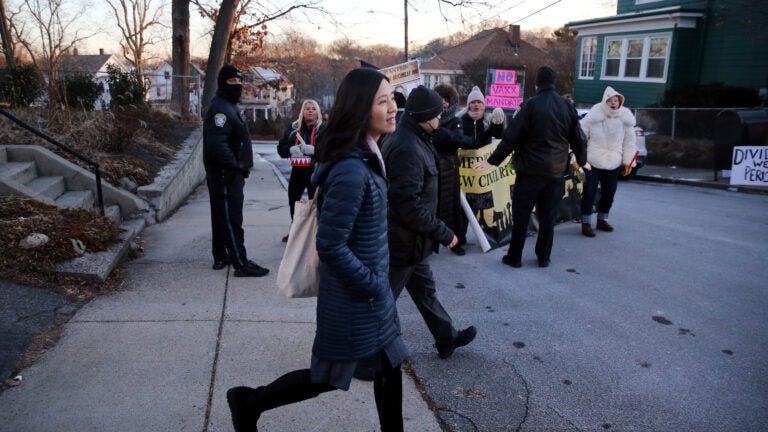
Gov. Charlie Baker called Mayor Michelle Wu’s proposed ordinance to limit protests at private homes a “worthy topic” earlier this week.
Last week, Wu proposed a city ordinance that limits the times you can protest outside of someone’s private residence to between 9 a.m. and 9 p.m.
“People have the right and should have the opportunity to make their voices heard and those of us in public life should expect to hear them,” Baker told reporters, including NBC Boston, Monday when asked about Wu’s proposal. “I do find based on my own personal experience that when people start protesting and shutting down roads and making it very difficult for your neighbors to live their lives, it’s worthy of further discussion.”
Both Wu and Baker have faced protestors outside their homes in Roslindale and Swampscott, respectively. Recently, Wu has seen several weeks of protests about the vaccine mandate.
Wu’s proposed ordinance does not affect marches or protests passing through residential areas that are not targeted at a particular home. It also applies to any targeted residence, not just homes of elected officials.
In a statement, the Mayor’s Office noted that the U.S. Supreme Court upheld a similar ordinance in Frisby v. Schultz, a case concerning anti-abortion protesters consistently targeting doctors who performed abortions in Wisconsin.
If passed, Wu’s proposal would effectively shift any protests slightly later into the day — current Boston rules effectively restrict loud protests from taking place before 7 a.m. or after 11 p.m.
Opponents of the proposed ordinance point to free speech concerns in limiting protests, but during an interview Monday afternoon on WBUR, Wu said her proposal stays on the right side of the “fine line” between preserving community peace and protecting First Amendment rights.
“When the goal becomes less about having the right to be heard and share your views and more about repeatedly taking away a community’s sleep every single day at 7 a.m., just to ensure that you can try to verge on breaking the will of that community, that is harassment,” Wu said on WBUR. “And Boston is better than that.”
The proposed Boston ordinance bears some resemblance to a statewide proposal by Rep. Steven Howitt, R-Seekonk, although Howitt’s bill would impose legal penalties for protesting too close to the home of an elected official specifically.
“My feeling is that an elected official should have time to themselves,” Howitt told Boston.com. “If these protests are as such, people are going to weigh a little bit stronger whether they should get involved and offer their services to the government and to the people. In some cases, [these protests] can be intimidating.”
The proposal, which was filed in November 2021, says protests within 100 yards of an elected official’s residence would be punishable by up to a year of possible jail time or a fine of between $100 and $500.
Howitt said his proposal goes beyond state representatives or senators and covers everyone from the governor to town officials, regardless of political party.
“You can go and protest as they do at the Statehouse,” Howitt said. “If it is a protest against a particular legislator and you’re protesting a decision that they may or may not have made, and why should a family be drawn into what you’re doing as a legislator or as an elected official?”
Howitt’s proposal was a late file and he said he feels his best bet for getting it passed is to file it as a budget amendment.
“The hard part here is figuring out some way to maintain the very public rights that people should have to protest, which I’m completely supportive of, but at the same time recognizing private citizens, private residents deserve their privacy,” Baker told NBC Boston.
Howitt said he believes the families of elected leaders deserve “some protection against what has been going on,” especially considering how divisive the country has been.
“Why should a family, and in the mayor’s case, the young children have to endure these protests?” Howitt said. “It has an effect on good people who may want to run for an elected position.”
In an interview this week with WBZ’s Jon Keller, Baker said protests are a “nightmare” for neighbors who did not make the choice to run for office.
“People ought to have a right to protest, they ought to have a right to have their voice be heard,” Baker told Keller. “But I do have a little trouble with this idea, especially when people don’t necessarily respect or appreciate the fact that somebody lives on either side of elected officials. We really do put them and their families in a pretty crummy place.”
Stay up to date on all the latest news from Boston.com


To comment, please create a screen name in your profile
To comment, please verify your email address
Conversation
This discussion has ended. Please join elsewhere on Boston.com