
Newsletter Signup
Stay up to date on all the latest news from Boston.com
The president of the Massachusetts Medical Society released a statement Friday weighing in on the plans from Boston leaders and Suffolk County Sheriff Steve Tompkins to address the humanitarian crisis in the area of the city known as Mass. and Cass.
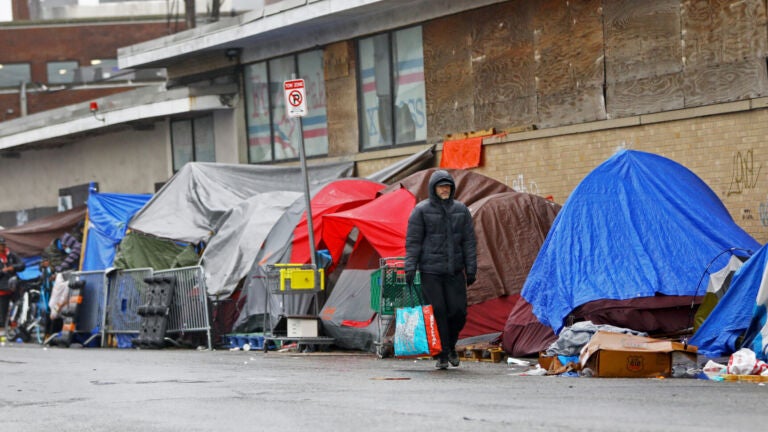
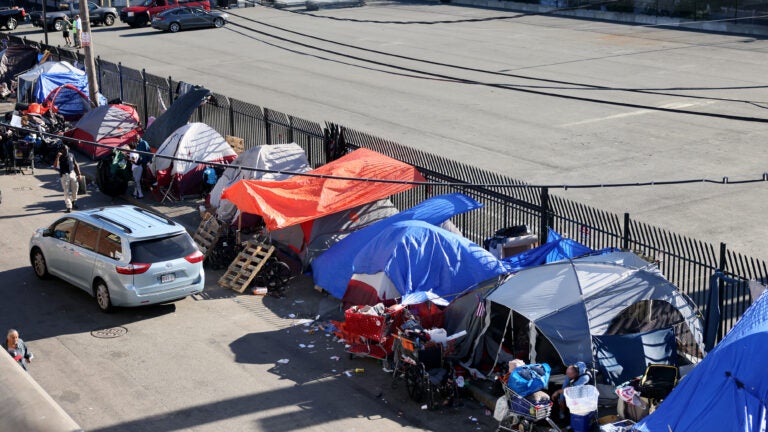
Last week, Acting Mayor Kim Janey declared addiction and homelessness to be a public health crisis in the city and issued an executive order aimed at removing the more than 100 tents that have been put up in the streets around the intersection of Massachusetts Avenue and Melnea Cass Boulevard since the summer. At the same time, Tompkins is pushing forward a proposal to establish a court and treatment facility in the South Bay correctional facility where individuals from Mass. and Cass who have outstanding warrants could be brought in and committed. A spokesperson for the Massachusetts Trial Court said the temporary virtual court in the Suffolk jail could be set up as soon as next week.
Both proposals are being strongly condemned by a coalition of doctors, researchers, advocates, and elected officials. The group is urging for public health measures, such as low barrier and transitional housing, be utilized, warning that efforts by Tompkins and Janey will cause harm and criminalize a marginalized population without providing any real solutions.
Dr. Carole Allen, president of the Massachusetts Medical Society, echoed many of the concerns being raised by the coalition in her statement on Friday and stated her group’s opposition to the use of involuntary commitment to address the overlapping crises at Mass. and Cass.
The medical leader said public policy approaches to the crisis should be rooted in “broad access to voluntary, evidence-based, low-barrier treatment and widely accessible harm reduction interventions.”
“Involuntary treatment for substance use disorder has generally not been found effective and in some circumstances may even be harmful; this is especially concerning when it is utilized within the context of the criminal justice system,” she said. “Accordingly, we strongly oppose strategies that contain involuntary civil commitment as a component.”
Read Allen’s full statement below:
Last week, the City of Boston declared addiction and homelessness to be a public health crisis, underscoring the urgent need for services and intervention for residents. This comes as proposals are being offered by elected officials in Boston, including involuntary treatment programs, as recommended by Suffolk County Sheriff Steven Tompkins. As the city further develops a plan to address this public health crisis, the Massachusetts Medical Society (MMS) would like to highlight key tenets that should be included in any such response, as informed by our physicians’ clinical experience and public health commitment.
The MMS appreciates the challenging and complex nature of the current situation and acknowledges the valuable efforts of so many committed organizations and stakeholders over the past many months and years. We share the goals of many engaged in improving this situation to provide resources that promote safety and wellness and that respect the autonomy and humanity of those affected by this crisis.
The Medical Society believes any public policy approach should be grounded in broad access to voluntary, evidence-based, low-barrier treatment and widely accessible harm reduction interventions. Involuntary treatment for substance use disorder has generally not been found effective and in some circumstances may even be harmful; this is especially concerning when it is utilized within the context of the criminal justice system. Accordingly, we strongly oppose strategies that contain involuntary civil commitment as a component.
The medical community has long appreciated the impact that housing status has on our patients’ health, which has guided the inclusion of improved housing policy as a core part of our health equity advocacy. But the logical corollary to equitable housing is not to criminalize homelessness. The Medical Society opposes enforcement of anti-camping laws and ordinances that fail to protect the health of unhoused individuals. Housing insecurity negatively affects people’s health and disproportionately impacts communities of color and lower-income populations. Any response to the current crisis of homelessness in Boston and beyond should be grounded in housing support and opportunity rather than in policies that explicitly or implicitly criminalize homelessness. The criminalization of homelessness, and the resultant incarceration, exacerbates inequitable health disparities and underlying health conditions of vulnerable individuals.
While many stakeholders currently engaged in this situation seek a meaningful and effective response to the acute issues in Boston, the Medical Society urges that we also strive for upstream, structural change that comprehensively addresses the numerous drivers of these co-occurring challenges. We must commit to establishing a societal perspective—from medicine to criminal justice—that acknowledges that substance use disorder is a chronic disease. We must commit to addressing an epidemic of trauma that is a root cause of so many hardships among our patients. And we must commit to more just and equitable policies to address housing insecurity, economic inequality, barriers to the mental health care system, and educational inequities. Critically, we must not fail to address the structural racism that exacerbates these many inequalities.
As physicians, we owe a duty of care to all our patients, especially those who are struggling with substance use disorder, those who have experienced trauma, and those who are experiencing homelessness. We urge a comprehensive public health approach to address substance use disorder and homelessness that serves the ethical principles of beneficence, nonmaleficence, autonomy, and justice. Doing so will treat persons living in our Commonwealth with the top-quality care that we all know they deserve. An approach that centers health equity, and individual and public health, built on evidence-based methods, will meet the needs of our most vulnerable residents and will create the foundation for sustainable change toward a more just and equitable society.

Stay up to date on all the latest news from Boston.com




To comment, please create a screen name in your profile
To comment, please verify your email address
Conversation
This discussion has ended. Please join elsewhere on Boston.com