
Here’s what you need to know about viewing the upcoming solar eclipse
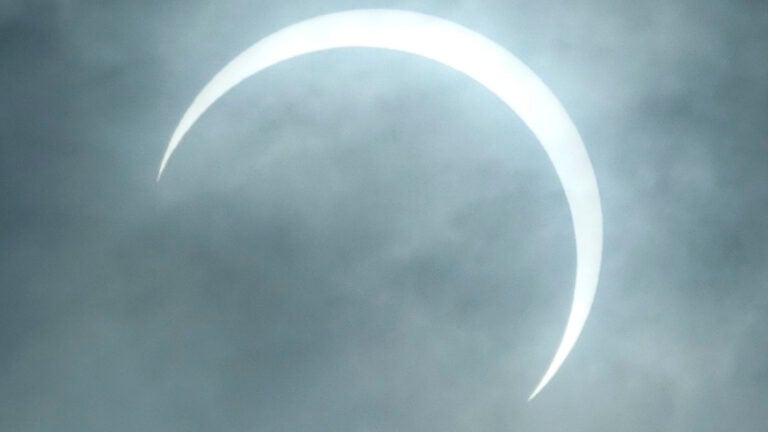
It’s hard to imagine that only about four years ago we had a total solar eclipse across much of the United States. In August that year, millions of people watched from Oregon to the Carolinas as the moon’s shadow rapidly crossed, putting those areas under total darkness and providing a spectacular experience.
On Thursday we’re once again going to find the moon sandwiched between Earth and the sun, but unlike four years ago there will not be a path of totality. A partial solar eclipse can still be viewed and is still beautiful, but provides a very different feeling. One of my favorite places to view these is in a forest. If the sun is high enough the leaves act as nature’s pinhole camera — you can see the eclipse appear on the leaves as thousands of little crescents.

In order to see the eclipse the weather needs to cooperate, which is possible Thursday morning. The other requirement is an unobstructed view of the sunrise. This time of the year the sun comes up at about 5:07 a.m., which means you need to be at the beach by then looking north from due east. If you are a mariner or have a compass, the sunrise is specifically at 57 degrees Thursday morning. This is as close to far north as it gets all year. You must use proper viewing techniques to view this eclipse; looking at it directly can cause irreversible damage to your eyes.
Here in Boston, the eclipse will reach its peak at 5:33 a.m. and completely end at 6:32 a.m. The moon will cover just about 73 percent of the sun, which will look kind of like a shark fin rising out of the ocean.

The proportion of the sun’s diameter covered by the moon’s shadow is determined by something called the magnitude. Locally, at the peak, magnitude will be about .73. Another way to think about how much of the sun will be covered is by looking at the obscuration. This term refers to the percentage of the sun’s disk covered by the moon at peak eclipse. Using both of these numbers, we can get an idea of just what to expect on Thursday morning.

Of course, none of this matters if we can’t see it. Presently, the models are clearing out the low and middle clouds by sunrise Thursday, but leaving some high clouds in the wake of a frontal passage. The thickness of these clouds may be thin enough to still see the eclipse, and we won’t know exactly how much of the sky will be visible until the event is almost here.

If you aren’t willing to get up super early to see this week’s eclipse, don’t worry, there’s another, more impressive one just a few years away. If the weather cooperates, which in April is a big if, parts of New England will be treated to totality! Plan now, the best views will be just a few hours’ drive away.

Follow Dave Epstein @growingwisdom.



To comment, please create a screen name in your profile
To comment, please verify your email address
Conversation
This discussion has ended. Please join elsewhere on Boston.com